

Best Marketplaces to Hire AI Engineers
An AI engineer is a complex role involved in every stage of AI development, from training and fine-tuning models to integrating and deploying them.

Their work can range from building custom AI systems for large enterprises in regulated industries to quickly "vibe coding" an MVP for a startup. The scale can be as different as building a bicycle for a short ride versus designing an aircraft for crossing continents.
Let's figure out how AI engineers differ and where to hire the best ones, depending on the engineer's experience and your use case. This guide compares the best marketplaces to hire AI engineers — from premium vetted networks to large freelance pools — so you can match your needs to the right platform.

4 Types of AI Engineers
Before jumping into the best marketplaces, let's differentiate between the most common AI engineer types. Once you understand how to distinguish between them, you'll know whom to target on the platforms.
1. Machine Learning Engineer
The ultimate master who knows every nitty-gritty of machine learning development, deployment, and maintenance. These specialists build ML models using Python frameworks such as PyTorch, TensorFlow, and Scikit-Learn, as well as cloud ML platforms (Google Vertex AI, AWS Bedrock, and Azure AI). Experienced ML Engineers can also boast deep expertise in data science and building reliable data pipelines.
ML Engineers are typically the rarest and most expensive specialists covered in this article, so hiring one should be a deliberate strategic decision rather than a default move. Their deep problem-solving capabilities are best justified when your project truly requires custom model development, advanced optimization, or proprietary AI systems, rather than tasks that simpler roles can handle more cost-effectively.
Hourly rates: $120–$250+/hour
2. AI Integrator
As their name suggests, AI Integrators combine your system's business logic and databases with models from OpenAI, Google, Anthropic, and Mistral via APIs.
These experts specialize in building retrieval-augmented generation (RAG) pipelines to ground models in your proprietary data, resulting in better outputs. They also work with vector databases (Pinecone, Quadrant, and Weaviate) and orchestration frameworks (LangChain, LangGraph, and LlamaIndex) to store, organize, and quickly retrieve only the relevant data.
Hourly rates: $90–$180/hour
3. "Vibe Coder"
Such AI tools as Cursor, Claude Code, and GitHub Copilot have spurred the rise of AI-assisted coders, or, as Andrej Karpathy named them, "vibe coders", assuming that coding is an easy flow now rather than a bug-heavy, tedious process.
AI-assisted coders are most effective for fast prototyping and MVP development. But you should be well aware of their experience level, since Juniors will require frequent code reviews and supervision, while senior AI coders will be responsible for the end-to-end coding process and will know how to fix issues before they escalate in production.
Hourly rates: $40–$130/hour
4. AI Infrastructure Engineer
This AI engineering role becomes relevant once you realize that your product needs to scale rapidly, and it's crucial for the AI infrastructure to remain stable and reliable. AI Infrastructure Engineers are also responsible for budget allocation and cost optimization, as API and cloud computing costs can spiral quickly with scale.
Hire them when you need to improve model performance under high traffic, strengthen AI observability, and implement cost-monitoring systems.
Hourly rates: $110–$220/hour (depending on expertise in MLOps, cloud architecture, Kubernetes, distributed systems, and enterprise-scale AI deployment).
What to Look for Before Hiring
Regardless of which profile you need, strong AI candidates share a few traits that separate genuine practitioners from AI-polished CVs:
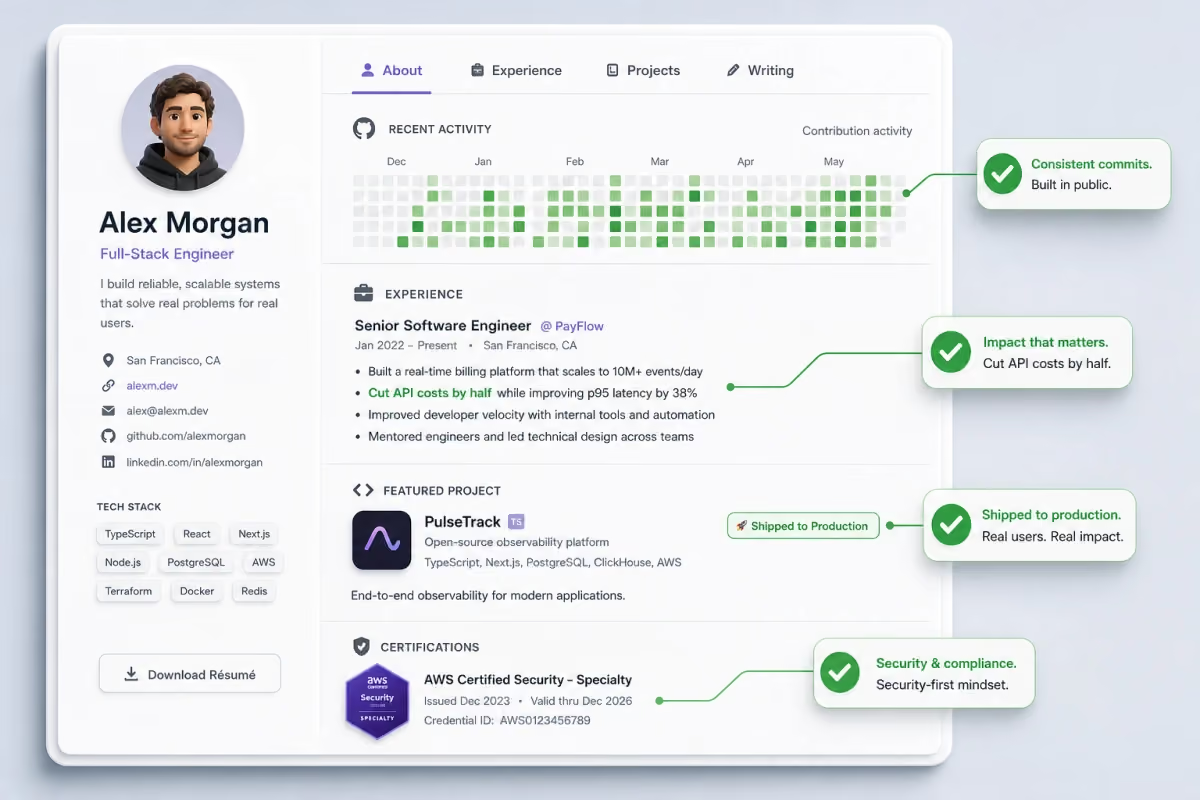
Deployment evidence over buzzwords. Look for GitHub repositories with real commit history, production metrics on CVs ("reduced inference latency by 40%," "cut API costs by half"), and portfolios that match the role.
Product thinking. Strong AI engineers think like builders first. They connect technical decisions to business outcomes and show a genuine interest in users and ROI.
Adaptability. The AI field moves faster than any other. The best candidates are excited when a new model release makes their last three months of work redundant, because they value efficiency over ego.
Security awareness. Prompt injection, data poisoning, and GDPR compliance are non-negotiables across all four AI roles. If a candidate can't account for security, they're not production-ready.
5 Marketplaces to Hire Top AI Engineers
To put this list together, we evaluated platforms across four criteria:
- Rigor of the developer vetting process
- Depth of their AI-specific talent pool
- Transparency of their pricing and engagement model
- Independent reviews on G2, Clutch, and Trustpilot
1. Toptal
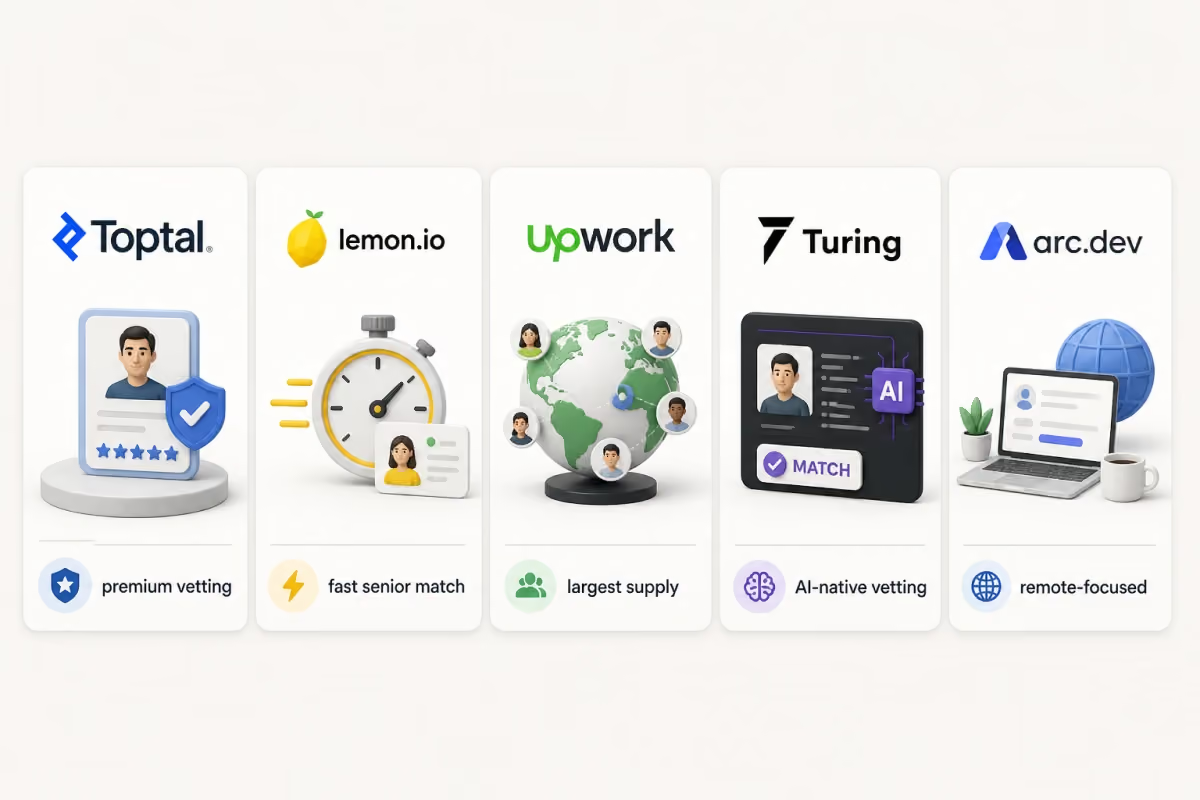
Toptal is one of the most well-known premium talent networks, claiming to accept only the top 3% of applicants through a multi-stage vetting process that includes language and personality screening, in-depth technical interviews, and live coding challenges.
For AI roles, Toptal lists machine learning engineers, data scientists, and AI specialists across industries. The platform offers a trial period to evaluate a developer before committing to a longer engagement.
The tradeoff is cost. Toptal is positioned at the premium end of the market, and the platform fee structure reflects that. It's a solid option for companies with budget flexibility and a need for well-vetted generalist talent. However, the marketplace is less specialized around AI roles specifically compared to platforms built for that niche.
Best for: Enterprises or funded startups that need thoroughly vetted talent and are willing to pay a premium for reduced hiring risk.
2. Lemon.io
Lemon.io is a vetted developer marketplace built specifically for startups and SMBs that need senior engineering talent fast. The platform pre-screens every developer through AI-focused technical interviews, soft skills audits, and background checks, so by the time you see a candidate, the heavy filtering is already done.
The matching process is designed for speed: you submit a request, receive 1–3 curated candidates within 24–48 business hours (often faster), and conduct a single final interview focused on cultural fit. The platform covers all four AI engineer profiles, from ML engineers and LLMOps specialists to AI integrators and AI-assisted coders across Western Europe, LatAm, and the US.
A replacement guarantee provides a safety net if a match doesn't work out, which matters significantly for startups that can't afford months of re-hiring.
Best for: Startups and SMBs that want vetted senior talent quickly, without running a full internal hiring process.
3. Upwork
Upwork is the largest general freelance marketplace in the world, with a significant volume of AI engineers available at every price point. You can find ML engineers, AI integrators, data scientists, and AI-assisted coders, but the sheer volume cuts both ways.
The screening is largely your responsibility. Upwork provides ratings, reviews, and test scores, but the platform does not pre-vet for technical depth the way specialized networks do. For companies with the internal capacity to evaluate candidates, Upwork offers unmatched supply and competitive pricing. For teams without an AI-literate hiring manager, the risk of a poor technical match is higher.
Upwork works well for short, well-defined tasks, building a RAG prototype, integrating a specific API, and fine-tuning a model on a dataset, where deliverables are concrete and scoped.
Best for: Teams with technical hiring capacity who need flexible, on-demand AI talent for defined project scopes.
4. Turing
Turing occupies a distinct position in the market: it's purpose-built around AI-powered vetting and matching, draws from a global talent pool spanning over 150 countries, and has positioned itself explicitly around AI and engineering talent rather than general freelance work.
The platform uses over 20,000 machine learning signals to build deep developer profiles, assessing coding ability, seniority, communication, project impact, and engineering judgment. Candidates must pass skills tests and live interviews (lasting longer than 5 hours) before appearing on the platform. For clients, this means the filtering work is largely done before you see a profile.
Turing promises to deliver pre-vetted AI engineer candidates within four days, and backs that with a two-week risk-free trial period. The platform covers the full AI engineering spectrum, including ML engineers, data scientists, AI integrators, and full-stack engineers, and has a documented client list that includes enterprise and Fortune 500 companies alongside startups.
The tradeoff worth noting: most Turing developers prefer long-term or full-time engagements, so the platform may offer limited options for smaller, short-scope projects.
Customer service response times have also drawn occasional criticism in reviews. But for companies looking to hire an AI engineer for a sustained engagement, especially if sourcing internationally, Turing's depth of vetting and global reach make it a strong contender.
Best for: Companies hiring for ongoing AI engineering roles who want global talent, deep pre-vetting, and a structured trial period before committing.
5. Arc.dev
Arc.dev focuses on remote engineering talent and has built a searchable network of pre-vetted developers across a wide range of specializations, including AI and machine learning.
Arc.dev allows companies to hire both freelancers and full-time remote engineers, which gives more flexibility than pure freelance networks. The AI-specific talent pool skews toward integrators and AI-assisted developers and deep ML research profiles, making it a practical fit for product teams adding AI features and building foundational models.
The platform's search interface makes it easy to filter engineers by skill, roles, and location before initiating contact.
Best for: Product teams looking for AI-augmented developers or AI integrators for ongoing remote engagement.
How to Choose the Right Platform
The right marketplace depends more on your internal hiring capacity than on the platform itself.
If you don't have a technical expert to evaluate candidates, use a vetted network like Lemon.io or Toptal that filters the best of the best senior candidates before you ever see a profile.
If you can evaluate candidates yourself and need volume or flexibility, Upwork gives you the widest pool. Arc.dev sits in the middle — lighter vetting than Lemon.io, more specialization than Upwork.
If you're hiring for a sustained engagement and want global reach with deep pre-vetting, Turing is worth evaluating, particularly if sourcing from outside the US or Western Europe matters to you.
One rule applies everywhere: before you open any platform, define which AI engineer you need and which tasks they should solve.
Bonus Checklist to Hire the Best AI Engineer
Use this framework to match your business stage, technical needs, and hiring capacity to the right AI engineer profile and marketplace.

Final Takeaway
The AI talent market in 2026 rewards specificity. Startups, SMBs, and enterprises that know exactly which type of engineer they need and choose a platform matched to that need, hire faster, spend less, and make fewer costly mistakes. Before you open the websites of any of the marketplaces, decide whether you need someone to build a model, integrate an API, ship features faster, or keep your AI infrastructure running at scale.
Treat every hire as a strategic growth lever. And before signing a contract, ask yourself an important question: which hire will create the biggest compounding advantage for your business a year from now? If you're hiring per project or task, then ask: which hire will guarantee a planned time-to-market without delays or risks?
Once you define the right hiring criteria before both search and final decision, your AI Engineer is far more likely to deliver on timelines, budget, and business goals.
If you're weighing the marketplace route against bringing an AI engineer in as a dedicated extension of your team, our IT outstaffing model offers a structured alternative worth comparing.
FAQ
How long does it usually take to hire an AI engineer through a marketplace?
Vetted platforms typically deliver matched candidates within two to seven business days. Lemon.io shortlists one to three senior candidates in 24–48 hours; Turing's first-match window is around four days; Toptal usually lands within a week after the screening call. Final-round interviews and start add another 7–14 days. Total request-to-first-standup is typically two to four weeks — significantly faster than the 8–16 weeks needed for a full-time internal hire, or the 4–10 weeks of sourcing directly through LinkedIn.
How do I know which of the four AI engineer types I actually need?
Start with the deliverable, not the role title. If you need a custom model trained on proprietary data or a recommendation system that learns over time, you need a Machine Learning Engineer. If you need ChatGPT, Claude, or Gemini wired into your existing application via APIs and RAG, you need an AI Integrator. If you need an MVP shipped in four to six weeks to test a hypothesis, an AI-Assisted Developer fits. If AI is already in production and the issue is cost, latency, or stability under load, you need an AI Infrastructure Engineer. Many projects need two of these roles in sequence — an Integrator first to ship, then an Infrastructure Engineer once usage scales.
Can a non-technical founder evaluate AI engineering candidates without help?
Partially. A non-technical founder can reliably assess communication, product thinking, past project outcomes, and references. Technical depth — code quality, model performance, security awareness, production hygiene — requires either a technical advisor in the final interview or a marketplace that pre-vets for those things. Lemon.io, Toptal, and Turing all handle the technical vetting before you ever see candidates, which is why vetted-network platforms are usually the right starting point for solo or non-technical founders.
Should I hire AI engineers full-time or on a contract basis?
Contract is usually the right model when the AI work is project-specific, when you are still validating product-market fit, or when your annual AI budget is under roughly $200K. Move to full-time when AI becomes core IP, when there is 12+ months of consistent work in the pipeline, or when integration with internal systems requires deep institutional context. Marketplaces like Lemon.io and Upwork are contract-first; Toptal and Turing both support contract-to-hire conversions if a great match emerges during the engagement.


