Our blog
featured articles

Empat Earns Claude Certified Architect Certification: What It Means for Our Clients
We're proud to announce that our team has earned the Claude Certified Architect (CCA) certification from Anthropic. It’s one of the most exclusive and technically demanding AI certifications currently available in the market.
On June 15, Vladyslav Fedenko, AI Innovation Lead at Empat, successfully passed the certification exam. He managed to demonstrate advanced expertise in AI architecture, skills in agent-based systems and prompt engineering, as well as deep knowledge of Claude ecosystem technologies.
"This exam isn't about whether you know Claude. It's about whether you can make the right architectural decisions under the pressure of a real production scenario. That's what separates practitioners from theorists in AI development.” - Vladyslav Fedenko
The Empat team is very proud of this achievement. At the same time, it means a lot for our clients. This certification validates the expertise required to develop more reliable, scalable, and effective AI solutions that create real business value for companies in different industries.
What Is the Claude Certified Architect (CCA) Certification?
The Claude Certified Architect (CCA) certification is an advanced professional credential created by Anthropic. It is the company behind Claude, one of the world's leading AI models.
Unlike many AI certifications that focus on theory or basic implementation, the CCA exam evaluates real-world architectural expertise across several critical areas:
- Production-grade prompt engineering
- Claude Code implementation and optimization
- AI Agent architecture and orchestration
- Model Context Protocol (MCP) servers
- Enterprise AI system design
- AI workflow automation
- Security, governance, and scalability considerations
The exam consists of 60 scenario-based questions that deal with real business cases. The candidates have a strict two-hour timeframe to complete the test. They must achieve a score of 720 out of 1000 to pass.
The certification remains valid for only six months. The reason is that AI innovation has a very fast pace of development. In such a way, it ensures that certified professionals stay current with the latest developments.
Why Is the CCA Certification So Exclusive?
One of the most notable aspects of the Claude Certified Architect program is its limited accessibility.
Currently, the certification is not publicly available. Access to examination vouchers is restricted to specialists working within organizations that maintain official partnerships with Anthropic. This makes the number of certified professionals worldwide relatively small compared to other technology certifications.
As AI adoption accelerates across industries, organizations increasingly need experts who understand not only how to use AI models but also how to architect secure, scalable, and business-ready AI systems. The CCA certification was designed specifically to validate that level of expertise.
What This Means for Empat Clients
For our clients, this certification provides additional assurance that their AI initiatives are being designed and implemented according to the latest industry standards and best practices.
When partnering with Empat, clients gain access to specialists who understand:
- Advanced AI architecture patterns
- Enterprise-grade AI deployment strategies
- AI Agent development
- MCP-based integrations
- Production prompt engineering
- Claude ecosystem best practices
More importantly, they gain a partner capable of translating AI capabilities into practical business outcomes.
Whether the goal is improving operational efficiency, automating workflows, enhancing customer experiences, or creating entirely new AI-powered software development products, architectural expertise plays a crucial role in achieving sustainable results.
Looking Ahead
In 2026, artificial intelligence is definitely not an experimental technology anymore. It is becoming a strategic business capability. That’s why organizations need partners who invest continuously in developing their expertise and staying ahead of emerging technologies.
Earning the Claude Certified Architect certification is another step in Empat's commitment to delivering world-class AI development solutions that create measurable value for our clients.
FAQ
What is the Claude Certified Architect (CCA) certification?
The Claude Certified Architect (CCA) is an advanced technical certification created by Anthropic. It validates real-world expertise in designing and implementing production-grade AI systems using Claude, including agent-based architectures, prompt engineering, MCP integrations, and enterprise AI workflows.
How difficult is the CCA certification exam?
The exam is highly challenging and scenario-based, consisting of 60 real-world architectural problems that must be solved within two hours. Candidates must score at least 720 out of 1000 to pass, making it one of the more rigorous AI architecture certifications available today.
Why is the CCA certification considered exclusive?
Access to the certification is currently limited and not publicly open. Exam vouchers are available only through organizations that have official partnerships with Anthropic. This restriction keeps the number of certified professionals relatively small and highly specialized.
Does the certification focus more on theory or real-world application?
The exam is heavily focused on real-world application. It uses scenario-based questions that simulate production environments, requiring candidates to make practical architectural decisions rather than answer purely theoretical or academic questions.

How to Choose a Product Development Partner: Buyer's Checklist
Decades of Standish Group CHAOS data show roughly two-thirds of software projects miss budget, schedule, or scope targets, and partner selection sits upstream of most of those failures. It costs the rebuild fee a year later, the time it takes to find a replacement partner, and the investor confidence damage when the launch timeline slips by a quarter.
The diligence to avoid that outcome is unglamorous. It's a 30-minute checklist run before the contract is signed, focused on capabilities you can verify, red flags you can identify, and questions you can ask that filter out vendors who would never deliver. This article is that checklist.
If you're a founder picking your first product development partner or a CTO evaluating a replacement for one that didn't work out, the framework below gives you concrete criteria. The companies that get this right ship better products. The ones that don't pay for the same software three times.
What a Product Development Partner Actually Delivers
The phrase "product development services" gets thrown around loosely. Some vendors mean staff augmentation under another name. Others mean fixed-scope freelance work. A real product development partner delivers four specific things end-to-end.
A discovery output. Before engineering starts, a real partner runs a discovery phase that produces a written artifact: scoped feature list, technical assumptions, integration map, risk register, and a realistic timeline with milestones. PMI's Pulse of the Profession is consistent on this point: organizations that invest in formal discovery and value-delivery practices waste roughly 28x less on poor performance. If a vendor wants to skip discovery, they're not a product development partner. They're a body shop. For startup-specific framing, see our concierge MVP guide.
A scoped roadmap. The roadmap maps features to sprints with capacity assumptions. It tells you what ships at each milestone and what doesn't. It changes as you learn things, but it's a real document, not a vague Gantt chart.
Working software shipped to a real environment. This sounds obvious. It isn't. Partners that bill T&M without scope discipline can run for months without ever shipping a production deploy. A real partner has a release cadence and respects it.
Governance artifacts. Sprint reports, burndown, retrospective notes, change request log, post-launch support plan. McKinsey's operations research consistently finds that disciplined governance is the single largest predictor of agile-delivery outcomes. These are the artifacts that make the engagement audit-able, both to you and to investors during due diligence.
If a vendor doesn't deliver all four, they're a vendor. They might still be useful, but they're not a partner.
The Buyer's Checklist: 8 Capabilities to Verify
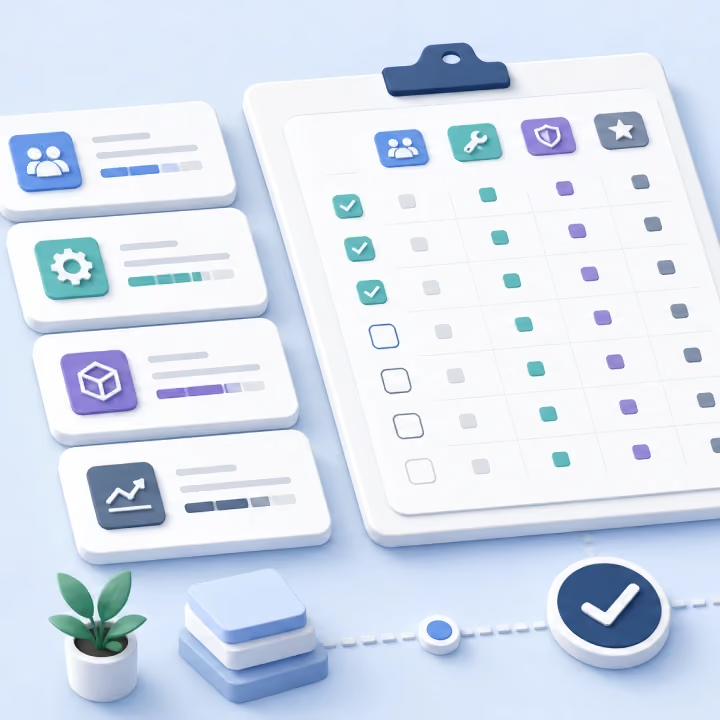
Use this list during evaluation calls. Score each capability 0–2: 0 if it's missing, 1 if it's partial, 2 if it's strong. A partner that scores below 12 isn't ready for your project.
1. Discovery rigor. Have they run discovery on at least three projects in the last two years? Ask for the artifacts they produced (redacted is fine). If they can't show one, they don't do discovery.
2. Senior engineering oversight. Is a senior engineer (7+ years, real production experience) on every project from day one? Or do they staff junior teams and hope the buddy system covers? Ask who the tech lead would be on your project and what their portfolio looks like.
3. Design and engineering integration. Are designers and engineers in the same sprints, or does design hand off PSDs to engineering after week six? The first model works. The second produces apps that look great in mockups and break in production.
4. QA discipline. Do they have dedicated QA on every project? Not "engineers test their own code." Real QA, written test plans, regression coverage. This is the most-skipped capability and the most expensive to fix retroactively.
5. Compliance experience. Have they delivered in regulated industries that match yours (HIPAA, PCI DSS, GDPR, SOC 2)? Ask for examples. Compliance can't be picked up mid-project at acceptable cost.
6. Governance and reporting cadence. Weekly delivery report, monthly retrospective, quarterly business review. If they default to "we'll send updates as needed," they don't have governance.
7. Post-launch support. What happens after the product ships? Bug fix SLA, performance monitoring, OS-update tracking. Many vendors treat launch as the end. Real partners treat it as the start of phase two.
8. References at your scale. Three references from projects within 50% of your size and complexity. Smaller doesn't translate. A vendor that ships $10K marketing sites might not ship a $300K marketplace.

Red Flags That Predict Project Failure
Some patterns predict bad outcomes regardless of how strong the pitch sounds.
Promise-heavy pitches with no discovery offer. A vendor that gives you a fixed price and timeline before running discovery is either guessing or padding. Either way the cost lands on you when scope diverges.
No senior on calls. If you only meet the senior engineer at the pitch but the project will be run by juniors, the pitch was the bait. Insist that the tech lead be on the kickoff call and the first three sprint reviews. Gartner's IT services research consistently lists "bait-and-switch staffing" among the top three failure modes in vendor selection.
No QA in scope. "QA is built into the developer process" is a euphemism for "we don't have QA." Insist on a named QA engineer on the team or in a shared pool.
No escalation path. If you ask "who do I call if a sprint slips" and the answer is "your project manager," they don't have one. A real partner has a delivery director above the PM.
No on-budget references. If every reference's budget grew "because scope evolved," the vendor doesn't scope well. References that came in on budget are the ones worth talking to.
The proposal is generic. If the proposal could be sent to any client in your industry without changing more than the name, they didn't do discovery. They did a template.
Questions to Ask Before Signing
Six questions that filter out vendors who would otherwise pass the pitch.
Who owns the code on day one? Work-for-hire clause, every contributor named, no vendor retention. If they hesitate, walk.
What happens to my code if you go out of business? Source code escrow, repository access continuity, knowledge transfer plan. If they don't have one, you're betting your product on their solvency. BCG's digital technology and data work emphasizes continuity planning as a baseline expectation for any serious software vendor relationship.
How do you handle scope changes? Change request log, signed amendments, transparent re-estimation. Not "we'll figure it out."
What's your sprint cadence and how do you handle slips? Weekly or bi-weekly. When a sprint slips, what's the recovery protocol? If the answer is "we'll work weekends," they don't have a process.
Can I see three references at my scale, in my industry, that came in on budget? This is the highest-information question in the entire evaluation. If they can produce three, the rest of the diligence is verification. If they can't, the rest of the diligence is rationalization.
What's your team's attrition rate? Industry average is 15–20% annually. Above 25% means you'll lose key team members mid-project. Below 10% with data is a strong signal.

How to Evaluate Past Work and References
Case studies on a vendor's website are marketing. References are diligence. The difference is in the questions you ask.
When you call a reference, don't ask "were they good." Ask:
"What surprised you about the engagement?" Surprises are where the real story lives. Good vendors surprise references with overdelivery; bad ones surprise with hidden costs.
"What's the worst thing they did?" Every engagement has friction. A reference that can't name anything is either an unreliable narrator or a friend of the vendor. A reference that names something concrete and explains how the vendor handled it is the gold standard.
"Would you hire them again, knowing what you know now?" Yes/no question. Listen to how long the pause is before the answer.
"What did the engagement cost vs the original estimate?" Numbers matter. A reference that came in within 10% of estimate is meaningfully different from one that came in 50% over.
"How long did onboarding take?" Tells you whether the vendor has process or theatre.
For case studies on the vendor's website, look at metrics, not adjectives. "Improved performance" is meaningless. "10M downloads, 4.8 App Store rating, 12-month build" is meaningful. If the case studies don't have numbers, the vendor either doesn't measure or doesn't want you measuring.

How Empat Approaches Product Development Partnership
At Empat, we've delivered 300+ projects across 23 markets for clients including 6 Y Combinator alumni, Fortune 500 companies, and 19 Forbes 30 Under 30 founders. Engagements start with discovery (2–6 weeks, from $10,000), move through MVP or full-scale build, and continue with post-launch support.
We score well on the checklist above because we built the company around it: senior engineering oversight from day one, dedicated QA on every project, design and engineering integrated in the same sprints, sprint reports as standard, and compliance experience across HIPAA, PCI DSS, GDPR, and SOC2.
Our reference list is concrete: Obimy (10M+ downloads, #1 US App Store), Monitree (100K+ NHS users), VitalAI (production-grade AI healthcare monitoring), Aurora (3.9× conversion lift). Average engagement is on-budget by design, not by luck.
If you're scoping a product development partnership, see our product development services, browse case studies, or book a free 30-minute consultation. For startup-specific outsourcing context, our outsourcing guide for startups covers the broader engagement-model decision. If you need a fractional senior to lead the engagement on your side, CTO as a service and fractional CTO cover that model. For SaaS-specific scope, see SaaS product development.
The questions you don't ask cost the most
A bad partnership shows up in two places: the budget runs over, or the product runs broken. By the time either happens, the diligence window has closed.
Run the checklist before you sign. Score the eight capabilities honestly. Call the references and ask the hard questions. The 30 minutes spent on diligence is the cheapest project management on the engagement, and the only kind that happens before the bill arrives.
FAQ
How is a product development partner different from a freelancer or staff augmentation provider?
A freelancer delivers tasks. A staff augmentation provider delivers engineers. A product development partner delivers a working product end-to-end: discovery, scoped roadmap, build, QA, launch, post-launch support, and governance artifacts. If a vendor calls themselves a partner but only delivers engineers, they're a staff augmentation provider with marketing.
What should a discovery phase output before signing the build contract?
A written scoped feature list, technical assumptions and stack decisions, integration map, risk register, milestone timeline with sprint-level capacity assumptions, and a realistic budget with confidence ranges per milestone. If discovery produces less than this, the build phase will be expensive.
When should I walk away from a product development partner mid-project?
Three signals: repeated missed sprint deliverables without a recovery plan, scope-change conversations replacing product-build conversations, or the senior engineer named on the contract no longer attending sprint reviews. If two of three show up, start the replacement conversation. The cost of switching at month three is lower than the cost of finishing with the wrong partner at month nine.
Should I pick fixed-price or T&M for product development?
Fixed-price works when scope is genuinely fixed and discovery has produced a confident estimate. T&M works for evolving products where requirements will shift. Most product development engagements should be hybrid: fixed-price discovery and milestone 1 (to bound risk), then T&M or monthly retainer for everything after (to handle scope evolution honestly).

Developer Onboarding Checklist: 14-Day Playbook
Gallup research on onboarding finds only 12% of employees say their company does the job well, and the productivity gap shows up fastest in engineering hires. When a senior developer joins on day one but doesn't ship anything useful until day 30, you've paid $20K+ for ramp-up time and lost a sprint cycle the roadmap can't recover.
Most of that delay is preventable. The mechanics of getting a developer from contract signature to first merged PR are well understood; teams just don't run the checklist. This guide is that checklist: a 14-day onboarding playbook covering access provisioning, codebase ramp-up, first sprint deliverables, and the outstaffing-specific steps that catch most teams off guard.
The framework works for any developer hire. It's most useful for outstaffed engineers, where the legal, contractual, and security layers add complexity that in-house onboarding skips. For broader context on engagement models, our outstaffing vs outsourcing guide covers the model-choice decision; this article picks up where that one ends.
Why Onboarding Decides the First Sprint
The first sprint of a new hire predicts retention better than the interview. Developers who ship a meaningful commit in week one feel like they belong. Developers who spend week one chasing access credentials, broken local builds, and unanswered Slack pings start looking at job boards by week three.
Bad onboarding costs the business twice. Once in lost sprint capacity: the developer is paid but not productive. Twice in opportunity cost: a senior backend hire idle for 30 days is roughly $20–30K of compounded delay on roadmap velocity. SHRM's onboarding research links structured onboarding to 50% higher retention and 62% higher productivity in the first year. For the broader hiring frame, see our remote developers guide.
The fix isn't more onboarding meetings. It's a tight, written checklist with owners assigned before the developer's start date.
The 14-Day Onboarding Playbook
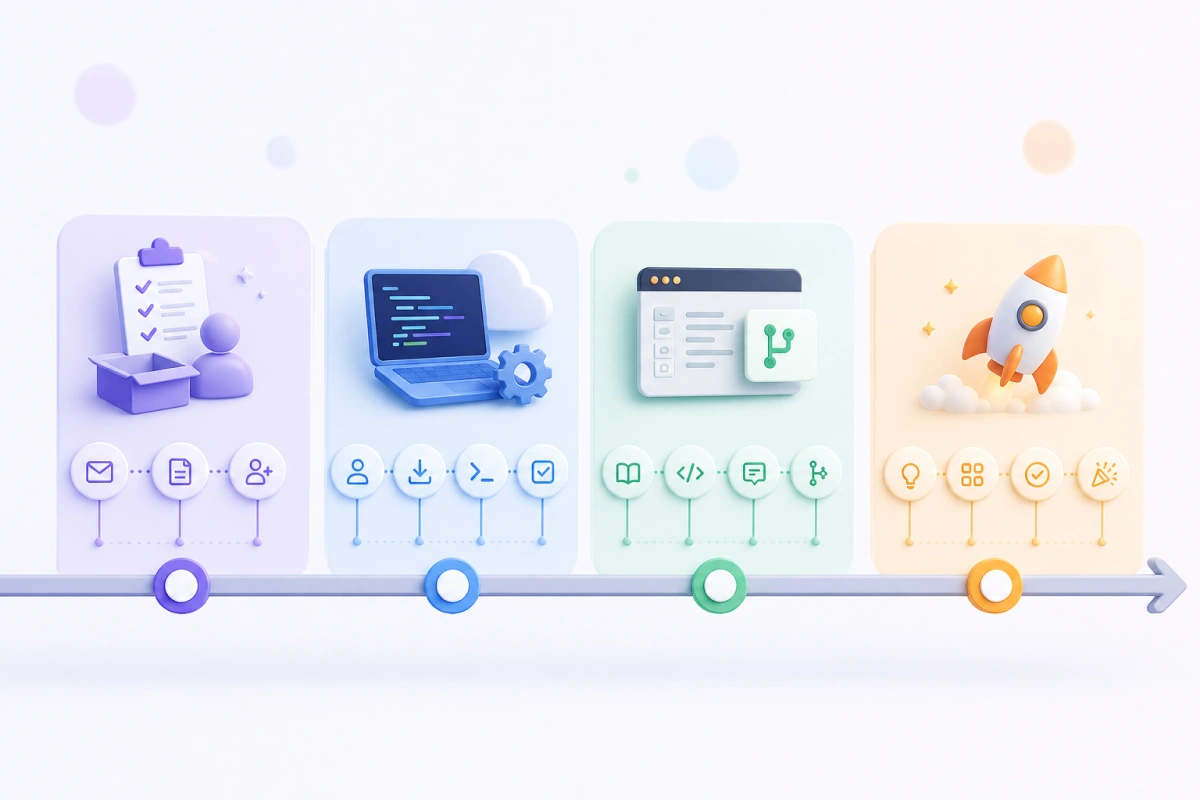
The playbook breaks into four phases. Each has a clear deliverable.
Pre-Day 1 (the week before start). Hardware shipped or accounts provisioned for BYOD. SSH keys exchanged. GitHub or GitLab repo access requested. Slack, Linear, or Jira accounts created. NDA and IP assignment signed. Buddy assigned. First-sprint scope drafted, not finalized.
Days 1–3. Day 1 is intro day: team meet-and-greet, codebase tour from the tech lead, environment setup, first local build. Day 2: read the last 30 commits, attend standup as observer, get the buddy walkthrough of the architecture diagram. Day 3: pick up a documentation-style ticket (fix a comment, update a README, write a missing test). Goal: first PR opened by end of day 3.
Days 4–7. First PR merged. Pick up a small bug-fix ticket. Attend sprint review. Have the buddy review the diff before submission. By end of day 7, the developer should have 2–3 small PRs merged and feel comfortable with codebase navigation.
Days 8–14. Take on a real feature ticket sized for one sprint week. Pair with the buddy for the first 1–2 days, then work independently. Submit for code review by day 13. Merge by day 14. By end of week 2, the developer should be a full sprint contributor. Use DORA's four key metrics (deployment frequency, lead time, change failure rate, MTTR) to track whether the new hire is reaching team baseline.
| Phase | Days | Deliverable | Owner |
|---|---|---|---|
| Pre-Day 1 | Week before start | Hardware, accounts, repo access, NDA, IP assignment, buddy assigned, first-sprint scope drafted | Hiring manager + IT + Legal |
| Days 1–3 | 1–3 | Environment running locally, first PR opened (doc fix or comment update) | Buddy + Tech lead |
| Days 4–7 | 4–7 | 2–3 small PRs merged, comfortable with codebase navigation | Buddy + Reviewer |
| Days 8–14 | 8–14 | One real feature ticket shipped, full sprint contributor | New developer + Buddy |
What's Different About Onboarding Outstaffed Developers
An outstaffed developer is legally employed by a vendor but works inside your team. That structure adds five onboarding steps in-house hires skip:
Per-contractor IP assignment. Master Service Agreement (MSA) with the vendor isn't enough. Each engineer should sign an individual IP assignment specific to your project. Without it, ownership of the code they write can be contested.
Individual NDAs. Same logic. The vendor's blanket NDA covers vendor staff at the corporate level; the engineer's individual NDA covers them at the personal level. Both should be in place before day one access.
Vendor escalation path. Defined upfront: who do you contact at the vendor if the engineer is underperforming, unavailable for a critical sprint, or needs to be replaced. The vendor should have a single point of contact for delivery issues, not just a sales rep.
Payroll and invoicing handoff. The engineer is on the vendor's payroll, not yours. Monthly invoicing flows through the MSA, not through internal HR. This sounds trivial but is the #1 source of friction in the first month if not pre-configured.
Security clearance for regulated environments. If your codebase touches PHI (healthcare), PCI data (payments), or other regulated information, the engineer needs documented access permission from your compliance officer before any access is granted. The IBM Cost of a Data Breach Report puts the average breach at $4.45M and rising; access provisioning is where many of those incidents start. Don't skip this step to save time. The audit later costs more than the delay now. For regulated-industry context, see our healthcare app development guide.
Access Provisioning Without Security Risks
Access is the #1 onboarding bottleneck. It's also the #1 source of security incidents. Get this right and the developer ships fast; get it wrong and you're explaining a credential leak to legal six months later.
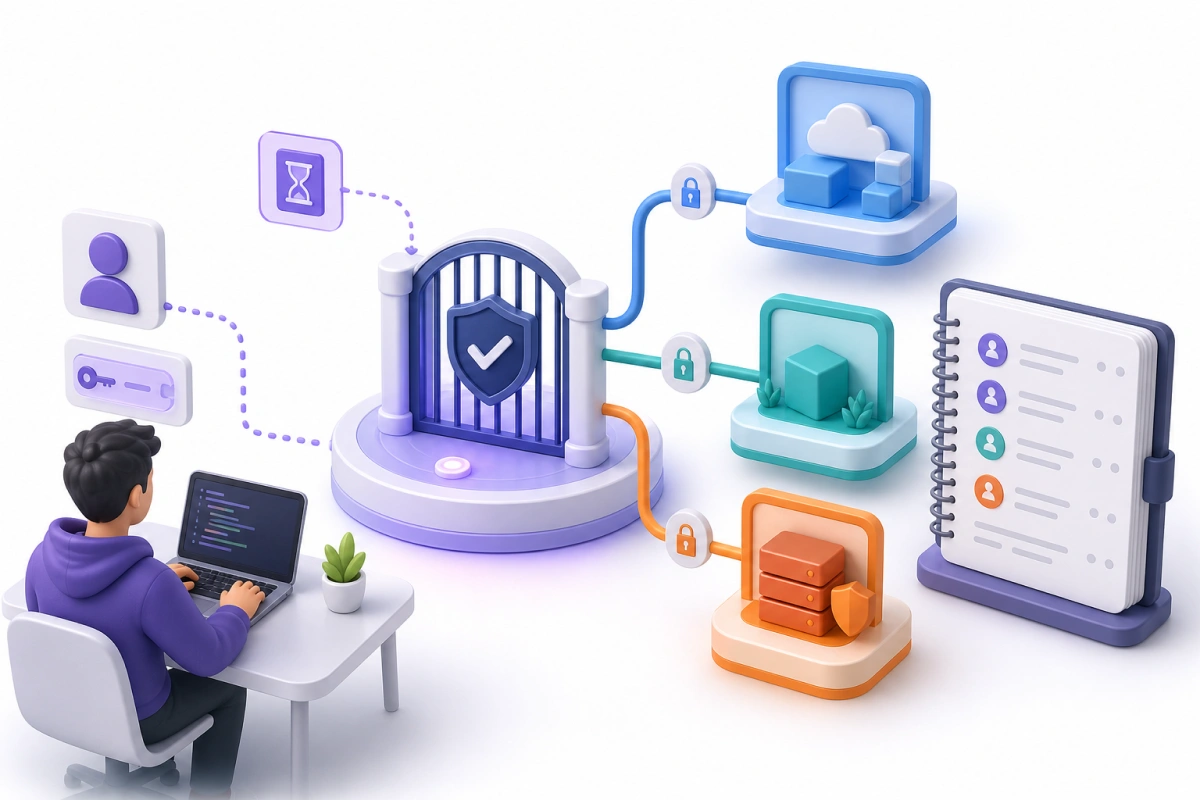
Use least-privilege from day one. The new developer doesn't need admin on the production database. They need read access to the staging environment, write access to one feature branch, and the ability to deploy to a sandbox. Promote permissions as the developer proves judgement.
Time-bound credentials. Every credential issued should have an expiration date matching the contract term. Vendor-managed engineers should never have indefinite admin tokens. Tokens lapse, get rotated, get re-issued. Tools like Vault, AWS SSO, or 1Password Business make this easy.
Audit trail. Log who provisioned what, when, and why. The log lives in your offboarding playbook too. When the engagement ends, the same log is the offboarding checklist.
No shared accounts. Each developer gets their own credentials on every system. Shared admin accounts are how breaches happen and how attribution becomes impossible after one.
Communication and Sprint-Cadence Setup
Onboarding is half access, half communication norms. Engineers default to whatever pattern they learned at their last job. If you don't set the norms, the team inherits whatever theirs were.
Async standup format. Slack thread, Linear update, or async video. Pick one. The new developer posts daily by 11 AM local time: yesterday's work, today's plan, blockers. The buddy is responsible for closing the loop on any blockers within 2 hours. The Stack Overflow 2024 Developer Survey shows async-first teams report higher productivity than sync-heavy ones, but only when the cadence is enforced.
Sprint cadence. One-week sprints work for MVP scale. Two-week sprints work for standard production. Pick one, don't switch mid-quarter. Sprint planning is Monday, retro is Friday. The new developer attends both from week one.
Doc-first culture. If a decision happens on a call, someone writes it down in Notion or Confluence within 24 hours. The LinkedIn Workplace Learning Report flags self-service documentation as one of the highest-ROI learning investments a team can make. The new developer learns the system by reading the doc trail, not by asking the same question three times.
Code review SLA. A new developer's PR sits in review queue longer than a senior's because reviewers want to be thorough. Set an SLA: PRs are reviewed within 4 business hours, even if the review is "looks good, let's pair on the next one." Velocity dies in review queues.
Red Flags That Tell You Onboarding Is Failing
By day 7, you should see clear signals. If you don't, intervene.
No PR by day 5. Either the developer is stuck and not asking, or the buddy isn't unblocking them. Talk to both. If it persists past day 10, the engagement isn't going to work.
Repeated environment issues. "I can't run the tests locally" on day 8 is a setup problem the team should have fixed by day 3. If the developer is still fighting setup at week two, the team's documentation is failing.
Ghost on standups. Missed standups in week one is a red flag. Address it on day 2, not day 14.
No questions asked. Counterintuitive but real. New developers who don't ask any questions in the first week aren't confident, they're disengaged. The buddy should be answering 5–10 questions a day for the first two weeks.
Buddy disengagement. The buddy is the make-or-break role. If they're "too busy" to onboard, the developer fails by default. Pick the buddy carefully and protect their calendar for the first two weeks.

How Empat Onboards Outstaffed Developers
At Empat, we onboard outstaffed engineers into client teams in 1–2 weeks on average. The mechanics are the same as the 14-day playbook above, with two specifics worth knowing:
The first sprint is scoped before contract signature. By the time the engineer's first day starts, the buddy is identified, the ticket is sized, and the IP assignment is signed. No waiting room.
Vendor-side delivery management. A senior PM on our side coordinates with your engineering lead, handles invoicing, and escalates blockers without consuming your management time. This is the cost-efficient half of the hybrid team model.
To see how this works on your project, see our outstaffing services, browse staff augmentation for shorter engagements, or book a free 30-minute consultation. For the broader hiring framework, our remote developers guide covers sourcing and vetting; this playbook covers what happens after the hire. If you're still picking an engagement model, outstaffing vs outsourcing and software outsourcing compare the options.
The first sprint is the test
Onboarding doesn't end on day 14. But by then, you know whether the engagement will work. The developer who has shipped 3+ merged PRs and contributed to sprint review is going to be a full team member. The developer still fighting environment setup needs a different kind of help, or a different engagement.
Run the checklist. Assign owners before day one. Protect the buddy's calendar. The cost of doing this well is two hours of planning. The cost of skipping it is two months of lost sprint capacity. The math is honest.
FAQ
How long should developer onboarding take?
For a senior developer joining a working team, two weeks is the realistic target for full sprint contribution. The first PR should land by end of day 3. By day 14, the developer should be sized for a full sprint ticket and shipping it independently. Anything longer signals a documentation or buddy-assignment problem, not a developer problem.
What's different about onboarding an outstaffed developer vs an in-house hire?
Five things: per-contractor IP assignment (not just MSA), individual NDA, vendor-side escalation path, payroll handoff through the vendor's invoicing, and security clearance for regulated codebases. The technical onboarding is identical; the legal and contractual onboarding adds about a day of paperwork that needs to happen before day one.
When should I replace a developer who's onboarding slowly?
If the developer hasn't shipped a PR by day 5, intervene immediately. If they still haven't by day 10, the engagement isn't going to work. Move fast. The cost of a slow-ramp replacement at week two is lower than the cost of a misfit engineer dragging on sprint velocity for two months.
What should an outstaffed developer be onboarded on first?
The codebase, in this order: read the last 30 commits, run the tests locally, ship a documentation fix (first PR by day 3), then a small bug fix, then a feature ticket. Architecture deep-dive and product context come second. Code-first onboarding gets the developer productive; product-first onboarding stalls them at week one.
Mobile App Development Cost in 2026: Full Breakdown (US Guide)
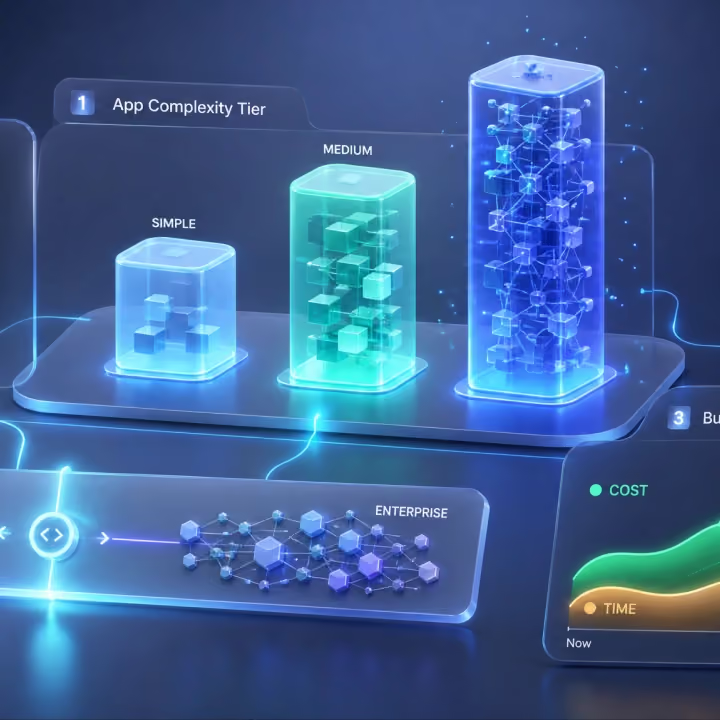
Building a mobile app in 2026 can cost anywhere from $20,000 for a simple MVP to $500,000+ for a complex enterprise platform development. Communicating with different businesses every day, we know for sure that many of them have received the widespread answer: "It depends…". As a result, companies that are looking for custom mobile app development services don't really understand what actually changes the budget. That's why we've prepared a detailed and informative guide on mobile app development costs in 2026.
Really, we need to admit that the issue of cost formation is rather complicated. Two apps can look similar on the surface and still have completely different development costs underneath. For example, a healthcare app with HIPAA compliance, secure infrastructure, and integrations with medical systems has considerable technical differences from a simple marketplace MVP. The situation is the same for fintech products, AI-powered apps, or internal enterprise tools.
In this guide, we'll break down realistic app development costs in the US market for 2026, explain the main pricing factors, and show how to estimate your project more accurately. We are more than sure that it will help you avoid expensive scope mistakes, in case you're already planning a product build or looking for a development partner.
Mobile App Development Cost at a Glance
Here's a simplified breakdown of general app development pricing in 2026.

These numbers reflect realistic US-market expectations for professional product teams. At the same time, keep in mind that freelancers or offshore agencies may quote less. However, in such a case, the final cost often increases later because of delays, technical mistakes, or missing functionality.
Try to avoid a common mistake that founders make, which is comparing app estimates without understanding what's included in the price structure. For example, one development agency may include discovery, QA, DevOps, and release support, while another software company includes only the price of development hours.
That's why a detailed pricing scope is one of the core decision factors when choosing a mobile app development company. So, let's figure out its components in more detail.
What Drives Mobile App Development Cost the Most
1. Scope of Features and Functions
According to Statista, global app market revenue is projected to reach $781.7 billion by 2029, growing at a 7.25% compound annual growth rate (CAGR) between 2022 and 2029. However, the competition grows as well. That is why, in order to capture the share of global revenue, your app needs to be qualitative and filled with beneficial features.
Consequently, the feature scope is the biggest factor that influences the mobile app development cost.
A simple scheduling app with email login and notifications is rather straightforward and simple in development. On the contrary, a marketplace with messaging, payment systems, admin panels, delivery tracking, and multi-role permissions is not that simple. The more business logic and functions your app requires, the more engineering time and qualifications it needs.
Let's view the well-known example. Apps similar to WhatsApp may cost around $80,000. At the same time, the applications with more complicated functionality, like *Uber, may cost $950,000.*
2. Platform Complexity
Platform choice is another major factor that forms the mobile app development cost for your project. When you need an app for just one platform, building either iOS or Android is usually the most affordable. The reason is that the team only needs to develop, test, and maintain a single codebase. In the US market, a basic iOS or Android MVP often costs from $20,000 to $50,000.
If you need both iOS and Android apps, costs naturally increase. To build two fully native apps, you need separate development work for each platform. It can raise the budget by 30–60% compared to a single-platform product.
To reduce time and budget, many startups choose cross-platform frameworks such as React Native or Flutter. These frameworks allow teams to reuse much of the same code across both iOS and Android. As a result, it can lower development costs by roughly 20–40% and speed up launch timelines. This is one reason why cross-platform remains a popular choice for MVP development in 2026.
3. Backend Architecture and Integrations
Even though users only see the frontend, backend systems often consume the largest share of development effort and mobile app development budget.
Payment processing, authentication systems, cloud infrastructure, user management, data synchronization, third-party APIs, AI integrations, etc. All these components determine how comfortable, effective, and competitive your app will be in the final result.
At the same time, a product with multiple integrations can quickly become expensive because every external service deals with:
- Security considerations
- Maintenance overhead
- API limitations
- Testing requirements
Fintech and healthcare app development are especially backend-complicated because they require secure data handling and regulatory compliance.
For example, integrating Stripe is relatively simple. On the contrary, building a custom payment routing system with fraud prevention is not.
The same logic can be applied to AI-powered apps in 2026. Adding a chatbot API may be easy and rather cheap, but creating reliable workflows around AI is much more complicated and expensive.
4. UX/UI Design and Brand Systems
According to Forrester research, every $1 invested in UX can return up to $100 in 2026.
With 10+ years of experience in communicating with business owners, at Empat, we've noticed that business owners often underestimate the importance of UX. They mostly expect good-looking pages, when the major functions of UX/UI design are improved conversion rates, retention, and reduced redesign costs.
The design work has a direct impact on both budget and development speed. The design teams usually work on:
- user research and competitor analysis
- wireframes and app structure
- user journeys and navigation logic
- clickable prototypes for testing
- accessibility standards
- design systems and reusable components
- responsive behavior across devices
- animations and interaction states
If you want to better understand how design choices affect timeline and budget, read the guide on mobile app design and development.
5. Security, Compliance, and Infrastructure
Security and compliance can significantly increase mobile app development costs because they add extra technical requirements besides core functionality.
For apps in healthcare, fintech, and other regulated industries, teams often need to implement:
- HIPAA compliance for handling medical data
- PCI DSS standards for payment security
- GDPR privacy requirements
- SOC 2 preparation
- data encryption
- audit logs
- multi-factor authentication
These components are not optional if you're estimating mobile app development costs for regulated industries. They directly affect how the app is built and whether it can legally operate.
For example, a healthcare app doesn't just store user data, they must have the technical ability to control who can access it. They also need to track every action, provide secure messaging between users, and protect file uploads like medical documents. As a result, it impacts database architecture, hosting setup, user permissions, logging systems, file storage, and messaging infrastructure. All these components add to the final app development cost.
Fintech apps have similar challenges. In addition to payment functionality, they often need fraud detection, identity verification, transaction monitoring, and stronger security layers.
Scalability is another factor that affects cost. If your app is expected to grow quickly, the backend needs to handle future traffic from day one.
Building an app for 5,000 users is very different from building one that may need to support 5 million users. If you have considerable growth expectations, you need to be ready for more investment in cloud infrastructure, database performance, server architecture, and monitoring systems early on.
6. Maintenance and Iteration
Most companies spend roughly 15–25% of initial development cost annually on maintenance and iteration. So, don't underestimate this factor and include it in your mobile application development budget.
Basically, launch is usually only the beginning.
You may need ongoing procedures, such as bug fixes, OS updates, performance optimization, security patches, analytics improvements, or user feedback implementation. All these services will add cost to the final mobile app development price.
For example, a $100,000 application may require $15,000–$25,000 per year in support.
We recommend not neglecting the stage of maintenance and improvement, because products that continuously improve usually outperform apps that are one-time development projects.
Mobile App Development Cost by App Type
Marketplace Apps
At first glance, marketplaces may seem to be simple: you only need a platform where users can list products or services and complete purchases. In fact, marketplace apps need to support multiple user groups, which significantly increases development complexity and budget.
A typical marketplace app often includes:
- buyer and seller accounts
- product or service listings
- payment processing
- in-app messaging
- reviews and ratings
- search and filtering systems
- order tracking
- admin dashboards
Each of these features requires separate logic, integrations, and testing. For example, payments alone may involve subscriptions, split payments, refunds, and transaction history. Messaging adds real-time functionality, and admin dashboards require moderation and analytics tools.
As a result, marketplace apps usually cost more than standard mobile products. The cost of the MVP marketplace varies from $40,000 to $90,000. What's more, the full-scale marketplace can cost up to $400,000.
Fintech and Payment Apps
Fintech apps are among the most expensive categories in mobile app development because security and compliance are non-negotiable.
The list of typical features of mobile apps includes identity verification, banking APIs, payment systems, fraud monitoring, transaction history, financial analytics, security layers, etc. All these backend infrastructure and legal requirements increase the prices of mobile app development.
As a result, the estimated cost for a basic fintech MVP can be $80,000–$150,000. When the enterprise fintech platform can cost up to $300,000–$1M+
Healthcare Apps
Healthcare apps require specialized development because of privacy and regulatory standards. If you are working in the medical sphere, your mobile app development will probably include patient portals, appointment systems, telemedicine, medical record integrations, secure messaging, and wearable integrations. etc. And all these features increase prices.
That's why the estimated cost for basic healthcare MVP is from $60,000 to $120,000. The HIPAA-compliant healthcare platform is more expensive, namely $250,000–$700,000.
B2B Internal Tools
Even though Internal enterprise tools may look visually simpler than consumer apps, they still often involve complex workflows. And it obviously affects the prices because of logistics dashboards, inventory systems, operations management tools, or internal CRMs that they may need. The main complexity comes from permissions, reporting systems, integrations, and business logic.
The mobile app development costs for internal MVP may reach $30,000–$80,000, while enterprise operational platforms can cost up to $120,000–$350,000.

Timeline vs Cost: What Speeds You Up (and What Slows You Down)
Timelines and budgets are closely connected. If you need fast delivery, you probably need to be ready to pay more.
Here's a simplified breakdown of how mobile app timelines work in practice.
Even though the development timing is preliminarily settled, you still have an opportunity to speed it up. It usually depends on how clear the project is from the very beginning and how stable the decisions are during the process.
Below is a simple comparison of what typically speeds up delivery and what usually delays it:

In our practice at Empat, the majority of delays don't come from complications with the code writing or development. Usually, we spend much time on figuring out what needs to be built, how these solutions will benefit the overall business model, and how stable those decisions are over time.
At the same time, the major cost driver is rebuilding features because of poor discovery work. This is why experienced product teams invest in planning before development begins.
How to Estimate Your App Budget Realistically
Separate Must-Haves From Nice-to-Haves
First of all, you need to focus only on functions that your business really needs. On the contrary, founders often try to implement every idea into the first version of the product. As a result, such an approach causes larger budgets, longer timelines, slower launches, and more technical risk.
We recommend launching only the core functionality that users absolutely need. Leave features that improve retention and user experience later. Finally, only after a successful launch can you move on to the experimental ideas.
Such an approach will keep MVP costs manageable while accelerating market validation.
Confirm Assumptions Early
Discovery workshops help validate technical and business assumptions before the development processes begin.
You may ask the following questions because they affect pricing:
- Do you need real-time functionality?
- Will users upload media files?
- Are there compliance requirements?
- Which systems need integrations?
- What scale should infrastructure support?
- Are there multiple user roles?
Small assumption errors can create massive budget differences later.
Watch for Unrealistically Low Estimates
Cheap estimates are attractive, especially if you are a startup. But let's be honest: low pricing can cause different problems, such as missing QA, weak architecture, no discovery phase, poor scalability, hidden post-launch costs, etc.
In order to avoid such threats, a reliable estimate should clearly explain scope assumptions, timeline, team structure, deliverables, technical risks, and maintenance expectations. In such a way, both sides understand what is included and what is not from the start.
If you're comparing vendors, this article on how to find an app developer can help you evaluate development partners more effectively.
How Empat Can Help
At Empat, we support teams with development services at every stage. We help them with early discovery as well as provide full product delivery. If you're still shaping your idea, we can help you find the real business opportunity, define the scope, prioritize features, and create a clear development plan. If you already have requirements, we'll prepare a realistic estimate and timeline based on actual technical complexity.
Our discovery process is structured and efficient. Due to AI-assisted workflows, it now takes 1–2 weeks instead of the typical 2–4. This helps teams move faster without losing clarity.
We also provide an AI-based cost estimator so you can quickly understand potential budget ranges even before we start a full engagement. From there, we help you move into design, development, and scaling with a predictable, transparent process.
Where the budget actually gets decided
The average mobile app development cost in 2026 ranges from roughly $20,000 for a simple MVP to several hundred thousand dollars for complex platforms. The list of the biggest cost drivers includes feature scope, backend systems, integrations, and compliance requirements.
The most successful app projects usually begin with careful discovery and realistic prioritization. A clear roadmap, experienced technical guidance, and accurate estimation can save months of delays and avoid budget overruns later.
If you're planning a mobile app development, contact Empat to get a quote.
FAQ
How much does it cost to build an app in the US?
In 2026, a basic app MVP in the US typically costs between $20,000 and $60,000. More advanced applications with custom backend systems, integrations, or compliance requirements often range from $100,000 to $500,000+.
What is the cheapest type of mobile app to build?
Simple content-based or utility apps are usually the least expensive because they require limited backend functionality and fewer integrations. Apps with payments, real-time systems, or multiple user roles are significantly more expensive.
What increases mobile app development cost the most?
The biggest cost factors are:
- Complex features
- Backend architecture
- Third-party integrations
- Security requirements
- Compliance standards
- Frequent scope changes
Poor planning can also increase costs substantially through rebuilds and delays.
How long does it take to build an app?
Most MVPs take 2–4 months to build. Standard products usually require 4–8 months, while complex enterprise platforms can take a year or longer, depending on scope and integrations.
all articles
our expertise amplifies them


Healthcare IT Consulting: When You Need It and What It Covers
Most people looking for healthcare IT consulting know something is wrong but not whether they need advice, a build, or permission to stop. This covers what the work includes, what it excludes, and how to tell which you need before paying anyone.


EHR and EMR Integration Services: What It Actually Takes
Healthcare software projects rarely fail on the software. They fail at the integration boundary. This guide covers the standards you will actually meet, how Epic access works now that App Orchard is gone, what integration touches on your side, and what it costs.

Top Fintech and Healthtech Software Development Partners (2026)
A shortlist of 11 engineering partners actively building regulated fintech and healthtech products for US clients in 2026, with named case studies, verifiable review profiles, and a side-by-side comparison table. Includes what to check on compliance, case evidence, and delivery model before you sign.

AI Integration Services: Adding AI to Systems You Already Run
AI integration means adding intelligence to systems you already run, which is a different problem from building an AI product from scratch. This guide covers the four integration patterns, what each one touches in your existing stack, where these projects actually fail, and what the work costs.

Web Application Development Services: What to Build With, What It Costs, Who to Hire
A web application is not a website with more pages, and pricing one like a website is how projects go wrong. This guide covers what web application development services include, how to pick a stack in 2026, which architecture decisions are expensive to reverse, and how to evaluate a development company.

MVP Development Services: What You Get, What It Costs, and How to Pick a Partner
MVP development services cover everything between an idea and a product real users can try: discovery, scope, architecture, build, QA and launch. This guide breaks down what you get at each price band, how long it takes, which engagement model fits, and the questions that reveal whether a vendor will actually ship.

RPA Development Services: What They Cost and Where They Pay Off
Where robotic process automation still earns its cost in 2026, when building beats configuring a platform, why the integration layer is the real project, what a build costs by stage, which processes you should not automate at all, and how to tell an RPA problem from an AI agent problem.

Ecommerce Development Services: Custom Build vs Platform, and What It Costs
When a platform beats a custom ecommerce build and when it does not, what an engagement actually contains beneath the storefront, what headless commerce changes in practice, how to migrate without losing search rankings, and what each scope costs.

Mobile App Development Company: How to Choose the Right Partner
What mobile app development companies actually deliver, how an agency compares to freelancers and in-house hiring, the six questions worth asking before you sign, what a build costs at each level of complexity, and the red flags that show up before the contract does.

Application Modernization Services: Refactor, Replatform, or Rebuild?
A decision framework for legacy application modernization: how to read the signals in your own system, which of the five paths fits, what the data layer and cloud migration really cost you, and how to sequence the work so the business keeps running.

AI Workflow Automation: What to Automate, How It's Built, and What It Costs
A practical guide to AI workflow automation in 2026: how it differs from RPA, which workflows to automate first, the reference architecture behind a production build, when agents beat deterministic pipelines, and what it costs to build and run.

Generative AI Development Services: What to Build, How, and What It Costs
A builder's guide to generative AI development services in 2026: which use cases are actually shipping, how to choose between an API, a fine-tune and a self-hosted model, what a realistic timeline looks like, and where the money goes after launch.






Top SaaS Development Companies in 2026
A comparison of 11 SaaS development companies in 2026, scored on multi-tenant architecture, subscription billing, API-first design, cloud scaling and verified reviews. Includes a side-by-side table, typical timelines by scope, and a checklist for running your own vendor evaluation.






AI Software Development Cost in 2026: Full US Breakdown
AI software development in 2026 typically runs from $15,000 for a proof of concept to $500,000+ for enterprise platforms. Here are the real US price ranges by project type, the factors that actually drive budget, and a practical way to estimate yours.









Technical Due Diligence: Investor & M&A Checklist (2026)
In 2026, the scope has widened. AI-generated codebases, vibecoded MVPs, and stricter compliance requirements turned what was once a 5-day code review into a multi-day engineering assessment covering architecture, security, scalability, team capability, and how the build supports product-market fit.








-s.avif)













.avif)

Software Development Solutions: How to Choose the Right One
The rule of “not all yogurts are equally healthy for you” applies to software development solutions as well. You may have access to countless software development services, but many might be useless due to specific business processes. In this guide, we will explore custom software development services beneficial for achieving various business needs.

.avif)


.avif)


How to Hire Developers for Your Startup: A Step-by-Step Guide to Building the Perfect Team
So you want to start a startup? Maybe you already have. But what if we told you that maybe somewhere in the corner of your company is lurking a “wrong fit” for your business? Yes, you read that right. Today we will talk about challenges in attracting the right software developers for your startup, why it`s important to hire the right ones, the competition, and cultural fits. Bucks up and let`s get cracking!


How Much Does It Cost to Hire an App Developer?
Today everything comes in apps. Your calendar, dating, medicine trackers, food, etc. If you think about something, this app already exists. But who are those who turn a paper calendar into an app? Mobile app developers. In this blog post, we will discuss, the costs of hiring one for your team.

The Manifest Recognizes Empat as one of the Global App Development Companies for E-Commerce Apps
The app development industry has been taking the world by storm! A lot of companies and businesses are integrating applications to help boost their productivity, while some are utilizing them as extensions of their products and services.


How To Outsource Software Development For Startups
Welcome! If you’re building a tech startup, outsourcing software development can be a smart strategy to overcome challenges and boost success. In this article, we’ll break down the different outsourcing models, help you choose the right partner, and discuss the pros and cons of outsourcing. Whether you’re just starting or looking to improve, this guide will give you the insights you need to make effective decisions and drive your startup forward. Let’s explore how outsourcing can help your business thrive!