

Technical Due Diligence: Investor & M&A Checklist (2026)
In 2026, the scope has widened. AI-generated codebases, vibecoded MVPs, and stricter compliance requirements turned what was once a 5-day code review into a multi-day engineering assessment covering architecture, security, scalability, team capability, and how the build supports product-market fit.

When a deal moves into final-stage diligence, the technical findings often decide whether the cheque clears. According to a Bain & Company analysis, poorly assessed technology and integration risk is one of the top three reasons M&A deals miss their value targets, and the pattern is the same in venture rounds where Series B leads now treat technical due diligence as standard, not optional.
In 2026, the scope has widened. AI-generated codebases, vibecoded MVPs, and stricter compliance requirements turned what was once a 5-day code review into a multi-day engineering assessment covering architecture, security, scalability, team capability, and how the build supports product-market fit.
This guide breaks down what technical due diligence actually covers in 2026, when to run it, the checklist experienced reviewers work through, the red flags that kill deals, realistic timelines and costs, and how to prepare your codebase if you are on the receiving end. Investors, acquirers, and founders preparing for a round all need the same framework, just used from different angles.
What Is Technical Due Diligence and Why Investors Run It
Technical due diligence (often called "tech DD" or software due diligence) is a structured assessment of a target company's technology, engineering team, and product delivery capability. It answers one practical question: does the technology behind this business actually support the valuation, the growth plan, and the integration scenario being discussed?
It is run before money or equity changes hands. The output is a written report that flags risks, quantifies remediation cost where possible, and gives the investor or acquirer enough confidence to either close, renegotiate terms, or walk away.
Four groups commission technical due diligence most often:
- Venture capital firms — primarily at Series A and beyond, when the cheque size makes a $15K–$30K technical assessment look cheap relative to the risk.
- Private equity and corporate acquirers — for any deal where the target's software is core to the thesis, or where post-deal integration depends on the codebase scaling under the new parent.
- Strategic buyers — looking at acquihires, technology rollups, or vertical software consolidation plays.
- Founders preparing to be sold or funded — running a self-imposed tech DD as a vendor due diligence to surface and fix issues before they become deal-breakers.
The difference between a casual code review and proper technical due diligence is structure. A code review checks if the code is well-written. Tech DD checks whether the technology is a defensible asset, a manageable liability, or somewhere on the spectrum between.
When Technical Due Diligence Becomes Critical
Not every deal needs the full treatment. Tech DD becomes essential in these situations:
- Software is the product, not just a tool. SaaS companies, marketplaces, AI products, fintech platforms, healthcare software — anywhere the codebase and the company are effectively the same thing.
- Cheque size crosses ~$2M. Below that threshold, full DD often gets compressed into a senior-engineer call. Above it, the cost of getting it wrong justifies a structured engagement.
- The company has been built quickly with AI tools. Vibecoded MVPs, no-code prototypes scaled past their limits, and AI-generated codebases need a more careful look because the speed-to-market trade-off usually shows up in architecture and maintainability.
- Compliance matters. Healthcare (HIPAA), payments (PCI DSS), EU operations (GDPR), enterprise sales (SOC 2). Any of these multiplies the importance of an honest assessment.
- There is a planned integration. When the buyer plans to merge two codebases, share infrastructure, or migrate users, integration feasibility becomes a first-order question.
- The team is small and senior. A two-engineer company means key-person risk is the technology risk. DD has to assess whether the institutional knowledge can survive transition.
If any two of these apply, structured technical due diligence is worth the investment. If three or more apply, skipping it is a red flag in itself.
The Technical Due Diligence Checklist: 10 Areas to Audit
A full technical due diligence covers ten areas. Each one has its own deliverable, and a strong report ties findings back to deal terms.
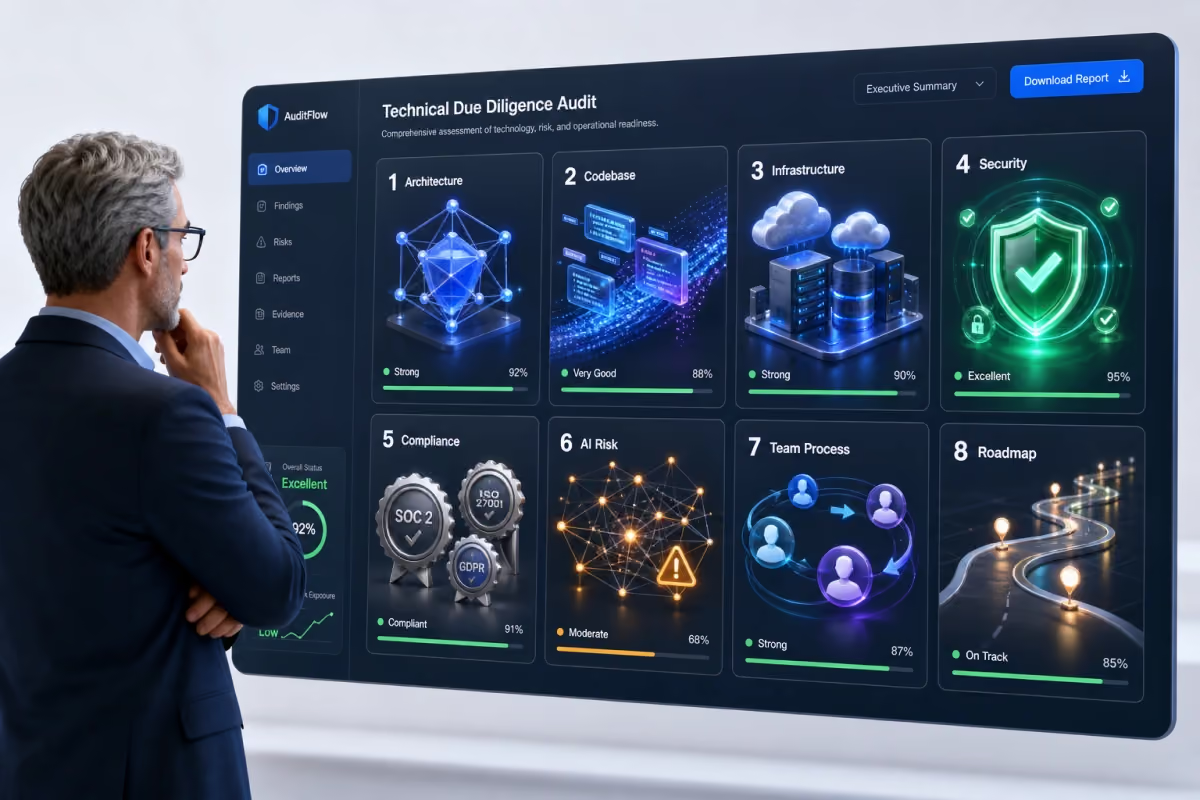
- Architecture and system design. Is the architecture coherent? Does it match the company's stated scale and roadmap? Look for accidental complexity, unjustified microservices, missing service boundaries, and single points of failure. Diagram what is actually deployed, not what was on a slide.
- Codebase quality. Static analysis, test coverage, code smells, dead code, dependency health, license compliance. Sample several modules: pick the most-changed and least-changed files and read them. Read the latest 50 commits to see how the team actually works.
- Infrastructure and cloud setup. Cloud account hygiene, IaC coverage (Terraform, Pulumi, CloudFormation), environment parity, secrets management, backups, disaster recovery runbooks, observability stack. Check whether infrastructure can be rebuilt from version control without tribal knowledge.
- Security posture. Authentication, authorization, encryption at rest and in transit, dependency vulnerabilities, exposed secrets in commit history, OWASP Top 10 review, penetration test history, incident response runbooks.
- Data and AI components. Data architecture, data quality, PII handling, ML model lineage, training data provenance, model monitoring, fallback behavior, prompt-injection defenses for LLM features. AI components are where 2026 deals get derailed most often.
- Compliance and certifications. Active certifications (SOC 2, ISO 27001), in-progress audits, gap assessments for HIPAA / PCI DSS / GDPR, customer-facing compliance commitments, documented data processing agreements.
- Engineering team and process. Headcount by seniority, attrition trends, deployment frequency, lead time for changes, MTTR, on-call rotation, documentation quality, code review culture.
- Roadmap feasibility. Compare the technical state with the public or pitch-deck roadmap. Estimate the engineering cost to deliver the next 12 months as promised. This is where most overvaluation gets caught.
- Vendor and third-party dependencies. Critical SaaS vendors, replaceability, contract terms, single-vendor lock-ins (especially around AI APIs and infrastructure), open-source license risk.
- Product analytics and unit economics from the build side. Does instrumentation actually exist? Can the team answer questions about feature adoption, latency, error rates, and infrastructure cost per active user without building new dashboards from scratch?
A report that covers all ten areas, with severity ratings and remediation estimates, is what separates a useful DD engagement from a glorified code walkthrough.
Red Flags That Kill Deals
Some findings are recoverable. Others end the conversation. The hard red flags experienced reviewers watch for:
- No source control history older than the founders' tenure. A repository that was "reinitialised" usually hides something.
- Production secrets in environment files committed to git. A small problem on its own, but a strong signal of how the team thinks about security.
- AI-generated code with no human review trail. Increasingly common in 2026 — entire features merged without a second pair of eyes, no architectural rationale, inconsistent style across files.
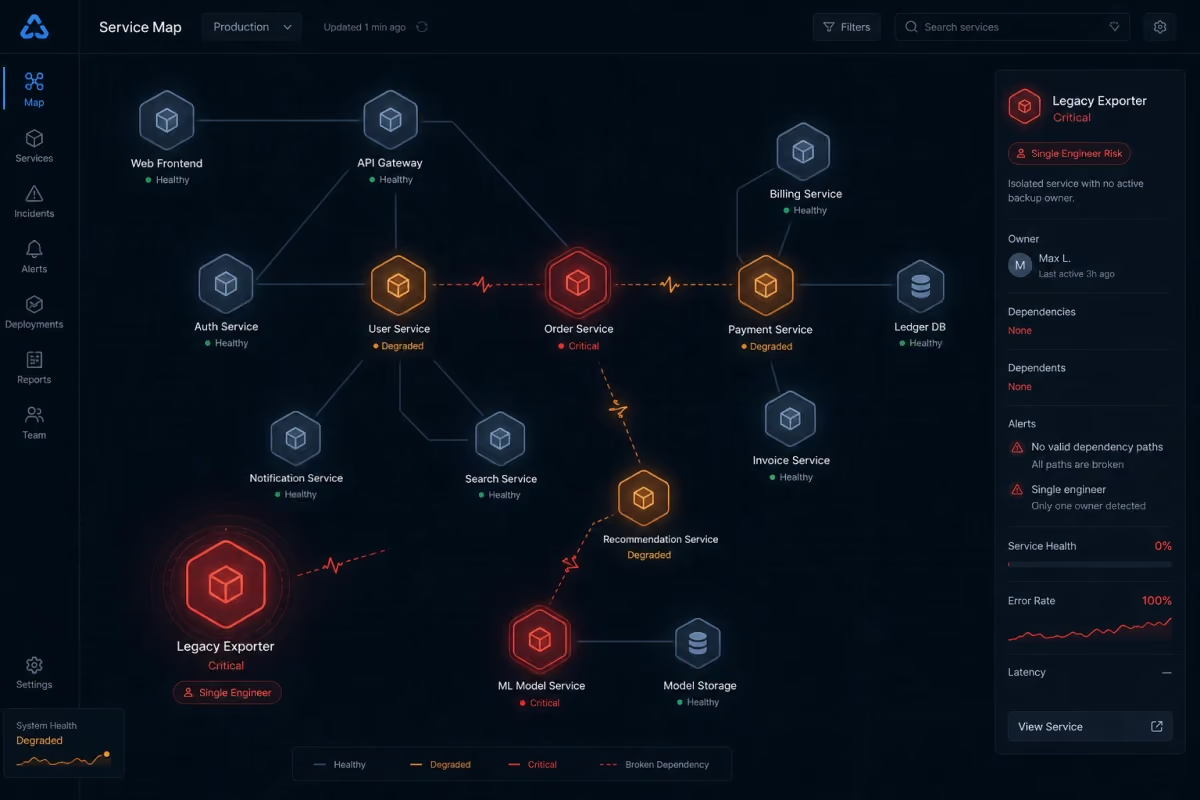
- Single engineer who understands the production system. If that person leaves, the company is locked.
- Compliance claims that do not match implementation. Marketing pages promising HIPAA compliance while the actual stack stores PHI in unencrypted Postgres tables.
- Customer data in shared development environments. A breach waiting to be reported.
- No production runbook, no observability, no recovery plan. The product runs because nothing has gone wrong yet.
- Tech debt that exceeds 12 months of full-team work. Beyond that point, the rebuild conversation becomes hard to avoid.
- Unresolved high-severity dependency vulnerabilities older than 90 days. Suggests the team either does not monitor or does not act.
- Significant gap between pitch-deck capabilities and actual production behaviour. Demos that only run on the founder's laptop.
Finding one or two of these does not necessarily kill a deal. They become deal-breakers when the buyer cannot get an honest answer about why the issue exists.
How Long Technical Due Diligence Takes
In 2026, the typical engagement falls into three timeframes depending on company size and deal complexity.
- Light tech DD (2–4 days) — early-stage company, small codebase, single service, single team. Usually a senior engineer plus a domain specialist running interviews and a focused code review.
- Standard tech DD (1–2 weeks) — mid-stage SaaS or marketplace, 5–25 engineers, multi-service architecture. Two-to-three reviewers covering architecture, security, and team / process. Most VC and growth-equity engagements land here.
- Deep tech DD (3–6 weeks) — late-stage, enterprise, regulated industry, or active integration planning. Multiple specialists (security lead, cloud architect, data and AI specialist, compliance reviewer), multiple workstreams, formal interim updates.
A realistic schedule has three phases: kickoff and access provisioning (1–3 days), active assessment (the bulk of the engagement), and report writing plus debrief (2–4 days). Founders typically underestimate phase one. Granting clean read-only access to repositories, cloud accounts, and analytics is rarely smooth on the first attempt.
Technical Due Diligence Cost in 2026
Pricing has tightened in 2026 as more specialised firms entered the space. Realistic ranges:

- Light tech DD: $5,000–$15,000
- Standard tech DD: $15,000–$40,000
- Deep tech DD: $40,000–$150,000+
- Vendor due diligence (commissioned by the seller): typically 30–50% above the equivalent buy-side engagement, because the report needs to be defensible to multiple potential buyers.
What actually drives the price up: codebase size and language diversity, regulated industry exposure, presence of meaningful AI/ML systems, multi-cloud or hybrid infrastructure, and the deadline. A two-week deadline on a complex SaaS easily adds 25–40% to a standard engagement.
A practical rule of thumb: budget tech DD at 0.3–0.7% of the deal size, and never less than $10K on any deal where software is the core asset. The ROI shows up in two places: better-priced deals when issues are caught, and avoided losses on deals that should not close.
How Empat Approaches Technical Due Diligence
At Empat, we run technical due diligence engagements for VC partners, growth-stage acquirers, and founders preparing for fundraising. Our reviewers are senior engineers with 10+ years of production experience across SaaS, fintech, healthcare, and AI products, not generalist consultants.
A typical engagement includes architecture review, codebase assessment with severity-ranked findings, infrastructure and security audit, compliance gap analysis (HIPAA, PCI DSS, GDPR, SOC 2 readiness), AI-specific risk review, team and process assessment, and a written report tied to deal terms with remediation cost estimates.
We also help on the other side. If your AI product or MVP is showing the same warning signs we typically flag in DD reports, our AI product rescue and stabilization service is built specifically for this. We audit, prioritise, and rebuild the parts that need rebuilding, while keeping what already works.
If you are running a deal and need a tech DD partner who delivers the report on time and explains the findings to non-technical stakeholders, book a free 30-minute consultation. We will scope the engagement and quote within two business days.
The cheapest line item in any deal
Technical due diligence in 2026 sits closer to a structured engineering audit than to a code review. It is a structured assessment that decides whether software is a defensible asset or a hidden liability, and the difference is usually visible only when someone qualified looks for it.
For investors and acquirers: the fee for proper tech DD is small relative to the cost of closing a deal that should have been renegotiated. For founders: running self-imposed vendor due diligence before a round surfaces the issues you can fix on your timeline, instead of in the middle of negotiation.
If you are on either side of a deal and want a partner who has run dozens of these engagements across regulated and high-growth verticals, Empat is built for exactly this. Bring the deal context, and we bring the framework, the reviewers, and the report.
FAQ
What is included in a typical technical due diligence?
Architecture review, codebase assessment, infrastructure and cloud audit, security posture, compliance gap analysis, data and AI risk review, team and process evaluation, roadmap feasibility, third-party dependency analysis, and product analytics readiness. The deliverable is a written report with severity-ranked findings and remediation estimates.
How long does technical due diligence take in 2026?
Light engagements take 2–4 days, standard engagements take 1–2 weeks, and deep engagements for enterprise or regulated targets take 3–6 weeks. Add a few days at the start for access provisioning and a few at the end for report writing.
How much does technical due diligence cost?
Light tech DD costs $5,000–$15,000, standard engagements run $15,000–$40,000, and deep engagements for late-stage or regulated companies range from $40,000 to $150,000+. A useful rule of thumb is 0.3–0.7% of deal size, with a $10K floor for any software-centric deal.
What happens if technical due diligence finds serious issues?
Deals get repriced, restructured, or paused. Common outcomes are escrow holdbacks tied to specific remediation milestones, valuation adjustments, or earn-outs that depend on rebuilding affected components. Serious enough findings, usually compliance violations or fundamental architectural problems, can also end the deal entirely.


