
Toptal vs Upwork: Complete Comparison Guide 2026 + Better Alternative
Compare Toptal vs Upwork: pricing ($60–200/hr vs $10–150/hr), vetting, pros & cons. And see why dedicated development teams may be better for your project.

Hiring developers is one of those things that sounds simple until you actually try it. You write a job description, post it somewhere, and wait for the perfect candidate to appear. Except they don’t. Instead, you get 200 applications, half of which are copy-pasted templates, and the other half are from people who listed React on their profile but last used it in 2019.
If that story sounds familiar, you’re in good company. Most startup founders spend weeks (sometimes months) cycling through freelance talent, running test projects, and dealing with no-shows before they find someone who actually delivers. The product sits unfinished. The budget creeps upward. And suddenly you’re spending more time conducting endless interviews than building your business. This is a common struggle when you’re trying to hire developers for a startup on a tight project timeline.
That’s the context behind the Toptal vs Upwork debate. Both platforms promise a solution to the same problem: connecting you with top talent for software development. But they go about it in very different ways. Toptal curates a smaller pool and handles the matching. Upwork opens up a marketplace of millions and lets you sort through it yourself. As John Winsor, executive-in-residence at Harvard’s Laboratory for Innovation Science, puts it in his book Open Talent, workers today set their own terms for what they do, where they do it, and at what price. That power shift means companies need to think much more carefully about how they source the right talent.
So the question worth asking goes deeper than “which is the best platform?” You need to figure out whether you want to hire freelancers and manage them yourself, or whether you want someone to co-own the outcome with you. Understanding the key differences between Toptal vs Upwork is the first step.
What Is Toptal?
Toptal is an exclusive network of freelance talent that positions itself as a club for top tier talent. The company was founded in 2010, and its headline claim is that it accepts only the top 3% of applicants into its global talent pool. Software developers, graphic designers, finance experts, and project managers all go through a rigorous screening process before they can join.
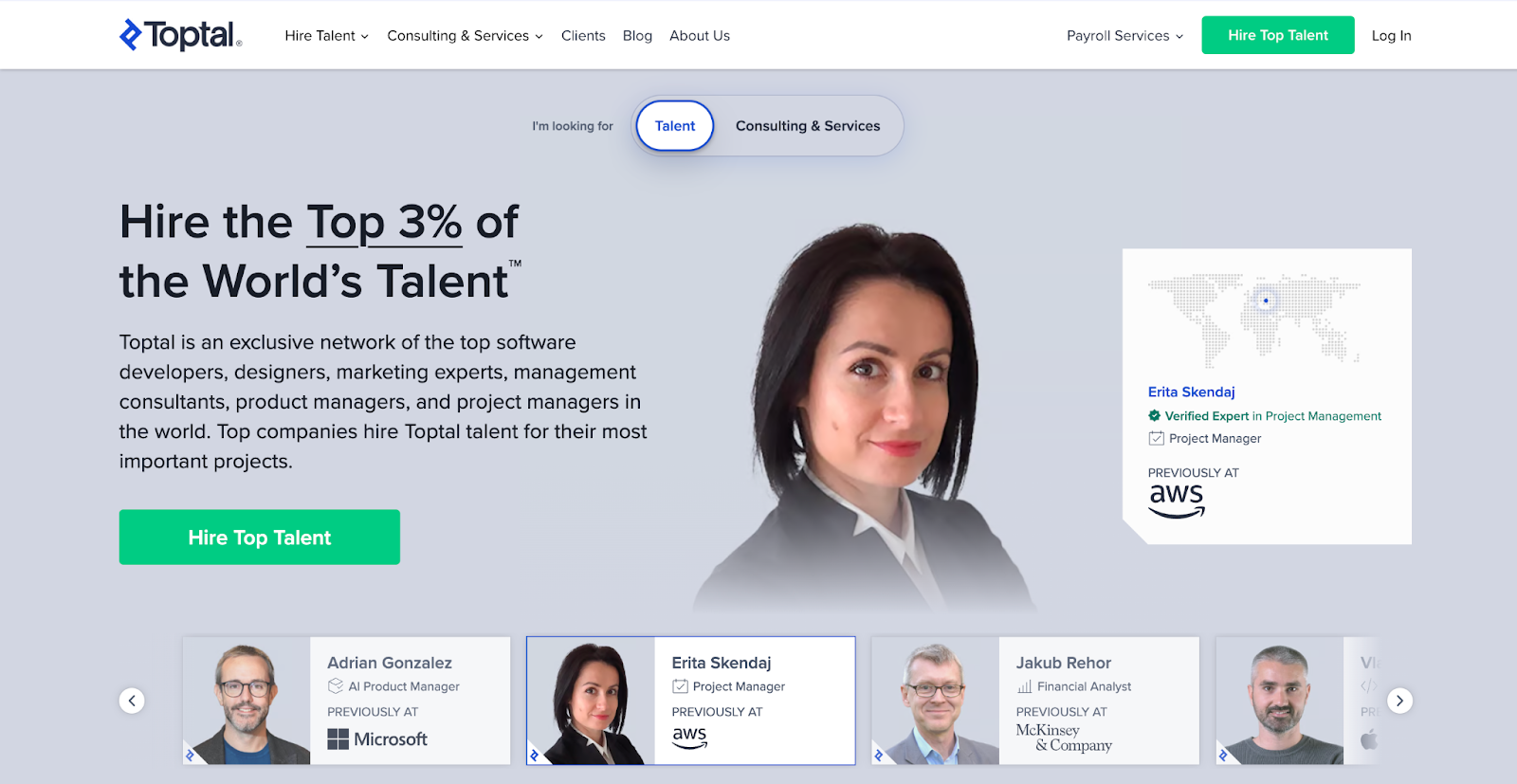
That screening process takes time. Applicants go through language checks, technical skills assessments, live coding interviews, and trial projects. The whole thing can stretch to five weeks. Because of this, the Toptal freelancers who make it through tend to be highly skilled freelancers, experienced and comfortable with complex projects.
When you sign up as a client, Toptal offers a streamlined process: a Toptal representative learns about your project and matches you with highly skilled professionals, usually within 24–48 hours. You pick who to work with, agree on terms, and get started. There’s a two week trial period, which gives you a small safety net if the match doesn’t work out.
Here’s the catch: Toptal is expensive. Rates typically start around $60/hour and can push well past $200/hour for specialized skills. On top of that, there’s a $500 deposit and a monthly platform fee. You’re paying a premium for access to vetted talent and talented professionals. But once the work starts, you’re still the one managing projects. For a deeper look at how Toptal stacks up against other options, check out this breakdown of Toptal competitors.
What Is Upwork?
Upwork is one of the largest freelancing platforms on the planet, with over 18 million registered freelancers forming a vast and diverse pool across nearly every skill category you can think of. Web development, graphic designers, marketing materials, social media management, data entry, translation—you name it. According to Upwork CEO Hayden Brown, 63% of executives feel they don’t have adequate talent in-house, which partly explains why the platform and its Upwork Enterprise tier keep growing.
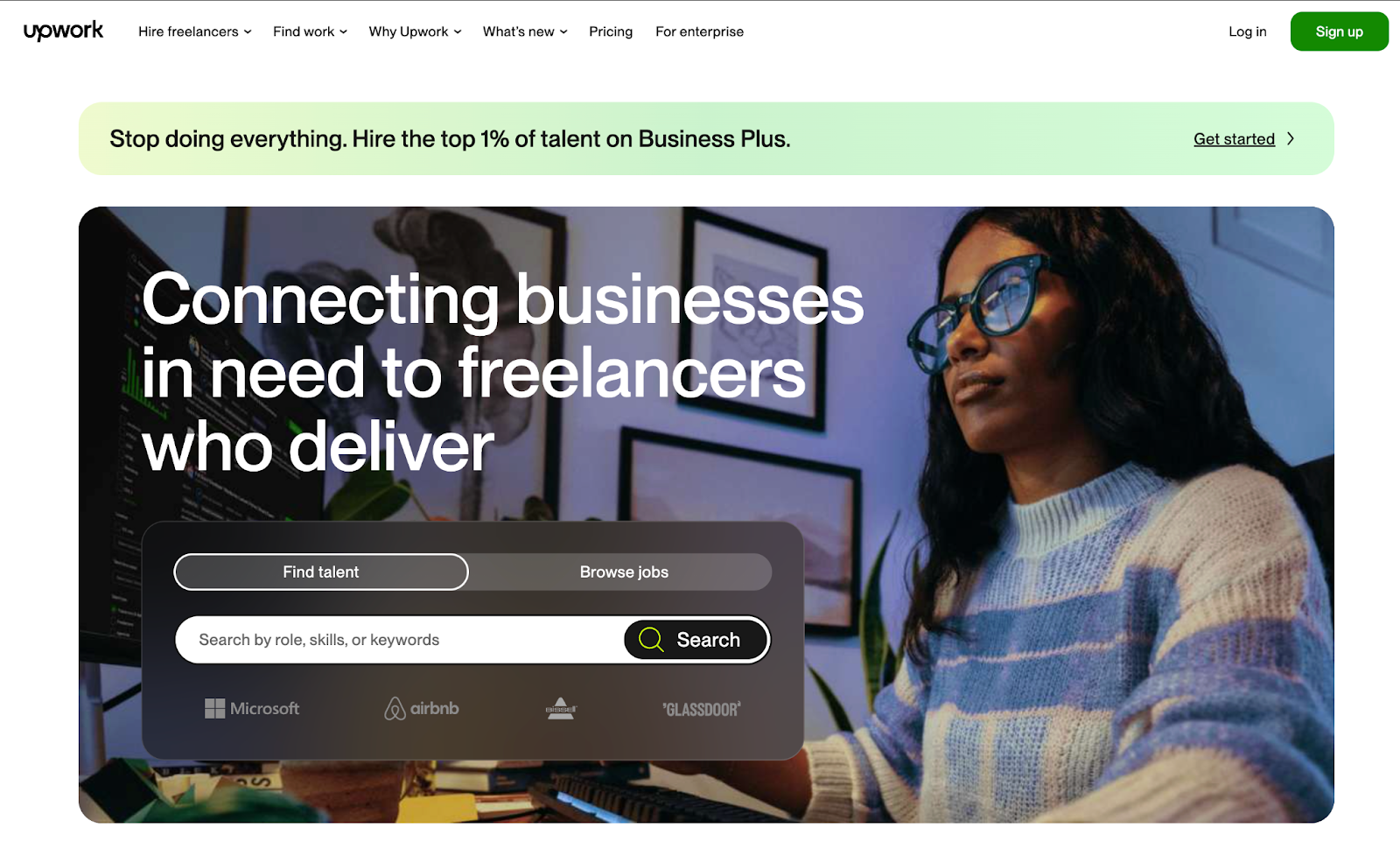
Unlike Toptal, Upwork is an open marketplace. Anyone can create a freelancer profile and start bidding on jobs. There’s no rigorous vetting process. That means you get an enormous diverse range of choice from this talent network, but you also take on the responsibility of figuring out who’s actually good among the varying skill levels. If you’re curious how Upwork compares to other freelancing platforms, the differences are worth understanding before you commit.
The workflow is straightforward: browse the project catalog, post jobs, receive proposals, review profiles and portfolios, interview your shortlist, and hire. You manage projects directly through Upwork’s platform, which includes time tracking, messaging, and milestone-based payments.
Price-wise, Upwork is more flexible. You’ll find talented freelancers charging anywhere from $10/hour to well over $100/hour. You can structure work using hourly contracts or fixed price contracts. But that flexibility comes with variance. The $15/hour developer and the $90/hour developer are sitting in the same marketplace, and telling them apart from their profiles alone can be tricky. Project success often depends on how much time you invest in screening.
Pricing Comparison: What You Actually Pay
Let’s talk numbers, because this is where founders comparing Toptal Upwork options get surprised.
Toptal charges premium rates. Most Toptal freelancers on the platform bill between $60 and $200+ per hour. Before you even start, you’ll pay a $500 deposit (which goes toward your first invoice). After that, there’s a recurring monthly platform fee of roughly $79. The rates reflect the vetting, but the price tag doesn’t include project management support, quality assurance, or any guarantee that the freelancer won’t leave mid-project.
Upwork looks cheaper on the surface. Hourly rates can start as low as $10, and fixed price projects are common for smaller jobs. But Upwork charges a service fee of around 5% on the client side, plus payment processing fees. If you’re hiring several qualified freelancers for a bigger project, those percentages add up quickly. Even small businesses feel the pinch.
And here’s the cost nobody puts in the budget: your time. The hiring process of posting jobs, reviewing profiles, running interviews, onboarding people, managing their output, and replacing them when they disappear is genuinely time consuming. As Daniel Daines-Hutt of Altar.io noted from his experience, he encountered a 75% failure rate on delivery and deadlines when first working with freelance developers. That’s a lot of wasted time and money that never shows up on an invoice.
Dedicated software development companies like Empat Tech take a different approach to pricing. Instead of hourly billing with hidden overhead, you agree on a fixed scope and a fixed price. Empat starts from $30,000 for an MVP and scales from there. That number includes software development, project management, quality assurance, and technical leadership. No surprises, no extras for coordination.
Talent Quality and the Vetting Problem
This is where the two platforms diverge the most, and where your decision about quality talent starts to get interesting.
Toptal has built its entire brand around the “top 3%” promise. The vetting process is genuinely thorough: language screening, timed technical challenges, live interviews, and a trial project that can last one to three weeks. Only a fraction of applicants make it through. For clients, that translates to a higher baseline of elite talent. You’re less likely to end up with someone who can’t do the job. According to Website Planet’s analysis, Toptal’s five-step screening process can take up to five weeks to complete, and freelancers who don’t pass the first round are disqualified entirely.
That said, the system isn’t perfect. Research found that Toptal’s matching algorithm sometimes suggested developers whose skills didn’t precisely match stated project requirements. In their testing, despite specifying React Native and JavaScript needs, two out of three suggested developers had limited mobile expertise. So “vetted” doesn’t always mean “perfectly matched.”
Upwork takes the opposite approach. With millions of Upwork freelancers in its diverse pool and no formal screening gate, quality varies enormously. Some are outstanding—senior software developers who prefer the independence of remote work. Others are beginners padding their profiles with skills they’ve barely touched. The burden of sorting through this talent pool falls entirely on you. If you decide to go this route, understanding how to hire remote developers properly becomes your most valuable skill.
That vetting burden is a real time sink. You often end up interviewing five to ten people before finding one who’s a genuine fit. And if that person leaves mid-project (which happens more often than anyone likes to admit on ongoing projects), you start the whole cycle again. Human expertise in evaluating candidates is irreplaceable, and it demands hours you probably don’t have.
Dedicated development companies sidestep this problem entirely. Instead of hiring and testing individuals one by one, you work with a team that already has a shared history of delivering products together. At Empat, for example, 85% of the developers hold strong technical degrees in IT or mathematics. You skip the screening and trial-and-error phase because the team has already been assembled, tested, and refined over hundreds of projects. That’s a proven track record you can verify, not a percentage claim you have to trust.
Pros and Cons of Toptal
What works well
Access to experienced freelancers who can handle complex projects and high stakes projects alike. The matching process is hands-off—you describe what you need, and Toptal finds candidates for you. The two week trial period reduces some hiring risk. And for short-term, highly specialized tasks (say, you need a senior machine learning engineer or a marketing manager for two months), Toptal can get someone in front of you fast.
Where it falls short
The rates are steep, and the $500 deposit plus monthly fees add up. You’re still responsible for managing the project day-to-day. There’s no built-in project management support or quality assurance. If a freelancer decides to leave, you absorb the disruption—lost momentum, context that walked out the door, and the cost of finding a replacement. For anything beyond a single-expert task, you start to feel the limits of the model.
Pros and Cons of Upwork
What works well
The sheer size of the talent pool means you can find almost any skill set, often at competitive prices. It’s great for small, well-defined one off tasks: a quick logo redesign, a WordPress fix, a data scraping script. The flexibility of hourly contracts and fixed price projects gives you room to experiment. And the platform’s built-in time tracking and payment protection add a layer of safety.
Where it falls short
No vetting means quality is a coin flip unless you invest serious time into your own screening process. Communication skills issues crop up frequently, especially with cross-timezone hires. The hiring process itself can eat days of your week. And service fees, while individually small, compound across multiple hires. For anything larger than a quick task, Upwork starts to feel like a second job you didn’t sign up for. Many founders eventually realize they need to outsource web development to a proper partner instead of managing projects on a freelance marketplace.
The Third Option: Working With a Dedicated Development Company

Freelance platforms are usually the first place founders look when they need development help. And for good reason—they’re easy to access, relatively quick, and feel low-commitment. But as projects grow in scope and complexity, the freelancer model starts to crack.
Missed deadlines, inconsistent code quality, communication gaps, people disappearing mid-sprint—these aren’t edge cases. They’re patterns. According to a World Bank report, the online freelance workforce numbers anywhere from 154 million to 435 million globally, and accounts for up to 12% of the labor force. With that kind of scale, the quality distribution is inevitably wide. Finding the right talent in that ocean takes effort, luck, and patience—three things most founders are running low on.
A dedicated product development company flips the model. Instead of you assembling and managing a patchwork team of individuals, you get a pre-built team that operates like an extension of your company. They handle web development, project management, quality assurance, and technical decision-making as a single coordinated unit.
Empat Tech, for example, has delivered over 300 projects across 23 markets since 2013. Their client list includes Fortune 500 companies and six Y Combinator startups. That kind of track record means you’re working with people who’ve seen (and solved) problems similar to yours before. As Harvard Business Review has noted, companies need to rethink their talent strategies entirely—moving beyond simple hiring toward orchestrating talent ecosystems. Dedicated teams are one way to do that.
How Empat Solves Common Freelancer Pain Points
Team continuity and accountability
Freelancers come and go. Sometimes literally mid-project, with no warning, leaving ongoing projects in limbo. Empat provides pre-coordinated teams that stay with your project from start to finish. The same developers, designers, and project managers work together throughout. That eliminates the knowledge loss, downtime, and repeated onboarding cycles that plague freelancer-dependent projects. You can explore their startup development services to see how this works in practice.
Built-in project management
On Toptal or Upwork, project management is your problem. You set priorities, track progress, run standups, and chase down blockers. Empat includes dedicated project managers who handle the project timeline, task allocation, and team communication. That means fewer things falling through the cracks and less of your week spent playing air traffic controller.
Vetted talent without the vetting headache
Every team member at Empat has a history of successful project delivery. The company maintains permanent teams with proven track records across hundreds of engagements. You don’t spend weeks screening, testing, and interviewing candidates. You start working with people who already know how to deliver together. If you’re curious about the kind of people behind the work, take a look at how Empat approaches hiring developers.
Technical leadership with CTO as a Service
A lot of early-stage startups don’t have a technical co-founder or in-house CTO. Empat offers CTO as a Service, helping you make architecture decisions, choose the right tech stack, and align your development strategy with your business goals. That’s a layer of human expertise you simply don’t get from a freelancer, no matter how talented they are individually.
Quality assurance baked into the process
Freelancers often ship code and move on. Empat’s teams follow structured workflows with code reviews and QA processes at every stage. You don’t need to micromanage quality because it’s built into how the team operates. For mission critical projects, that structural reliability matters more than any individual’s skill rating on a platform.
Transparent, fixed-price projects
Hourly contracts work against you in a subtle way: the longer something takes, the more it costs you. Empat’s project-based pricing starts at $30,000 and covers development, project management, QA, and technical leadership. You know what you’re paying before work begins. No budget surprises. No hidden coordination fees. You can contact Empat to get a transparent quote for your specific project.
This approach has delivered consistent results. Empat has been recognized among the Top 100 Fastest-Growing Companies for three consecutive years.
When to Choose Toptal vs Upwork vs a Dedicated Team
There’s no single right answer here—it depends on what you’re building, how much risk you can absorb, and how much of the management burden you want to carry.
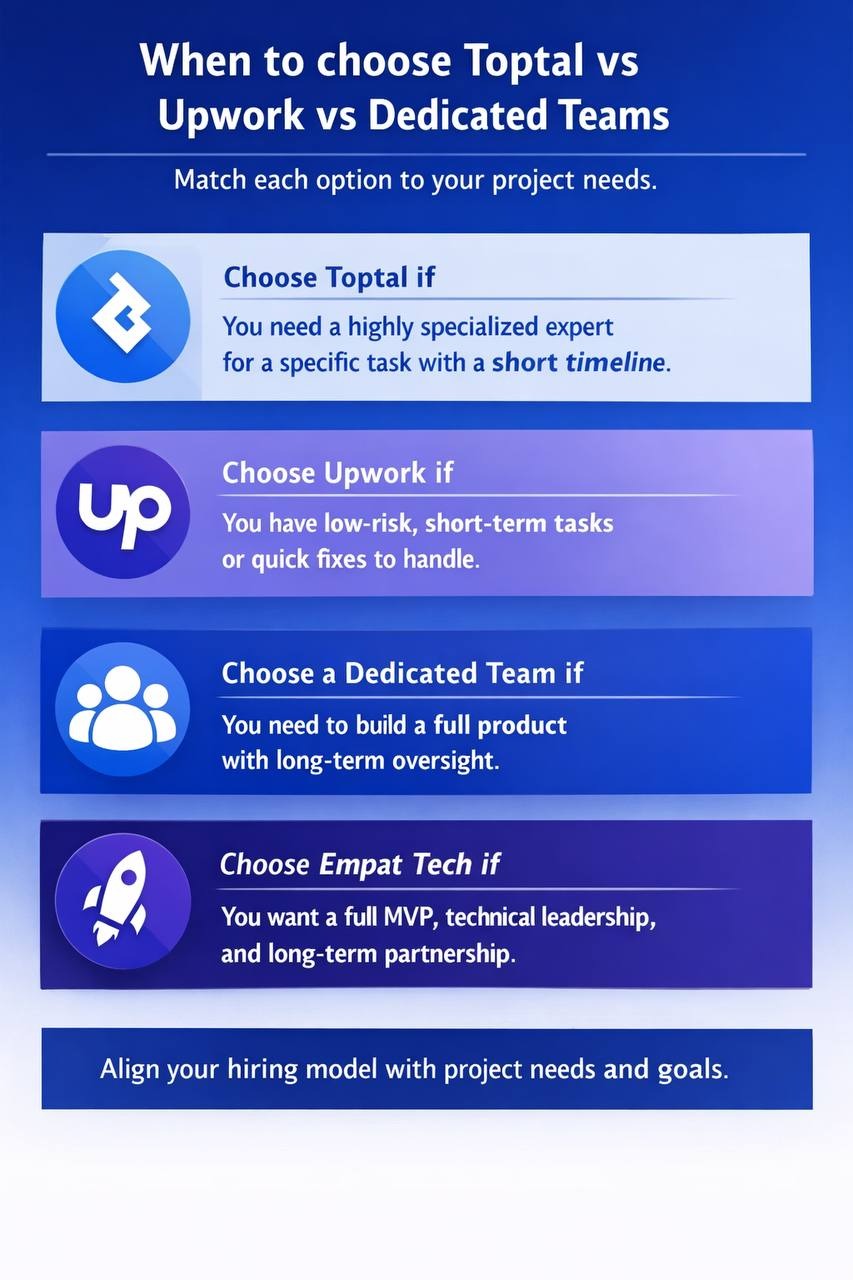
Go with Toptal when you need a single, highly specialized expert for a well-scoped task. Think: you have a clear technical requirement, a short timeline, and internal leadership already in place to direct the work. Toptal reduces the risk of hiring an unqualified freelancer, but you’re still steering the ship.
Go with Upwork when the work is tactical, low-risk, and relatively small. Design tweaks, content writing, quick bug fixes, one off tasks. Costs stay flexible, but quality depends heavily on how well you vet and manage people yourself.
Go with a dedicated development team when you’re building something that matters to your business long-term. Full products need consistency, technical direction, and ownership that goes beyond individual tasks. This model shifts responsibility from you managing a loose collection of contributors to a team that owns delivery as a unit. For high stakes projects, project success becomes predictable.
Go with Empat Tech specifically when you’re building a full MVP or scaling an existing product and need technical leadership alongside execution. Empat takes ownership of architecture, delivery, and quality while functioning as a long-term partner rather than a short-term vendor. Their custom software development services cover everything from mobile app development to full-scale AI-powered solutions.
Toptal vs Upwork vs Empat: Side-by-Side
| Feature | Toptal | Upwork | Empat Tech ★ |
|---|---|---|---|
| Model | Vetted freelancers | Open marketplace | Dedicated teams |
| Pricing | $60–200+/hr | $10–150+/hr | From $30K (project-based) |
| Vetting | Top 3% claim | None | Internal team + track record |
| Project Management | Limited | None (DIY) | Full PM included |
| Technical Leadership | No | No | CTO as a Service |
| Team Coordination | You manage | You manage | Pre-coordinated teams |
| Abandonment Risk | Medium | High | None – guaranteed |
| Best For | Single expert tasks | Quick, small tasks | Full product development |
| Track Record | Varies by freelancer | Varies widely | 300+ projects, Fortune 500 |
| Hidden Fees | $500 deposit + $79/mo | 5–10% service fees | Transparent quotes |
Final Verdict and Recommendation
Toptal and Upwork both have their place. Toptal works well when you need one senior expert for a clearly defined, time-limited engagement. Upwork fits budget-conscious, quick-turnaround work where speed matters more than long-term ownership.
The trade-off with both platforms is the same: you own the management burden. You find the people, you direct the work, you handle quality, and you deal with the fallout when something goes sideways. For small tasks, that’s manageable. As the product grows more complex, that hidden workload becomes a real drag on your progress. A Statista forecast projects the freelance platform market will reach $16.89 billion by 2029, which means the options for hiring developers will keep multiplying—but the core challenge of managing freelance talent stays the same.
If you’re building a real product—something that needs architectural thinking, consistent execution, and someone who cares about the outcome beyond their next invoice—the model needs to change. Dedicated development teams bring continuity, technical leadership, and clear accountability. The outcome matters more than the hourly rate. Toptal is more expensive but faster and curated, Upwork is cheaper but demands your time—and for serious products, neither model fully solves the ownership problem.
For founders who need a team that owns the result, Empat Tech combines permanent teams, CTO-level guidance, and transparent pricing to reduce delivery risk and help you move faster with confidence.
Talk to Empat Tech and get a clear delivery plan, realistic timeline, and transparent budget before you start investing in software development.
Frequently Asked Questions
Is Toptal better than Upwork for hiring developers?
It depends on the job. Toptal is the stronger choice for complex projects that require senior talent, as long as your budget supports rates in the $60–200+/hour range. Upwork works better for budget-conscious, simpler tasks. If you need a full product built with coordinated teamwork, a dedicated development company is worth considering over both platforms.
How much does Toptal cost compared to Upwork?
Toptal freelancers typically bill $60–200+ per hour, with an additional $500 deposit and a ~$79/month platform fee. Upwork rates range from $10–150+ per hour, with a 5% client service fee on top. Toptal costs roughly 2–4x more, but includes vetting that Upwork does not.
What are the best alternatives to Toptal and Upwork?
Other freelance platforms include Arc.dev, Fiverr, and Lemon.io. For full product development, many companies are moving toward dedicated software development partners like Empat Tech, which provides coordinated teams, project management, and technical leadership instead of individual freelancers.
What is Toptal’s top 3% vetting process?
Toptal’s rigorous vetting process involves five to six stages: language and personality screening, a skills assessment, a live technical interview, a test project lasting one to three weeks, and ongoing quality reviews. The full screening process can take up to five weeks, which is why the accepted freelancer pool stays relatively small.


