
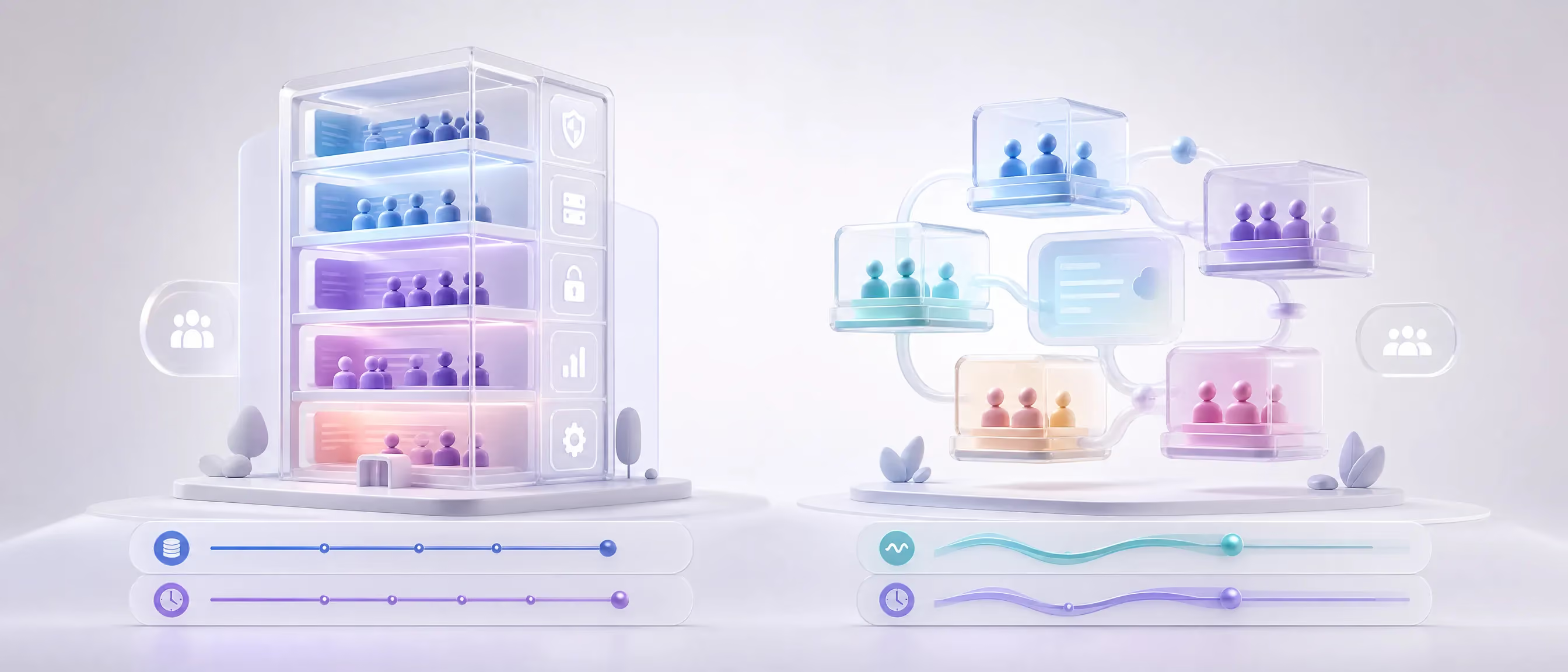
In-house vs Outsourcing AI Development: Which Is Right for You?
A practical comparison of building an AI team in-house versus outsourcing, covering cost, speed, control, talent access, risk, and the hybrid model most companies actually run in 2026.
Every company building AI products in 2026 eventually hits the same fork in the road: hire AI engineers in-house, or bring in an outside team. The right answer depends less on budget alone and more on how fast you need to ship, how much AI expertise already lives in your organization, and whether the work in front of you is a one-off build or an ongoing capability you'll need for years.
This guide compares in-house and outsourced AI development across the factors that actually decide the outcome — cost, speed, control, talent access, risk, and scalability — then walks through when each model wins, what a hybrid setup looks like, and how to vet an outsourcing partner if that's the direction you take.
In-house vs. outsourcing AI development: the short answer
Outsourcing gets you a working AI product faster and with less upfront risk, because you're renting a team that has already solved similar problems. Building in-house gives you full control and, over a multi-year horizon, can be more cost-efficient — but only if you can hire and retain scarce AI talent, which is the hard part. Most companies that ship AI successfully in 2026 don't pick one model permanently; they outsource the first product to prove it out, then bring select capabilities in-house once the roadmap is proven.
In-house vs. outsourced AI development: full comparison
| Factor | In-house team | Outsourced team |
|---|---|---|
| Cost structure | High fixed cost: salaries, benefits, equity, tooling, recruiting — largely independent of output | Variable cost tied to scope or monthly retainer; lower upfront commitment |
| Speed to first release | Slower — you're hiring and ramping a team before writing product code | Faster — an experienced team starts on your problem in weeks, not quarters |
| Control | Full control over priorities, process, and roadmap day to day | Shared control; strong partners adapt to your process, but you're coordinating across a boundary |
| Talent access | Limited to who you can recruit and retain in a tight AI labor market | Access to a bench of specialists (ML engineers, MLOps, prompt/eval specialists) without recruiting each one |
| Risk profile | Key-person risk if a hire leaves; slower course correction if the initial approach is wrong | Vendor risk (quality, communication, continuity); mitigated by contracts, IP terms, and code ownership |
| Scalability | Scaling means more hiring, which takes months per role | Scaling means adding contracted capacity, which can happen in weeks |
When does in-house AI development win?
In-house makes sense once AI is a permanent, core part of your product rather than a one-time initiative. Build in-house when the model your product depends on is genuinely proprietary and hard to hand off, when you need full-time ownership of a system that changes daily (like a live recommendation or fraud-detection engine), or when you already have the AI leadership to hire and manage a team well.
When does outsourcing AI development win?
Outsourcing wins when you need a working product validated before you commit to a full-time team, when the AI component is one part of a larger build rather than the whole company, or when the skills you need (say, a specific LLM framework or a computer-vision pipeline) are needed for months, not years.

The hybrid model: what most teams actually run
Most companies that ship AI well in 2026 don't run a pure in-house or pure outsourced model — they combine both. A common pattern: an outside team builds and ships the first version, while a small in-house group (often just a product lead and one or two engineers) owns the roadmap, data, and vendor relationship. As the product matures and specific pieces prove durable, the company selectively brings those functions in-house, one role at a time, instead of front-loading a full team before knowing what to hire for.
This staged approach avoids the two most common failure modes: hiring an expensive in-house team before you know what to build, or outsourcing indefinitely and never developing internal AI capability at all.

What does AI development actually cost?
Cost is the factor most founders ask about first, and the honest answer is that it depends heavily on scope, so treat any single number you see quoted online with caution. Directionally: a fully in-house AI team carries a large fixed annual cost — salaries, benefits, recruiting, and ramp-up time before anyone ships — that exists whether or not the product succeeds. Outsourced engagements are typically scoped and billed against a specific deliverable or a monthly retainer, which is why they carry a lower upfront commitment, even though the effective hourly cost of senior outsourced talent isn't necessarily cheap.
The AI talent market makes this comparison sharper than it would be for general software work. Deloitte's 2026 State of AI in the Enterprise research found that only around one in five organizations consider their talent highly prepared for broad AI adoption — meaning the in-house option isn't just expensive, it's often gated by whether you can hire the people at all. For a detailed breakdown of what different AI project types actually cost, see our AI development services overview.
How to choose an AI development partner
If you decide to outsource, the partner you pick matters more than the pricing model. Look for a team that can show real delivery history on similar problems (not just a client logo list), that will put engineering leads — not just account managers — in front of you during scoping, and that is explicit about IP ownership and code handoff before you sign anything.
We put together a deeper comparison of agency and freelance options in AI Development Company vs. Freelance AI Engineer, and a full breakdown of vetted options in our guide to top AI software development companies.

How Empat approaches build vs. buy
We typically see clients arrive at this decision from one of two directions: a startup that needs to validate an AI feature fast without hiring a full ML team, or an enterprise team that has in-house engineers but lacks specific AI expertise (RAG, agents, evaluation) for a defined project. In both cases, our approach is to scope the actual technical problem first — not just staff a generic 'AI team' — and be upfront when a client's use case doesn't need a bespoke model at all. You can see how we structure AI engagements on our AI MVP development services page.
FAQ
Is it cheaper to outsource AI development than to build an in-house team?
In the first one to two years, yes for most companies — outsourcing avoids the large fixed costs of salaries, benefits, and recruiting that an in-house team carries regardless of output. Over a longer, multi-year horizon with continuous AI work, the math can shift back toward in-house, which is why many companies use outsourcing to start and bring capability in-house selectively later.
What are the risks of outsourcing AI development?
The main risks are quality variance between vendors, communication overhead across time zones and processes, and continuity if the vendor team changes. These are manageable with a clear contract, defined IP and code-ownership terms, and a partner that documents architecture decisions as they build — not just at handoff.
Can you outsource AI development and still keep your IP?
Yes, if the contract says so explicitly. Reputable AI development partners transfer code, model weights, and documentation to the client as standard practice. Confirm this in writing before the engagement starts, including who owns any fine-tuned models or proprietary data pipelines built during the project.
When should you hire an in-house AI team instead of outsourcing?
Hire in-house once AI is a permanent, core part of your product rather than a single project, once you need daily iteration on a live system, and once you have the technical leadership to manage AI specialists well. Without that leadership in place, in-house hiring often stalls before it delivers.


