

Outstaffing Services vs Staff Augmentation vs Outsourcing (US Guide 2026): Pricing, Control & Risk Checklist
Staff augmentation vs outsourcing refer to the same category, although they have absolutely different approaches.

You've probably seen both terms in vendor proposals and job postings. Staff augmentation vs outsourcing refer to the same category, although they have absolutely different approaches. If you choose the wrong one for your project, you face a threat of poor project quality, unexpected invoices, and even a codebase that belongs to someone else.
The confusion is understandable. Both staff augmentation and software development outsourcing models involve external software engineers who probably promise fast delivery. But their organization processes are absolutely different. The list of core differences includes: who leads the team, who is responsible for the task, and who bears responsibility if schedules are delayed.
To be short: outstaffing means loyal team members working inside your process and controlled by your instructions. Outsourcing signifies handing a defined project to a contractor who manages delivery on their end. Understanding that distinction up front is what keeps a $60,000-budget project from gradually escalating to a $120,000 one.
US product leaders in particular tend to underestimate how much the engagement model shapes the overall success of their project. We've created the outstaffing vs outsourcing guide that breaks down clearly all the peculiarities of these models, including a risk checklist you can use before signing anything.
Outstaffing vs outsourcing: At a Glance
Before getting into the details, here's a quick comparison of how these models stack up across the factors that matter most.
Both outstaffing and outsourcing serve distinct use cases. The right fit depends on how much control you want to keep, what you're building, and how long you need external support. We'll describe each model in detail below.

What's outstaffing?
Outstaffing is when you hire external specialists, such as developers, designers, or quality assurance testers, who join your team and work under your management. You direct the whole working process. You run the standups. You define the sprint goals. The outstaffing vendor handles employment contracts, benefits, and HR overhead. You get the output.
Think of it like adding headcount without adding payroll complexity. The engineers work for you in practice, even if they're legally employed by someone else. That's why outstaffing is often described as team extension because in such a case, you're not delegating a project, you're extending your capacity.
This model is also the closest equivalent to what US companies typically call staff augmentation. The terminology varies by market, but the mechanics are essentially the same: external talent, your direction, your process.
What's staff augmentation?
Staff augmentation is the term most commonly used in the US market to describe hiring external specialists who temporarily or long-term extend your internal team. Instead of going through lengthy recruitment cycles, companies bring in vetted engineers, designers, or product specialists through an external partner and plug them into their existing workflows.
The appeal is largely operational. Hiring senior engineering talent internally can take months. Filling technical roles in the US often takes 40–60 days or more. What's more, it doesn't include onboarding time. Staff augmentation reduces this delay significantly by giving companies access to ready-to-start specialists.
This model is especially attractive for companies facing growth bottlenecks, temporary workload spikes, or specialized talent gaps. Instead of committing to permanent hires, teams can scale up or down more flexibly while keeping strategic and technical control in-house.
What's outsourcing?
Outsourcing means you hand a scoped project to a vendor and they deliver it. You define the requirements. They figure out how to build it. Their project manager coordinates their team. You review milestones and accept or reject deliverables.
Global IT outsourcing tends to constant growth. Industry forecasts estimate that total market revenue will grow to $806.56 billion by 2030. It means that external technology partnerships have become a core growth strategy for companies that need engineering and digital operations.
[Editor note: embed Statista chart "IT Outsourcing Revenue Worldwide" here.]
This model works well when you know exactly what you want, you don't have strong opinions about how it gets built, and you'd rather not manage a team. The trade-off is less visibility into daily progress and less flexibility mid-project. Changing scope in the middle of an outsourced engagement is rarely painless.
A common source of frustration is contract ambiguity, especially around IP ownership and code access. The vendor may build the solution, but unless contracts are explicit, ownership terms can become unclear. This is one of the main reasons companies should carefully review outsourcing contracts before engagement.
Pricing comparison of outstaffing vs outsourcing
Outstaffing pricing
Outstaffing is usually priced per person, per month or per hour. Rates vary by role, seniority, and geography.
For example, a mid-level React developer in Eastern Europe might run $35–55/hr. A senior full-stack engineer with seven years of experience can reach $70–85/hr. Frontend specialists, ML engineers, and DevOps engineers tend to sit at the higher end of the range.
What's included at that staff augmentation rate: the engineer's time, a basic HR and payroll layer, and usually some overhead for tooling. On the contrary, outstaffing does not include project management, product strategy, or architecture guidance. If your team already has a strong PM and tech lead, that's fine. In case your project doesn't have such experts, probably outstaffing is not your best choice.
At the same time, make sure that you take into account the hidden costs. The largest one deals with the onboarding time. Every new outstaff hire needs context, namely your codebase, your conventions, your product roadmap, etc. You need to have from two to four weeks before they're operating at full speed. That ramp-up period is a real cost for your business, even if it doesn't appear on an invoice.
Outsourcing pricing
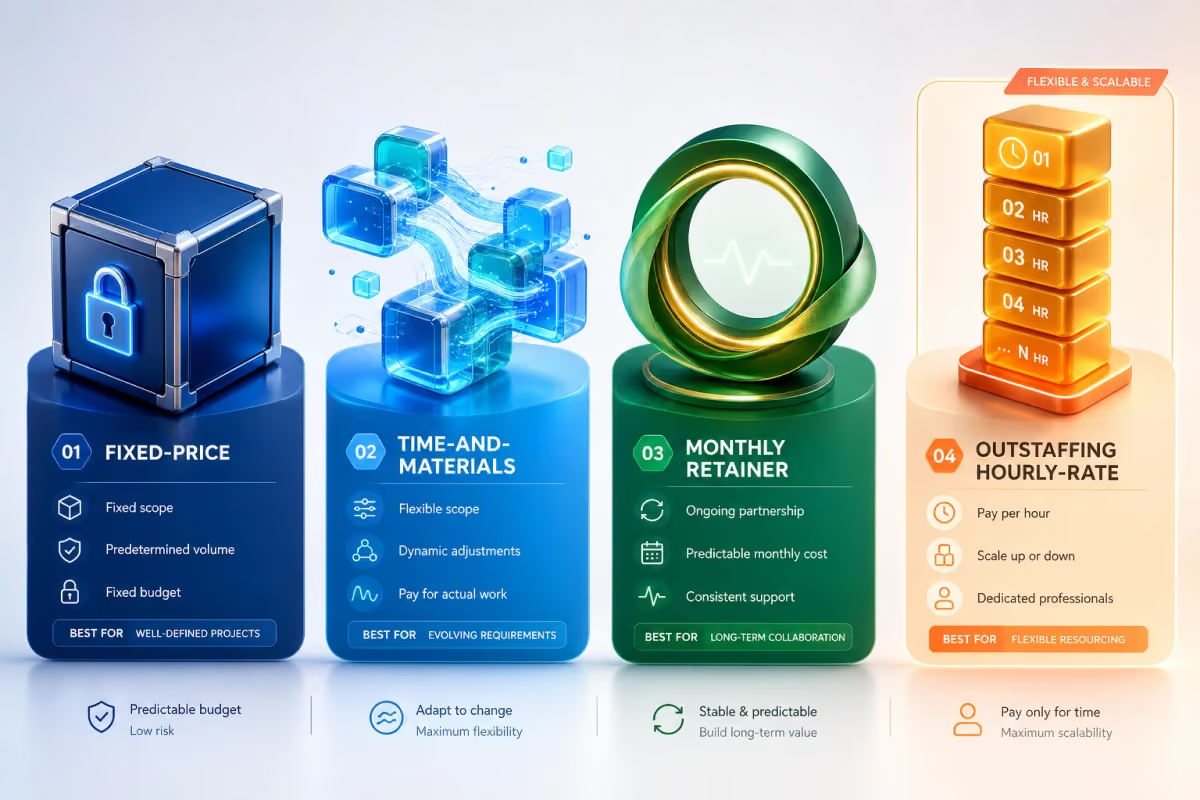
Outsourcing is typically priced using one of three models: fixed-price projects, time-and-materials, or monthly retainers. Fixed-price contracts are common for clearly scoped initiatives because they create budget predictability upfront. However, that predictability only works when requirements are well-defined and relatively stable before development begins.
Having over 10 years of experience in software outsourcing, we know for sure that software projects rarely stay static. New priorities emerge, user feedback changes requirements, and technical components surface during implementation. As a result, fixed-scope engagements often lead to change requests that increase both budget and timeline. In such a way, a project initially estimated at $50,000 can expand significantly once additional features, integrations, or revisions are introduced mid-delivery.
The second type of outsourcing pricing is the time-and-materials model. It offers more flexibility because you pay for the actual hours that developers worked on your projects. Such an approach is more suitable for evolving products. However, the total cost becomes less predictable over time.
A third option is the monthly retainer model. It is increasingly common for long-term product partnerships of outsourcing. Under this structure, the client pays a monthly fee for reserved team capacity or ongoing support. For example, a company may retain a dedicated product squad, design support, or maintenance team for a fixed monthly budget. This model combines some of the predictability of fixed pricing with the flexibility of time-and-materials. In such a way, it is a useful outsourcing pricing model for businesses that need continuous development, feature releases, or post-launch iteration.
Empat has a transparent approach to pricing. You can use our online calculator to estimate your project cost before starting a conversation.
Outstaffing vs outsourcing: which model is cheaper?
It depends on what you're building. For ongoing work, iterating on a product, scaling a team, maintaining infrastructure, outstaffing is almost always more cost-efficient over 6+ months. For one-time, clearly defined projects, outsourcing can be more predictable, provided the scope holds.
The clearest pattern: companies start with outsourcing because it feels lower-risk. As their product matures and they need continuity, they shift toward outstaffing. So, both models have a place.
Best-fit scenarios of staff augmentation and outsourcing
Choose outstaffing if…
- You already have a product team and need to add capacity quickly
- Your project involves ongoing development across sprints, not a single delivery
- You want to keep technical decisions in-house
- You need specialists for a specific stack, for example, a Node.js or React Native developer without hiring full-time
- You're scaling faster than your HR pipeline can support
Outstaffing works especially well for US companies building on Eastern European or LATAM talent pools. Time zone overlap is manageable. At the same time, the hourly rates are significantly lower than equivalent US hires without sacrificing experience level.
Choose Outsourcing If…
- You have a clearly defined project with stable requirements
- You don't have internal engineering management capacity
- You need a complete deliverable, such as MVP development, integration, or a microservice, that has a fixed budget
- You want the vendor that is responsible for the result
- You're testing a new product area and want to limit internal overhead
The sweet spot for outsourcing is bounded projects where you can write detailed specifications before work starts. When requirements change frequently, the model strains. Every pivot becomes a negotiation.
If you're unsure how to evaluate vendors for either model, Empat's guide on how to hire remote developers walks through the evaluation framework in detail.
Staff augmentation vs outsourcing choice: risk checklist
Businesses may underestimate risks, until something goes wrong. We recommend running through these areas before you sign any engagement contract. The two minutes you spend now can save months of legal headaches.

There are a few areas worth extra attention:
- IP assignment: In outstaffing, IP clauses should appear in each contractor's agreement, not just the master services agreement with the vendor. If a developer isn't named in the IP assignment, it might be a problem.
- Code access offboarding: Define this before day one. Who revokes GitHub access? When? An offboarding checklist prevents the scenario where a former contractor still has read access to your repo six months after they left.
- SLA definitions: "Weekly updates" means different things to different people. Specify format (Slack message, written report, async video), frequency, and who the recipient is. Vague SLAs are a common source of friction at the three-month mark.
Questions to ask before you choose staff augmentation vs outsourcing
The sales process tells you how a vendor wants to be perceived. These questions tell you how they actually operate. Ask them before the proposal stage, not after.
One signal that separates good vendors from great ones: how they answer the attrition question. A vendor who says "we have very low turnover" without data is guessing. A vendor who says "our average engineer tenure is 2.8 years, and here's our knowledge transfer protocol" has thought about continuity.
According to MBO Partners research, the number of full-time independent professionals in the US more than doubled between 2020 and 2024. The talent market is competitive. Vendors who retain good engineers over the long term are actively managing something that's genuinely hard. That's worth paying attention to.
How Empat Can Help
Empat works with US product teams across different stages of growth. The development company offers flexible engagement models depending on how much control, speed, and internal capacity a company needs. Instead of a one-size-fits-all approach, Empat provides IT outstaffing services, software development outsourcing, as well as dedicated product teams. Such a combination allows companies to choose the setup that best fits their current stage.
Since 2013, Empat has delivered more than 300 projects across 23 markets. Most teams are onboarded within one to two weeks, with a defined setup process. It includes communication standards, delivery governance, and clear reporting from day one. The goal is predictability in execution, regardless of the engagement model.
Empat also provides CTO-as-a-service for companies that need technical leadership without hiring a full-time executive. This includes architecture decisions, team structuring, and long-term engineering strategy aligned with product goals.
If you're not sure whether outstaffing or outsourcing fits your current stage, schedule a free strategy call with Empat to walk through your situation and get a clear recommendation.
The cheapest project management you'll ever do
Outstaffing gives you control and flexibility. Outsourcing gives you a defined deliverable with someone else managing delivery. Neither is universally better, what matters is matching the model to the actual project.
If you have product leadership and need capacity, outstaffing extends your team without the overhead of full-time hiring. If you have a bounded scope and want to hand off delivery accountability, outsourcing handles that effectively.
The real cost of choosing wrong isn't just the invoice. It's the project delays, the scope fights, and the rework that comes from misaligned expectations. Taking thirty minutes to evaluate the model before you sign is the cheapest project management you'll ever do.
Ready to figure out which model fits your team? Talk to Empat and get a clear answer without a sales pitch.
FAQ
Is outstaffing the same as staff augmentation?
Mostly yes. In the US market, the standard term is staff augmentation. In Eastern European and LATAM markets, where much of the engineering talent is sourced, outstaffing is more common. Both describe the same arrangement: external specialists working under your management within your existing processes. The mechanics are identical; the terminology varies by region.
When is outsourcing better than outstaffing?
Outsourcing is a better fit when you have a clearly scoped project, limited internal engineering management capacity, and a fixed budget. If you need a complete deliverable such as a new microservice, an MVP, or a third-party integration, and you're comfortable handing delivery accountability to a vendor, outsourcing is the cleaner model. For iterative, ongoing work, outstaffing almost always wins.
What risks should I check in an outstaffing contract?
The five areas that matter most: IP assignment (ensure it's in each contractor's agreement, not just the master services agreement), NDA coverage for individual team members, data access controls and offboarding protocol, communication SLAs with defined format and frequency, and a clear process for handling team member replacement if someone leaves mid-project. The risk checklist in this article covers each of these in the contract context.
How much does outstaffing cost per developer in 2026?
Mid-level engineers from Eastern Europe or LATAM typically run $35–55 per hour. Senior full-stack engineers with seven-plus years of experience reach $70–85 per hour. Specialized roles, ML, DevOps, and senior frontend, sit at the higher end. Rates include the engineer's time, a basic HR and payroll layer, and tooling overhead. They don't include project management, product strategy, or architecture guidance, which stay on your side. Beyond the hourly rate, budget two to four weeks of onboarding time per new hire; that ramp-up doesn't appear on an invoice but is a real cost.


