
Toptal vs Fiverr in 2026: Honest Breakdown of Costs, Vetting & Best Use Cases
Compare Toptal vs Fiverr in 2026 — pricing ($5 gigs vs $200/hr), vetting, pros & cons. Find out which platform fits your project and when to skip both.

The freelance market in 2026 is a bit like choosing a restaurant. On one end, you've got the fast-food counter: quick, cheap, and occasionally surprising (in both good and bad ways). That's Fiverr. On the other end, there's the prix fixe dinner: curated, vetted, and priced like they know you have a deadline. That's Toptal. Understanding the key differences between these two freelance platforms is worth your time before spending any money.
For startups and growing businesses, this choice comes up a lot. Do you spend $5–$50 on a gig and hope for the best? Or commit $60–$200 per hour for top tier talent and hope the budget holds?
Fiverr works well for quick turnaround tasks and low-cost jobs. Need a landing page, a set of social media graphics, or a minor website update? You can have someone working on it within the hour. The trade-off is predictability. With no formal screening, results can swing from excellent to… well, let's just say "creative." Reviews help, but they only tell part of the story.
Toptal goes the other way entirely. Every freelancer goes through a multi-stage vetting process that can take weeks. If your project calls for specialized skill sets, Toptal delivers reliable, experienced freelance talent. But you're usually hiring one person at a time, which means if your project needs a designer, a developer, and a PM, you're doing the coordination yourself.
And then there's the third scenario nobody talks about at first: what happens when your project outgrows individual freelancers entirely? When you need a team that handles design, development, and product management together without you playing air traffic controller every morning? That's a different conversation, and we'll get into that too.
According to a McKinsey survey, 60% of companies cited the scarcity of tech talent as a key barrier to their digital transformation. So the question of where and how you hire isn't just a cost decision—it directly affects whether your project moves forward or stalls.
If you're wondering whether your project has outgrown individual freelancers, Empat offers a free 5-minute assessment to help you figure out if a dedicated development team makes more sense for your situation.
Before we get into the project details, here's a quick side-by-side of how Fiverr, Toptal, and Empat Tech stack up.
Quick Toptal vs Fiverr vs Alternative Comparison at a Glance
At a high level, Fiverr is fast and budget-friendly but unpredictable. Toptal offers vetted, highly skilled freelancers, but usually only for individual roles. Empat Tech fills the gap when you need coordinated teams, ongoing project management, and full product ownership. Both Toptal and Fiverr serve different target audiences, so the best fit depends entirely on what you're building.
| Feature | Fiverr | Toptal | Empat Tech ★ |
|---|---|---|---|
| Model | Gig marketplace | Premium freelancers | Dedicated dev teams |
| Pricing | $5–$6,000/project | $60–200+/hr | From $30K (project) |
| Vetting | None (self-reported) | Top 3% claim | Internal + 300+ projects |
| Service Categories | 700+ (broad) | Dev, Design, Finance, PM | Full-stack product dev |
| Project Management | None (DIY) | Minimal | Full PM included |
| Design + Dev Integration | Separate gigs | Hire separately | Integrated teams |
| Best For | Quick, cheap tasks | Expert individual work | Full product builds |
| Time to Start | Instant | 1–2 weeks | 1–2 weeks |
| Platform Fees | 5.5% + $2 (under $75) | $500 deposit + $79/mo | None (project-based) |
| Quality Guarantee | Reviews only | 2-week trial | Project milestones |
If you're managing multiple freelancers and starting to feel the coordination overhead, a hire dedicated developers team can reduce hidden costs, simplify communication, and deliver consistent results.
What Is Fiverr?
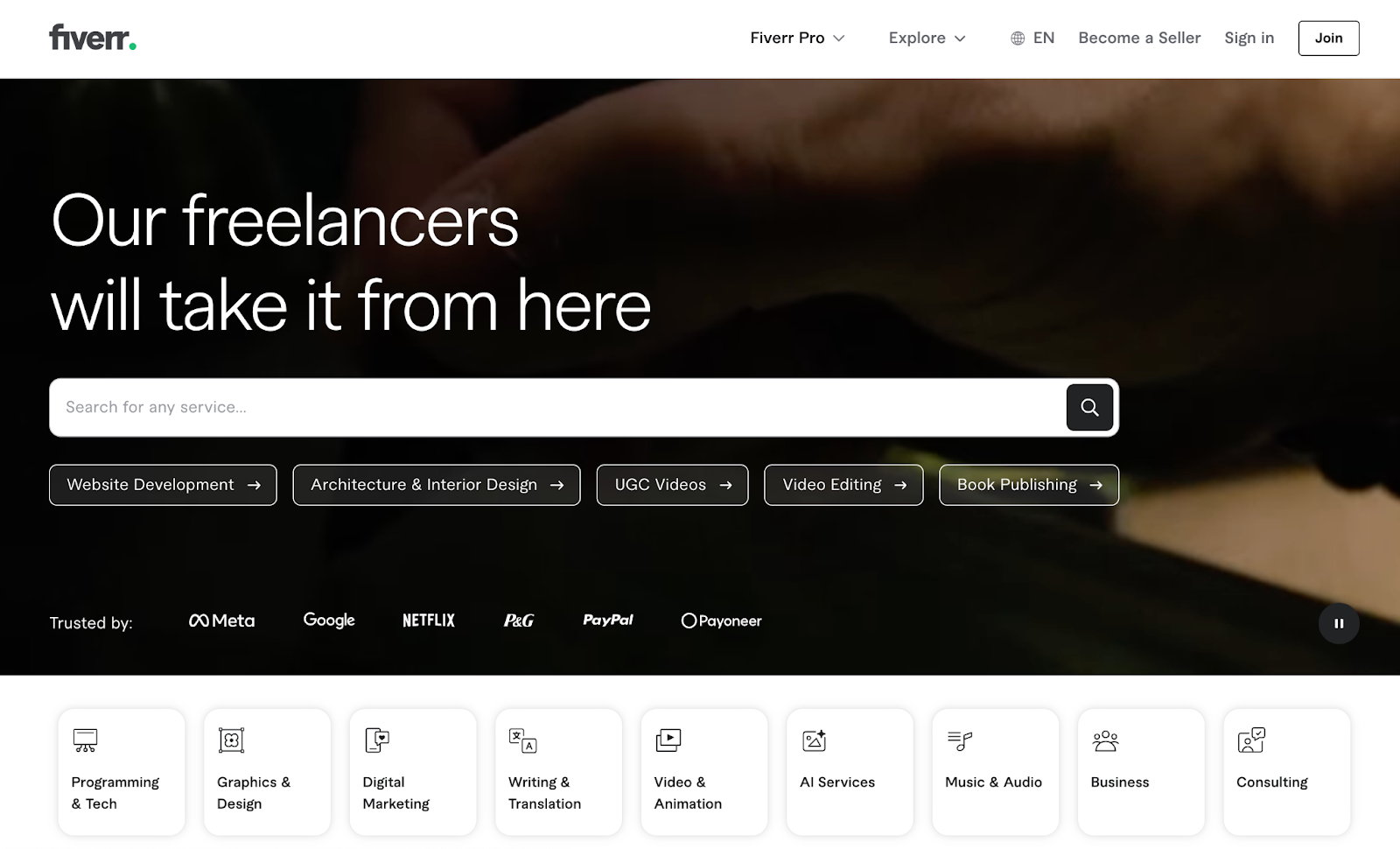
Fiverr is one of the largest freelance marketplaces in the world, with more than 3.8 million sellers. It's built for speed and affordable solutions. If you need a logo, a landing page, social media graphics, or a small website fix, Fiverr can get someone on it almost immediately. Most startups discover it early because, honestly, who doesn't love the idea of getting a logo for the price of lunch?
Fiverr's Gig-Based Model Explained
Fiverr runs on a gig economy model. Freelancers create listings (called "gigs") with set price points and deliverables. You pay upfront, the freelancer does the work, and you get the result. Simple.
This setup is great for specific tasks that don't need ongoing management. Need a one-off banner for your Facebook ad? Perfect. The downside is consistency. Since anyone can list a gig and offer services, quality varies widely. You might find talented freelancers on your first try, or you might burn through three before getting something usable. It's a bit like thrift shopping—sometimes you strike gold, sometimes you leave empty-handed. If you're weighing your options, we've also compared Fiverr alternatives to help you decide.
700+ Service Categories
Fiverr covers a broad spectrum of digital services: graphic design, copywriting, video editing, digital marketing, software development, data entry, voice-overs, and hundreds more. For businesses seeking quick, specialized tasks handled, this variety is a real advantage.
The catch? Larger projects that need multiple disciplines (say, a designer and a developer and a copywriter) mean you're coordinating several freelancers across multiple platforms yourself. And if you've ever tried to get three independent contractors to agree on a color palette, you know that's its own kind of project management.
Fiverr Pro and Fiverr Business
For businesses that want more reliability, Fiverr offers Fiverr Pro—a curated tier with hand-screened freelancers and verified portfolios. Fiverr Pro rates typically start around $75/hr and go up from there, making it a step toward professional services quality. Fiverr Business ($149/year) adds team collaboration tools and project tracking, along with additional services for team-based workflows.
These upgrades help, but they still don't give you a project manager, integrated teams, or anyone who's accountable for the whole picture. You're still assembling the puzzle yourself.
Seller Levels
Fiverr uses a tier system to help buyers gauge reliability. New freelancers are just starting out. Level 1 and Level 2 sellers have proven themselves over time. Top Rated Sellers have a strong track record. Reviews and ratings help, but they don't replace formal vetting. A freelancer who shines on a $50 logo project might struggle when you hand them something more complex. You're still the one doing the quality check.
What Is Toptal?
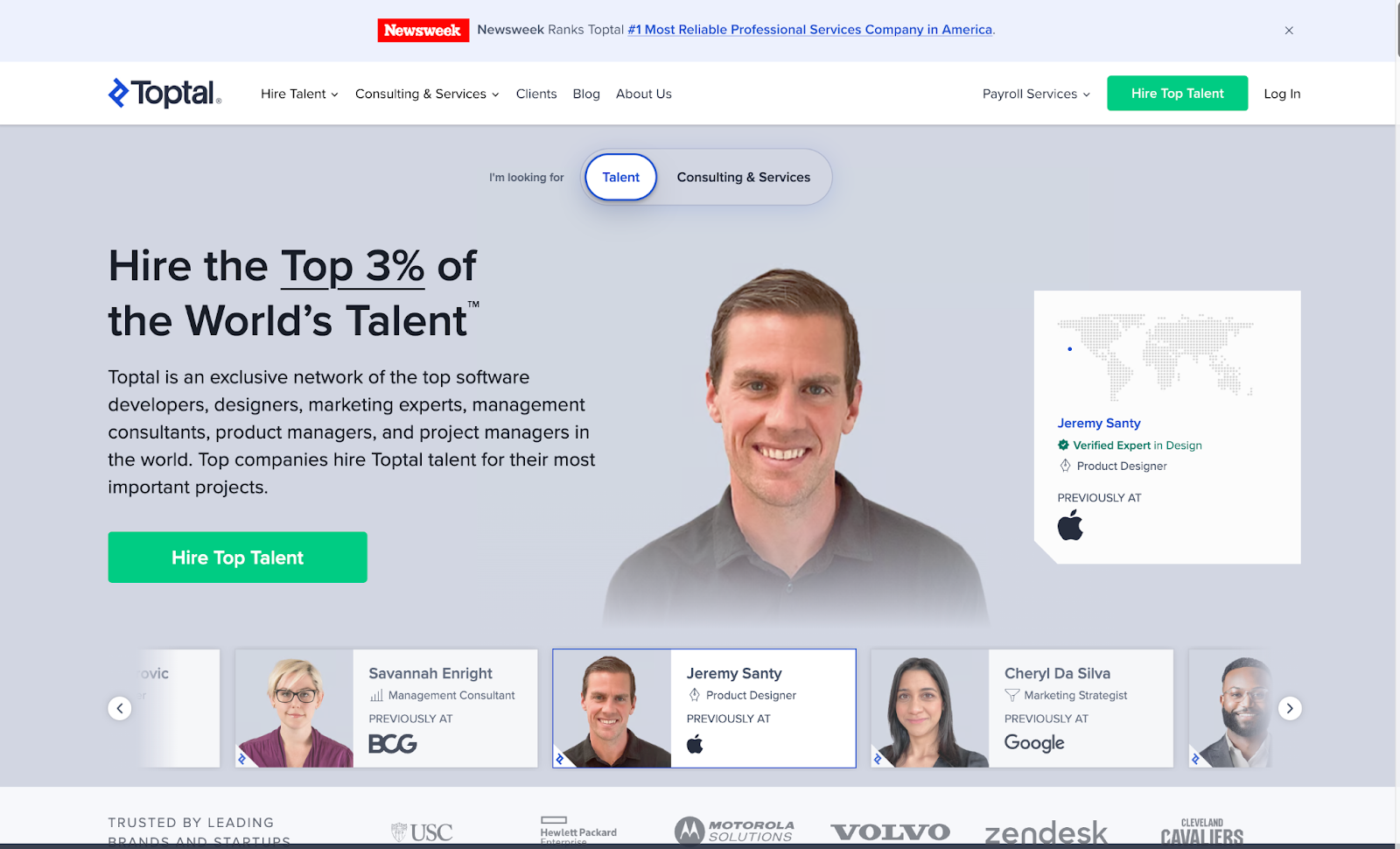
Toptal is a premium freelance platform that connects businesses with highly skilled professionals for specialized technical projects. Unlike Fiverr's open marketplace approach, Toptal guarantees vetted expertise. Companies turn to Toptal when their project requires serious technical chops, design leadership, or financial experts where a mistake isn't just annoying—it's expensive. If you're exploring the market, we've put together a full breakdown of Toptal competitors worth considering.
As Toptal CEO Taso Du Val has explained in interviews, the idea came from a specific frustration: existing freelance platforms had plenty of options, but non-technical founders had no reliable way to tell who was actually good. Toptal was built to take that guesswork out of the hiring process.
Toptal's Vetting Process
Toptal positions itself as an exclusive network and exclusive talent pool that only accepts about 3% of applicants. For clients, that means the Toptal freelancers you're matched with have already been thoroughly screened. This is one of the areas where Toptal excels. A startup looking for a senior React developer, for example, can expect someone with verified experience and strong communication skills, not just an impressive-looking profile.
This selection process lets you focus on your product instead of spending days evaluating candidates. The trade off is cost: Toptal's premium rates start around $60/hr and can top $200 for highly specialized skills.
5–6 Stage Screening Process
Getting into Toptal is no quick application. The rigorous vetting process includes language assessment, technical interviews, skill reviews, live problem-solving exercises, and test projects. The whole hiring process can take up to five weeks.
For clients, the payoff is reduced hiring risk. You can be reasonably confident that the person you're working with can handle complex projects without constant hand-holding. The screening process also keeps quality consistent across the platform—something that other platforms and open marketplaces can't guarantee.
Categories
Toptal focuses on four core categories: software developers, product/UI-UX designers, finance experts, and project managers. So if you're building a fintech MVP, you could hire a backend developer, a UX designer, and a financial expert all through Toptal.
The limitation? You're still hiring individuals for niche roles. If your project scope spans multiple disciplines, you're the one making sure the designer and developer are actually talking to each other. Toptal gives you excellent pieces of best talent, but you assemble the puzzle.
Pricing: Fiverr vs Toptal Costs Breakdown
Price is often the first thing that makes startups pick one freelance platform over the other. It's also the reason many teams switch platforms after their first few projects. Fiverr and Toptal sit at opposite ends of the spectrum, and their pricing models reflect that. Understanding project costs upfront can save you from unpleasant surprises later.
Fiverr Pricing
Fiverr uses fixed price services. Freelancers post their gigs with clear deliverables and set prices. A basic logo might cost $25. A more involved website project could reach $6,000 or more.
Buyers pay a 5.5% in service fees on every order, plus $2 for purchases under $75. On the surface, costs feel predictable. In reality, projects often expand. Extra revisions, added features, or tighter deadlines usually mean buying additional services. That $200 website project can quietly become an $800 one once you add mobile optimization, a few more pages, and a round of "can you just tweak this one thing?" It's a common pattern with low cost gigs.
Toptal Pricing
Toptal charges premium rates by the hour, typically between $60 and $200+, depending on the role and experience level. Hiring AI developers, for instance, can push well past the $200/hr mark. Clients also pay a $500 refundable deposit and a $79 monthly subscription fee.
This works well for short term projects or when you need a senior expert fast. The challenge is estimating total cost. Long term projects require careful hour tracking, and even small scope changes can blow a budget. A two-week project that turns into three months of hourly billing is a financial surprise nobody enjoys. If you're a startup weighing different models, our guide on how to outsource software development for startups covers the trade-offs in detail.
Hidden Costs on Both Platforms
Both Toptal and Fiverr carry costs that don't show up in the initial price tag. On Fiverr, you often end up managing multiple freelancers across design, development, and testing. The time you spend coordinating, reviewing, and fixing mismatches rarely appears in anyone's budget—but it directly inflates your true project costs.
On Toptal's side, the platform applies an undisclosed markup on freelancer rates—estimated at 30–50%. You're paying premium prices without full transparency on how that number breaks down.
Empat Tech takes a different approach with project-based pricing and no hidden fees. Costs are defined upfront, project scope is fixed, and delivery includes project management and ongoing support through its software development outsourcing services.
Quality and Vetting Comparison
Quality is where the gap between Toptal and Fiverr gets obvious. Both platforms connect you with freelancers, but how they filter for quality is completely different. If you're hiring for anything more than a simple one-off task—especially high value projects or long term engagements—this matters a lot.
A Gartner survey found that IT executives identified talent shortages as the most significant barrier to adopting 64% of emerging technologies. When finding good freelance talent is already hard, the platform you use to find it matters more than most people realize.
Fiverr's Open Marketplace
Fiverr is open to everyone. Anyone can create a profile, list a freelance service, and start taking orders. There's no screening process before a freelancer goes live. Your main quality signals are reviews, ratings, and seller levels.
For simple or low-risk tasks, this is fine. If a logo doesn't hit the mark, you hire someone else for $30 and move on. For more complex projects that have detailed project requirements, reviews only tell part of the story. A freelancer with five stars for basic social media graphics may not be equipped for a full website redesign. You usually need to test a few people before finding a reliable fit.
Toptal's Screening Process
Toptal goes deep. Freelancers must pass language checks, technical interviews, live problem-solving sessions, and test projects before they're accepted. The full screening process can take up to five weeks, allowing clients to trust that only elite freelancers make it through.
The result is a smaller but more reliable talent pool of top talent. Companies work with professionals who meet consistent standards, which reduces hiring risk for complex or high-stakes work. The downside? Speed and flexibility. You can't start instantly, and if you need to swap a freelancer mid-project, that's another matching process.
Quality Comparison Table
| Factor | Fiverr | Toptal |
|---|---|---|
| Vetting process | None | Multi-stage screening |
| Quality signal | Reviews and ratings | Screening + trial period |
| Risk level | Varies by freelancer | Lower, more predictable |
| Best use case | Quick gigs, low-cost work | Complex or high-value projects |
| Time to hire | Immediate | Several days to weeks |
In short: Fiverr favors speed and choice, Toptal prioritizes consistency and skill. The right pick depends on how much risk your project can absorb and how much time you're willing to spend managing quality.
Pros and Cons of Fiverr
Fiverr is at its best when you need something done quickly and cheaply, and the task itself is straightforward enough to verify. It's built for quick gigs and cost effective execution on clearly defined work.
Fiverr Pros
Budget-friendly entry point. You can test ideas without a large upfront commitment. Getting a logo concept for $25 beats spending $2,000 before you've validated whether customers even care about your brand. Fiverr is one of the most cost effective ways to get small tasks done.
Massive variety. With 700+ categories covering everything from graphic design to digital marketing, you can find freelancers for design, content, marketing, and basic development in one place. It's a one-stop shop, even if the quality of each aisle varies. You can also find a web developer on the platform for smaller website projects.
Instant access. You can browse profiles, compare offers, and kick off a project the same day. No interviews, no onboarding calls, no waiting. For quick turnaround tasks, that speed is hard to beat.
Transparent pricing per gig. Each listing shows a fixed price and delivery scope before you commit, so you know what you're getting into—at least initially.
Fiverr Cons
No vetting process. Anyone can sign up and start selling. Quality depends entirely on the individual, and sorting through profiles takes time you probably don't have. Compare that to other platforms with formal screening, and the risk gap becomes clear.
Results are inconsistent. A freelancer who excels at $50 tasks may struggle with larger or more technical projects. Scaling up with the same person isn't always realistic, which is a common trade off with open marketplaces.
The gig model limits continuity. When your project grows or pivots, you often need to rehire, renegotiate, or start from scratch with someone new. There's no built-in way to maintain momentum across long term projects.
Pros and Cons of Toptal
Toptal is built for companies that need reliable, experienced professionals for demanding work. It's the platform you turn to when you can't afford to gamble on quality—particularly for high value projects where technical depth matters.
Toptal Pros
Vetted talent. The rigorous screening process means you're far less likely to end up with someone who oversold their abilities. Toptal handles the candidate evaluation, allowing businesses to skip the usual headaches of sorting through unvetted profiles. For complex projects, this peace of mind is worth a lot.
Fast matching once you're in the system. After you describe your needs, Toptal typically connects you with suitable candidates within days, allowing clients to get started without weeks of interviewing.
Trial period reduces risk. You can test a freelancer before making a longer commitment. If the fit isn't right, you can request a new match without starting completely over. The trial period gives you a safety net that most freelance platforms don't offer.
Toptal Cons
Expensive. Hourly rates often exceed standard market prices, especially for senior roles. For a bootstrapped startup trying to hire developers for a startup on a limited budget, this can eat through runway fast.
Pricing lacks transparency. You don't see how much of your payment goes to the freelancer versus the platform. For budget-conscious teams, that's uncomfortable.
Individual talent, not teams. You're hiring people one at a time. If your project needs a designer, two developers, and a PM, coordination is on you. Toptal offers access to elite freelancers, but building a cohesive team from individual hires takes real effort.
Freelancers are still independent contributors. Even top-tier individual performers don't replace an integrated team. Design, development, and product decisions stay fragmented across people who may never directly collaborate.
From Gigs to Growth: When to Move Beyond Freelance Platforms
Freelance platforms are a great starting point. They help you move fast, test ideas, and keep costs low in the early stages. Problems tend to show up when projects grow in size, scope, and complexity. At a certain point, the question shifts from "where should I hire freelancers?" to "does the freelance model still make sense for what I'm building?"
Research from Korn Ferry projects that the global talent shortage could result in $8.5 trillion in unrealized annual revenues by 2030. As hiring gets harder across the board, the model you choose for building your team—whether that's individual freelancers, professional services firms, or dedicated teams—matters more than ever.
Signs You've Outgrown Freelance Platforms
One clear signal is coordination overload. If your project needs a designer, a front-end developer, a backend engineer, and a project manager—and you're the one making sure they're all on the same page—that's a full-time job on top of your actual full-time job. When small changes take days instead of hours and nobody's quite sure who owns what, you've hit the ceiling.
Another red flag is instability. Freelancers take on other work, become unavailable, or prioritize higher-paying clients. Even your best talent might disappear mid-sprint. When you're building something with a six-month timeline and evolving project requirements, that's a risk you can't plan around.
Quality gaps also surface over time. Early tasks go smoothly, but as requirements evolve, inconsistencies pile up. Different freelancers make different technical decisions. One developer uses one framework, the next uses another. Before long, you've got rework, technical debt, and a codebase that looks like it was built by a committee—because it was. If you're finding a mismatch between what you need and what freelancers can deliver, our guide on how to hire a full-stack developer covers what to look for in a more versatile hire.
The Hidden Costs of Managing Multiple Freelancers
Freelancer rates only show part of the picture. The real cost includes onboarding time, aligning expectations across multiple people, reviewing work, and fixing mismatches. Every new hire resets context and slows momentum.
Fragmentation adds more cost on top of that. Designers work without developer input. Developers implement features without understanding the product context. Project managers, if involved at all, often lack authority to make real decisions. The result is duplicated effort, missed deadlines, and teams that are technically on the same project but functionally in different rooms.
These costs rarely show up in spreadsheets, but they directly affect delivery speed, product quality, and your team's morale. For diverse projects that span design, engineering, and strategy, the coordination tax of managing individual freelancers can dwarf the hourly savings.
The freelance market is moving toward higher-value, more complex projects. An increasing share of buyers come to platforms looking for programming and tech talent. When project complexity rises, the gap between hiring individuals and working with coordinated teams becomes harder to ignore.
According to MBO Partners research, the number of full-time independent professionals in the U.S. more than doubled between 2020 and 2024, climbing from 13.6 million to 27.7 million. The freelance market is bigger and more capable than ever. But a bigger client base of available freelancers doesn't automatically solve the challenge of building a product that requires sustained team collaboration.
How Dedicated Teams Solve the Fragmentation Problem
Dedicated teams change the structure entirely. Instead of hiring individuals and hoping they figure out how to work together, you work with a stable group that covers design, development, and project management as a unit. Everyone shares the same goals, roadmap, and accountability.
This approach reduces handoffs and miscommunication. Decisions happen faster because the team already understands the product and the project details. Technical choices stay consistent, and knowledge stays inside the team instead of walking out the door after each milestone. For many companies, this shift from individual hires to IT outstaffing services or dedicated teams is the turning point.
For complex or long-running projects, dedicated teams improve predictability. Timelines get clearer, progress is easier to measure, and you're not constantly re-explaining your product vision to the latest new hire.
Empat Tech: Full-Product Development Expertise
Empat works with companies that have moved past single-task outsourcing. The company doesn't sell isolated gigs or piecemeal digital services. Empat provides dedicated teams focused on full product development—developers, designers, and project managers who work together from discovery through delivery.
Since 2013, Empat has delivered more than 300 diverse projects for clients across 23 markets. On Clutch, 100% of reviews highlight positive experiences, with frequent mentions of strong communication and a smooth, predictable collaboration process. Clients consistently note that working with Empat feels structured without being rigid. The company has also been recognized as one of the top 15 fastest-growing companies by Clutch.
Most projects start from $30,000 on a fixed-scope model with defined milestones. No vague estimates, no moving targets. You know what you're paying for, what gets delivered, and who owns each part of the process.
Empat also offers CTO as a service for startups, giving companies access to experienced technical leadership without the cost of a full-time hire. This means your project benefits from strategic guidance, sound technology choices, and aligned development processes—even if you don't have a technical co-founder. You can read more about how this model works in our detailed CTO as a service guide.
For teams exploring AI app development, Empat's AI software development company division brings specialized expertise to projects that require machine learning, data pipelines, or intelligent automation.
This approach replaces freelance coordination with shared ownership. The shift from gigs to growth isn't about spending more—it's about reducing the risk, friction, and wasted effort that come with managing everything yourself.
Want to see what a dedicated team can actually deliver? Explore 300+ real projects—from early-stage MVPs to full-scale enterprise platforms.
When to Choose Fiverr vs Toptal vs a Development Partner
The right choice depends on your project's complexity, your team's structure, and how much ownership you want to retain versus delegate.
Choose Fiverr if you need fast, affordable execution for clearly defined, small tasks. Logo updates, landing page visuals, short copy, simple scripts—these are Fiverr's sweet spot. If the project scope is limited, the risk is low, and your team can review the output directly, this freelance service makes sense.
Choose Toptal if you need a highly skilled individual for a specific role and you already have product leadership in place. Toptal is strong for complex technical projects where one expert—say, a senior React JS developer or a Python developer—can plug into your existing team. Premium rates are higher, but the screening process reduces hiring risk. You'll still handle integration, coordination, and project oversight yourself. If cost is a concern, similar platforms like Upwork offer alternatives with different pricing models.
Choose a development partner if you're building a product, not completing isolated tasks. This includes MVP development, multi-platform engineering, or long term projects where design, development, and product management need to move together. A dedicated team reduces handoffs, keeps knowledge within the group, and improves predictability. If you're unsure how to outsource web development effectively, working with an established partner removes much of the guesswork.
Choose Empat specifically if:
- You're launching an MVP and need end-to-end delivery without managing freelancers yourself
- You need design, development, and project management working as one team
- You want fixed scope, clear responsibilities, and shared ownership of results
Whether you need mobile app developers, Node.js developers, or a full-stack developer who can handle both sides of the stack, Empat matches you with talent that has already been vetted across hundreds of real projects.
Matching your hiring model to your project stage helps reduce friction, maintain quality, and keep timelines realistic. The right structure frees you to focus on growing your business instead of constantly wrangling freelancers.
Final Verdict
Fiverr is your best bet for quick, budget-friendly gigs. It's ideal when the task is small, clearly defined, and speed matters more than long-term continuity. For businesses seeking simple freelance services at low cost price points, it gets the job done.
Toptal works well when you need premium, vetted individuals for complex technical work. It reduces hiring risk through a rigorous vetting process but still requires you to manage coordination as your project scales. For short term projects and long term engagements alike, Toptal offers access to top tier talent—just be prepared for the price tag.
For companies that are ready to scale, neither platform delivers what a dedicated team can. A development partner like Empat Tech provides integrated design, development, and project management—giving you ownership, predictability, and the kind of continuity that individual freelancers can't offer.
The freelance platforms market reached $5.6 billion in 2024 and is projected to hit $13.8 billion by 2030. The freelance market is bigger and more capable than ever. The real question isn't whether freelancers are good enough—it's whether the freelance model fits what you're actually building.
Ready to move beyond freelance gigs and build with a full dedicated team? Schedule a free strategy call.
FAQ
Is Toptal better than Fiverr for hiring developers?
It depends on your project and budget. Toptal is the stronger choice for complex projects requiring vetted senior developers ($60–200+/hr). Fiverr is better for quick, budget-friendly tasks like simple websites or one-off fixes ($5–500). For full product development with multiple roles and ongoing coordination, dedicated development teams are often more effective than either platform.
How much does Toptal cost compared to Fiverr?
Toptal charges $60–200+/hour, plus a $500 deposit and $79/month subscription. Fiverr projects range from $5 to $6,000+ with a 5.5% buyer fee. For context, a simple logo might cost $25 on Fiverr vs. $500+ through a Toptal designer. The price gap reflects different levels of vetting and talent access.
Can I build a full app or MVP on Fiverr or Toptal?
Technically, yes—but it's challenging on both. Fiverr's gig model wasn't designed for complex, multi-phase projects. Toptal provides skilled individuals, but not coordinated teams. For MVPs and full products, dedicated development companies like Empat Tech offer integrated teams with built-in project management, which is a more practical path for product development.
Does Fiverr vet its freelancers like Toptal?
No. Standard Fiverr has no vetting—anyone can sign up and start selling. Quality signals come only from reviews and seller levels. Fiverr Pro does offer hand-selected freelancers with verified work, but it still doesn't match Toptal's rigorous multi-stage screening process, which includes technical tests, live exercises, and trial projects.


