

Flutter vs React Native Comparison: Which One Should You Choose in 2026?
Flutter vs React Native comparison for 2026: we break down performance, hiring costs, ecosystem size & real use cases to help you pick the right framework.

Your choice of mobile framework will affect your timeline, budget, and developer hiring for the next three years. In 2026, cross‑platform mobile app development services are a widespread case. Both frameworks deliver business results.
According to Statista, 790 apps built with React Native generate between $10,000 and $100,000 in monthly revenue, compared to 727 Flutter apps in the same revenue range. The gap is small, but it highlights an important point: both frameworks are already powering products development with proven commercial traction.
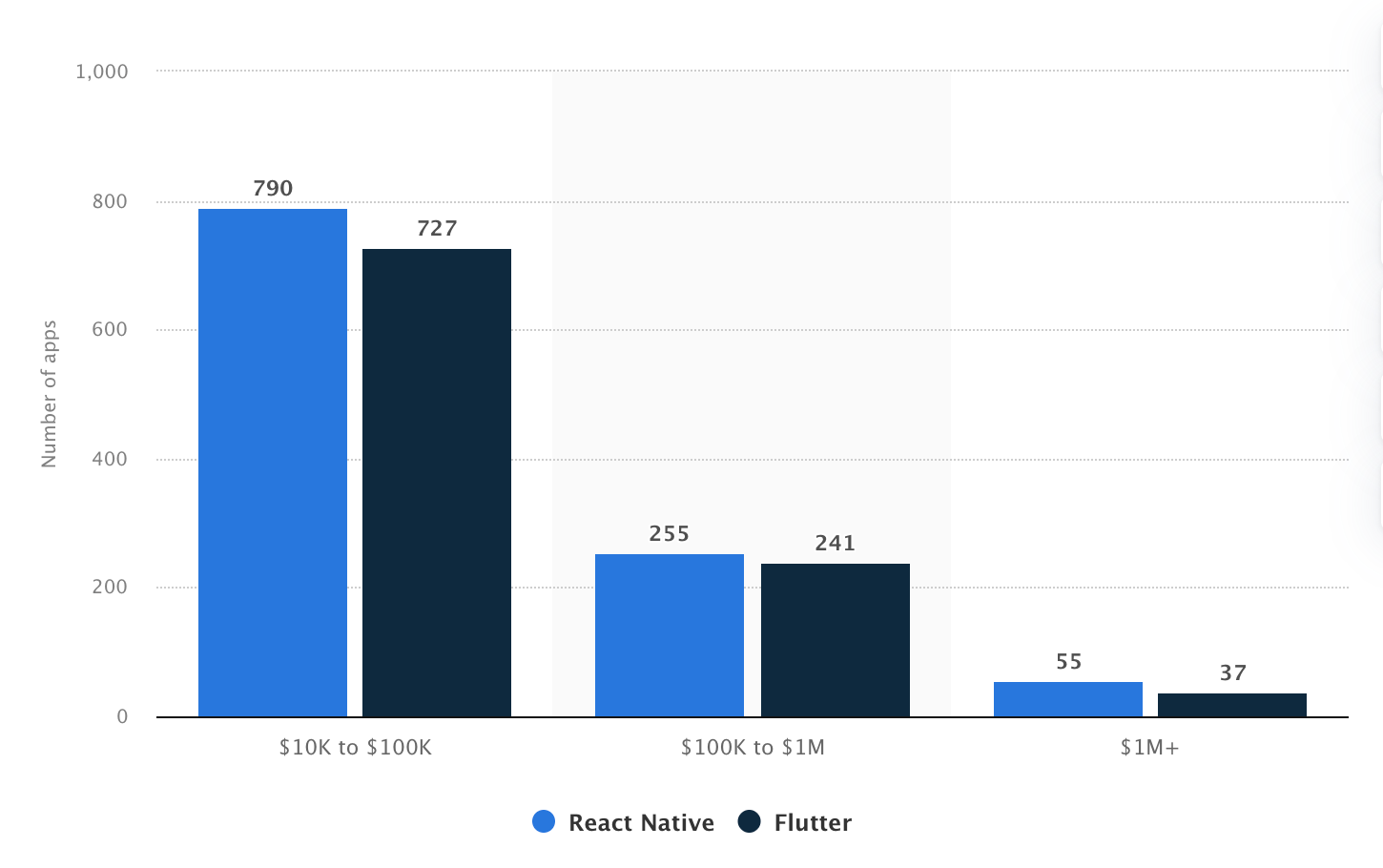
It means that teams building greenfield products are choosing it for both speed and cross‑platform reach. Meanwhile React Native remains deeply embedded in high‑scale consumer products thanks to its vast JavaScript ecosystem and mature tooling.
This Flutter vs React Native comparison breaks down performance, ecosystem, hiring realities, use cases, and real‑world decision factors. We'll help you pick the right tool for your product, team, and budget. But first, lets take a quick look at key differences ⬇️
Flutter vs React Native — quick comparison table (2026)
| Feature | Flutter | React Native |
|---|---|---|
| Language | Dart | JavaScript / TypeScript |
| Rendering Engine | Impeller | Native UI Components |
| Performance | High | High |
| UI Consistency | Pixel-perfect | Native feel |
| Ecosystem Size | Medium | Large |
| Learning Curve | Moderate | Easy for JS devs |
| Platform Support | iOS, Android, Web, Windows, macOS, Linux | iOS, Android, Web (limited) |
| Hiring Difficulty | Medium | Low |
| App Size | Larger (~5–10 MB) | Smaller (~3–5 MB) |
| Hot Reload | Yes, reliable | Yes |
| Backed By | Meta | |
| Best For | Design-heavy apps | JS-heavy apps, rapid team scaling |
Note: Both frameworks are production-ready in 2026. The differences below are strategic, not binary.
What is Flutter?
Core architecture
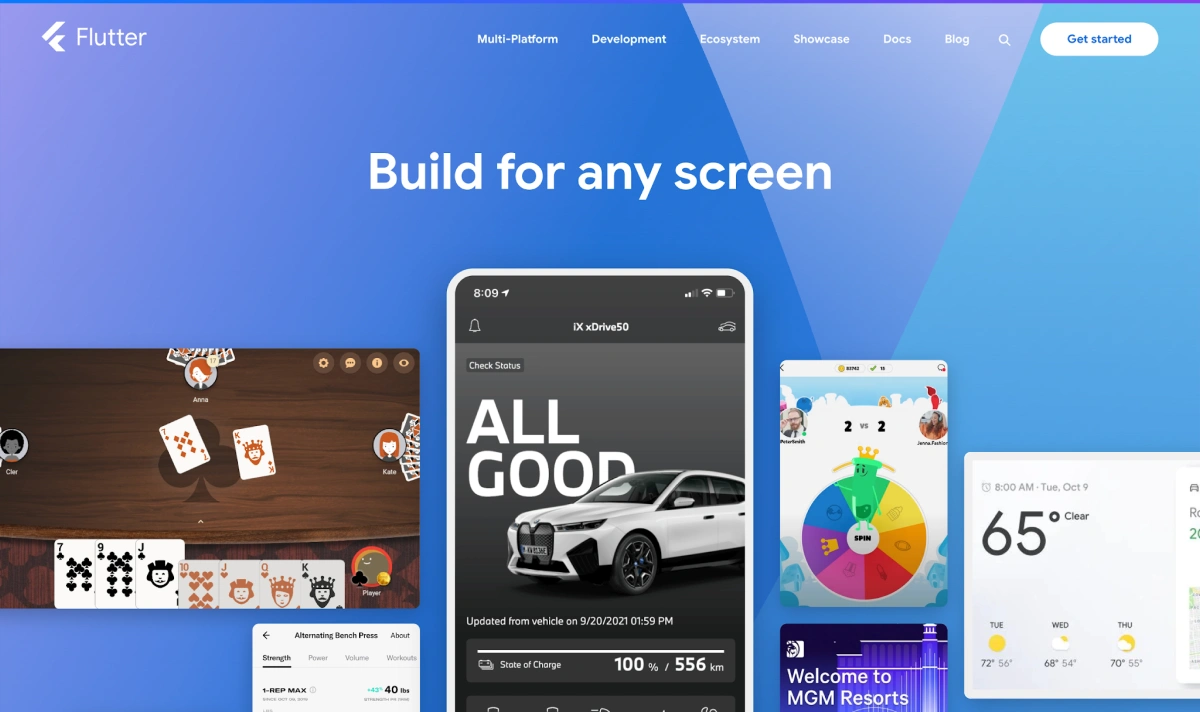
Flutter is a cross-platform mobile development framework from Google. It uses the Dart programming language. Unlike many cross platform frameworks that rely on native UI components, Flutter controls every pixel on the screen through its Impeller rendering engine. It can make complex animations and custom interfaces smooth and predictable. Flutter also uses Ahead-of-Time (AOT) compilation, which converts Dart code into native machine code before the app runs. The result? Faster startup times, responsive UIs, and consistent performance across devices.
Platform support
One of Flutter’s biggest advantages is that you can build cross platform apps for mobile, web, and desktop from a single codebase. This makes it easier to maintain feature parity across platforms and reduces both development time and QA effort. For companies targeting multiple platforms, including iOS, Android, and desktop apps, Flutter can save weeks of work while keeping the experience consistent for users.
Who backs it
Flutter is actively maintained by Google. The stable Flutter 3.x release includes improved performance, web support, and more stable desktop builds. The framework has over 102,000 stars on GitHub, showing both its popularity and the growth of an engaged developer community.
Notable apps built with Flutter
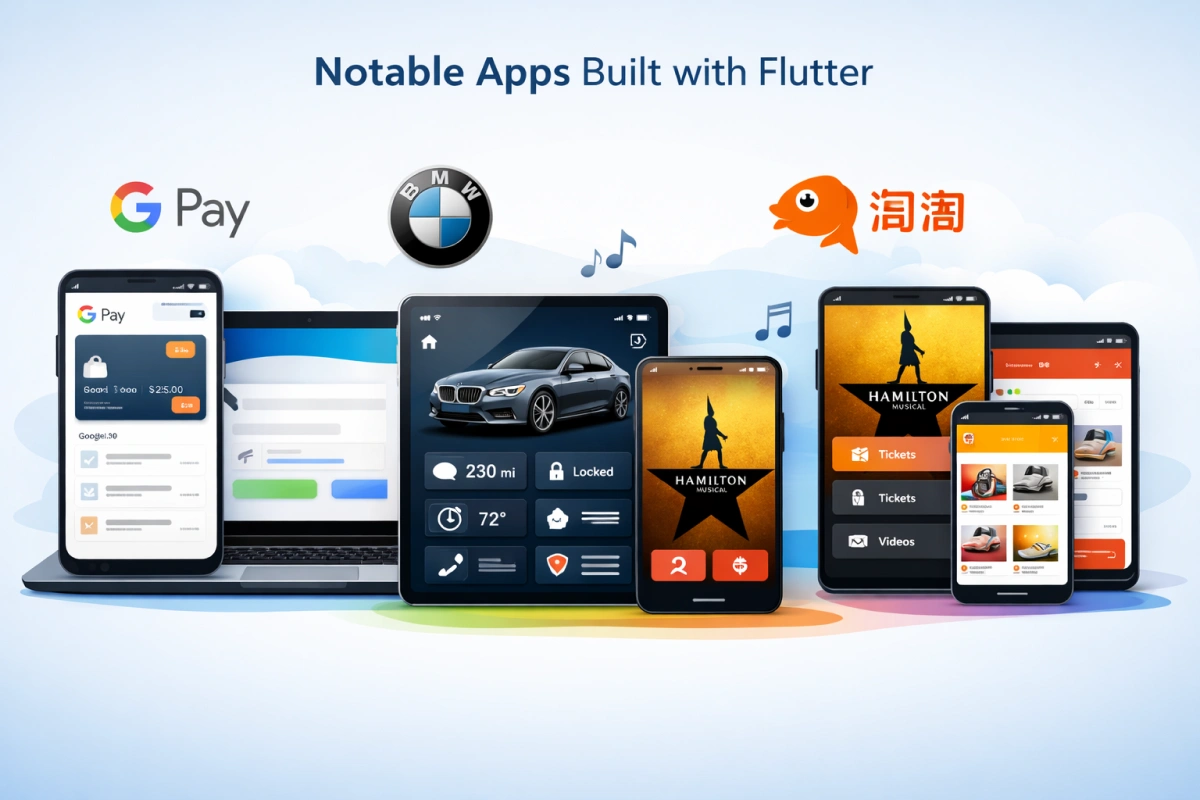
Flutter is used in production by major brands. Google Pay relies on it for a consistent experience across devices. BMW uses it for connected car apps. Hamilton Musical delivers rich interactive content and Alibaba’s Xianyu scales smoothly for millions of users. These examples highlight how Flutter works well for apps that need custom design, smooth animations, and multi-platform reach.
What is React Native?
Core architecture
React Native is a cross-platform framework from Meta. It lets teams build mobile apps using JavaScript or TypeScript. Its New Architecture with JSI, Fabric, and TurboModules connects JavaScript code to native platform components. As a result, it alls apps to look and behave like fully native apps while still sharing code across iOS and Android apps. This makes it a strong choice for teams already familiar with JavaScript or React.
Platform support
React Native mainly targets iOS and Android. While web support exists through React Native Web, it’s not as comprehensive as Flutter’s multi-platform approach. Its strength lies in deep integration with native platform features. As a result, it is very suitable for apps that need access to Bluetooth, NFC, cameras, or other device-specific hardware.
Who backs it
React Native is maintained by Meta which makes it a mature framework with a large global developer community. The stable 0.82+ release includes the New Architecture by default, ensuring better performance and easier maintenance. With 92,200+ GitHub stars, it benefits from extensive third-party libraries, community resources, and a rich ecosystem built around JavaScript and React programming languages.
Notable apps built with React Native
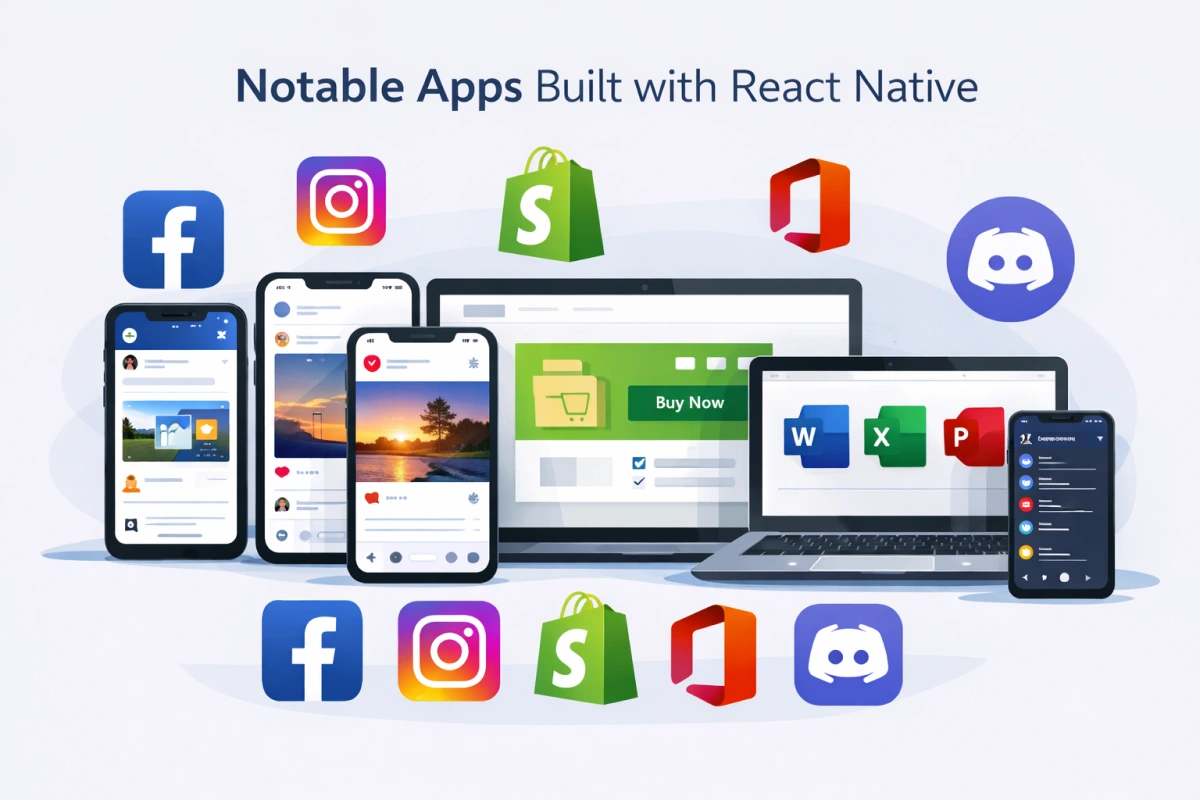
Many widely used apps run on React Native. Facebook and Instagram use it to maintain consistent features across platforms. Shopify relies on it for commerce apps. Microsoft Office mobile integrates productivity tools efficiently. Discord delivers responsive, high-performance experiences due to React Native. The platform is particularly strong for consumer-facing apps where developer onboarding speed and a platform-native feel matter.
Performance — Flutter vs React Native in 2026
When deciding between Flutter and React Native, performance is often top of mind criteria for the decision. Especially when you need the apps with heavy animations, complex UI, or enterprise-level usage. In 2026, both frameworks are mature, and the performance gap has narrowed significantly. Here’s what you need to know:
Rendering approach
Flutter controls every pixel using its Impeller rendering engine. It gives designers full control over UI and animations. On the contrary, React Native leverages native OS components via Fabric. It maps JavaScript code to native platform widgets. This results in a naturally native feel but slightly less control over pixel-perfect designs.
Frame rates
- Flutter: Smooth animations with 60–120 fps, even under heavy visual load.
- React Native: Stable 60 fps for standard UIs; may require optimization for highly animated or custom interfaces.
Cold start time
- Flutter: Thanks to AOT compilation, cold start times average ~250 ms on mid-range Android devices.
- React Native: Slightly slower cold start times due to the bridge initialization and JS runtime, though acceptable for most business apps.
App size
- Flutter: Includes its engine in the bundle (~5–10 MB overhead), which can make even simple apps slightly larger.
- React Native: Uses system UI components, keeping simple apps leaner.
The verdict
Performance is no longer a deal-breaker. For most business apps, MVPs, and consumer applications, either framework will deliver responsive, stable performance. Flutter gives more control for UI-heavy apps. On the contrary, React Native integrates seamlessly with native components and third-party modules.
Flutter vs React Native — performance benchmark (2026)
| Metric | Flutter | React Native |
|---|---|---|
| Cold Start (ms) | ~250 | ~300 |
| Animation FPS | 60–120 | 60 |
| Memory Usage | Moderate (~30–50 MB avg) | Moderate (~25–45 MB) |
| App Size Overhead | 5–10 MB | 2–5 MB |
Note: Numbers represent averages for mid-range Android devices; real-world results vary based on app complexity and dependencies.
Developer experience & learning curve
The ease of working with a framework affects the mobile app design and development speed considerably. What is more, it impacts how smoothly your team can deliver features. Flutter and React Native differ in how developers experience the day-to-day development workflow. Understanding these differences can help you plan your team structure and timeline.
Language barrier
Flutter uses Dart. It's a language designed specifically for building user interfaces and it’s rather powerful. However, if your team hasn’t used Dart programming language before, there’s a learning curve of about 2–4 weeks before they can work productively on complex UIs.
On the other hand, React Native relies on JavaScript or TypeScript, which most web developers already know. Teams with JavaScript experience will typically get up to speed faster and can start contributing to projects almost immediately.
Hot Reload / Hot Restart
Both frameworks support hot reload, which allows developers to see changes instantly without restarting the app. Flutter’s implementation is particularly reliable when working with stateful UI elements. As a result, changes in complex layouts or animations show up immediately. React Native’s hot reload feature works well for most cases. However, sometimes it requires a full restart when certain states or components don’t update correctly.
Tooling
Flutter comes with DevTools, which includes widget inspection, performance profiling, and memory tracking. React Native developers often rely on React Native DevTools paired with Flipper, which gives similar debugging capabilities. Both frameworks work smoothly with major IDEs like VS Code and Android Studio. In such a way, your team can use familiar tools while coding and testing.
Documentation quality
Flutter’s documentation is well-organized. It includes step-by-step guides, native code examples, and clear best practices. React Native’s documentation covers the basics well, but you may need to consult community resources when using third-party libraries or advanced native features.
Testing
Testing is built into Flutter. You can write unit, widget, and integration tests without adding extra tools. React Native testing relies on Jest for unit tests and tools like Detox or Appium for integration and end-to-end tests, which can require additional setup.
Summing up: If your team is experienced in JavaScript, React Native can shorten onboarding. If you want a more structured workflow for UI-heavy apps, Flutter provides reliable hot reload, built-in testing, and clear documentation that helps maintain consistency across projects.
Ecosystem, libraries & community
The ecosystem around a framework often matters more than the framework itself. It affects how fast you build and how often you run into blockers. Besides, it also impacts how much technical debt you accumulate over time.
React Native ecosystem
React Native benefits from the JavaScript ecosystem, which gives access to 2M+ packages via npm. That’s a huge advantage when you need to move fast or integrate third-party services.
But consider that there’s a trade-off. Not all libraries are actively maintained. Besides, the quality varies. It’s common to rely on third-party libraries for things like navigation, state management, or native integrations. Over time, this can lead to dependency conflicts, especially in long-running React Native projects.
Flutter ecosystem
Flutter’s ecosystem is smaller, with around 45,000+ packages on pub.dev. However, it’s more controlled. It supports many core features, like authentication, storage, maps, and notifications. They are also supported by official plugins maintained by Google.
This reduces the need to rely on external packages. In practice, teams often deal with fewer breaking changes and less dependency management overhead compared to large React Native apps.
Community size
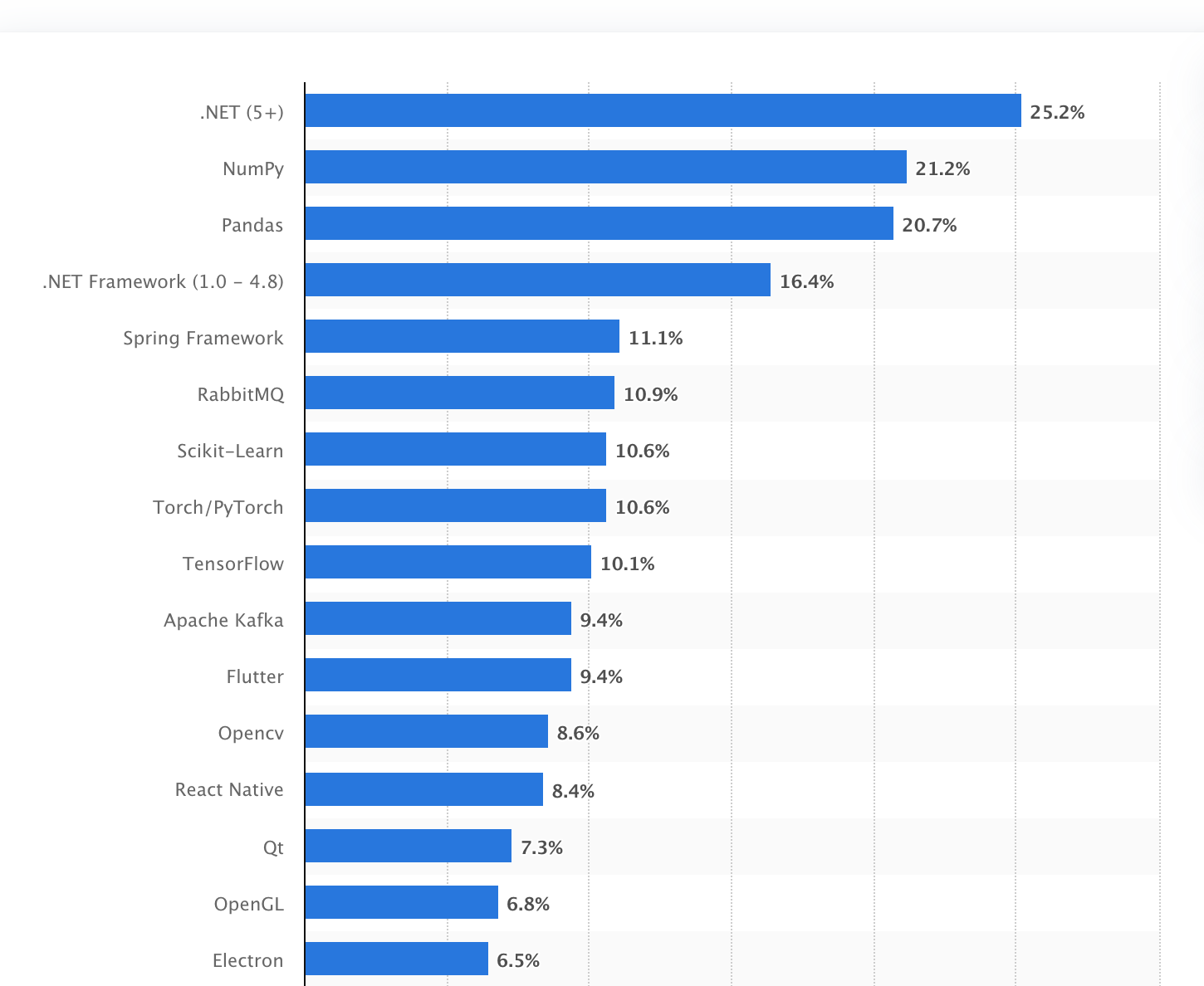
Flutter has a large and active community due to its established developer base. According to Statista, 9.4% of developers use libraries and frameworks of Flutter. Flutter's community has high engagement, and the ecosystem is becoming more mature each year.
React Native has also a fast growing community size because it builds on JavaScript. 8.4% of respondents state that use it. React Native provides a familiar environment for web developers with JavaScript and has extensive community support for resolving issues.
Long-term maintenance risk
Long-term maintenance risk is one of the key competitive advantages when it comes to the choice.
React Native creates more dependencies that cause higher risk of version conflicts and upgrade issues. On the contrary, Flutter has fewer external dependencies. As a result, it delivers more predictable maintenance.
This might not matter for short-term projects. But for products planned to run and evolve over several years, dependency sprawl can turn into real cost.
What this means for you:
If speed and flexibility are your priority, React Native’s ecosystem gives you more options. If you want stability and fewer moving parts long-term, Flutter tends to be easier to maintain.
UI consistency & design flexibility
This is one of the most practical differences between Flutter and React Native. It directly affects how your product looks, feels, and behaves across different devices.
Flutter’s approach
Flutter gives you full control over the UI. It doesn’t rely on native platform components. Instead, it renders everything itself using its own rendering engine.
For clients, it means that the UI looks exactly the same on all devices. You’re not affected by OS updates changing UI behavior. You can build completely custom design systems without constraints
This approach works well for products where design consistency is critical. For example, this issues is critical for fintech dashboards or health tracking apps where every detail matters.
React Native’s approach
React Native uses native UI components, which means that it maps your native platform code directly to the platform’s built-in elements.
As a result, the apps feel naturally native on both iOS and Android. They also have built-in behaviors like iOS gestures or Android animations. It ensures automatic adaptation when OS design patterns evolve.
This is especially valuable for consumer apps, where users expect the app to behave like everything else on their device.
When Flutter wins
Flutter is usually the better choice when:
- You need a custom design system that looks identical everywhere
- The product relies on complex animations or transitions
- You’re building fintech dashboards, health apps, or data-heavy interfaces
- Brand consistency matters more than native platform behavior
When React Native wins
React Native makes more sense when:
- Users expect a native look and feel
- Your app relies on platform-specific behavior or integrations
- You’re building a consumer-facing app where familiarity matters
- You want to move fast using existing JavaScript skills and libraries
What this means for you:
If your product is design-driven, Flutter gives you more control. If your product needs to feel native and familiar right away, React Native is usually the safer choice.
Hiring, team, and cost of development
When making the Flutter vs React Native comparison framework, you need to realize that your choice doesn’t affect only the code. The framework you pick shapes how quickly you can hire mobile app developers or the cross platform app development team.
Talent availability
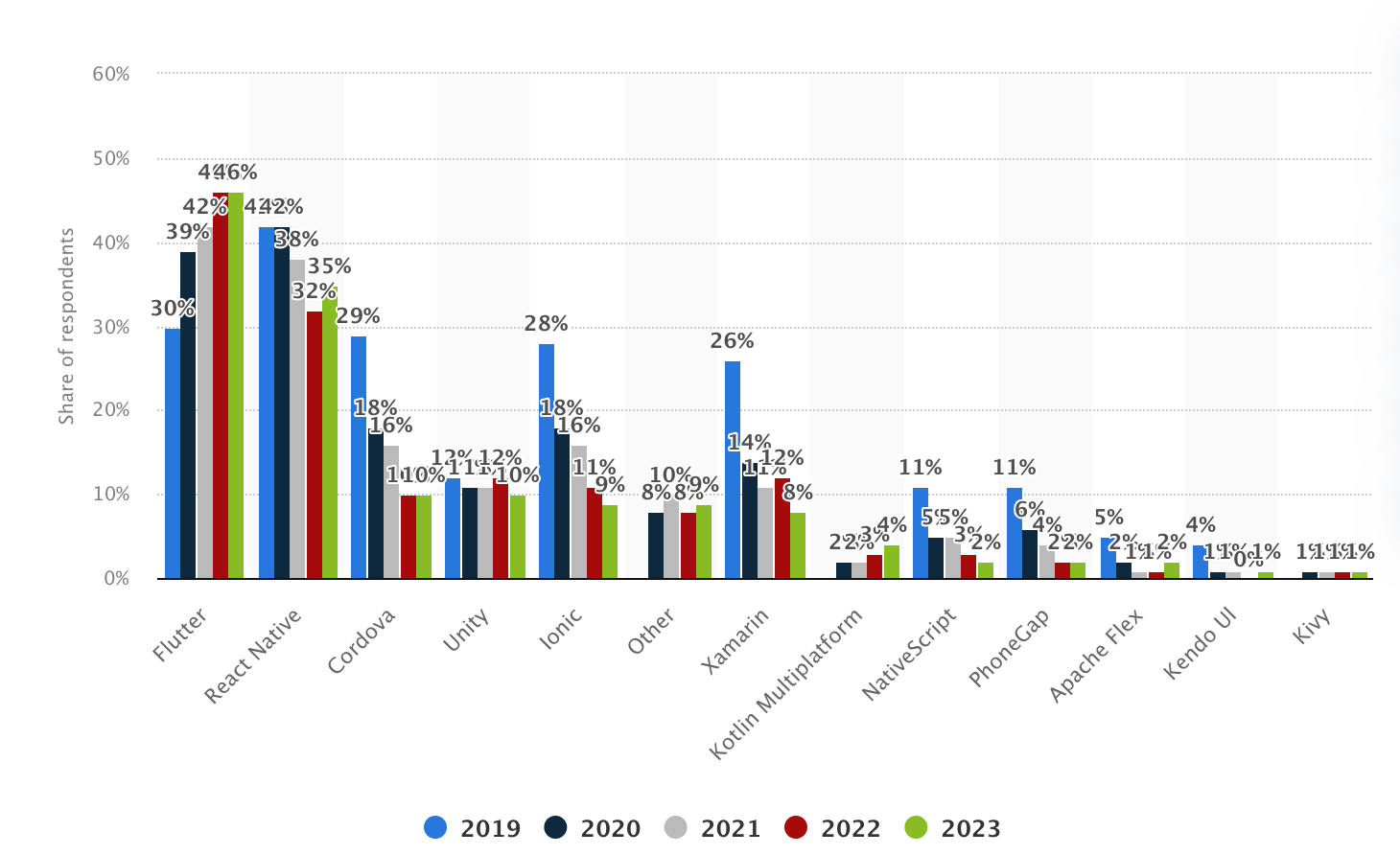
According to the Statista survey, 46% of developers worldwide used Flutter and 35% of engineers use React Native. That's why many developers have the skills and experience of working with both platforms.
While React Native still benefits from the broader JavaScript ecosystem, Flutter is no longer a niche skill. You’re increasingly choosing between specialized Flutter developers and JavaScript developers who can work with React Native.
What matters more is not just the framework, but whether the team has real production experience, which includes building, shipping, and maintaining mobile apps at scale.
Salary ranges (2026)
In the US market, the cost to hire an app developers reflect that difference in supply:
- Flutter senior developers: $135,000–$180,000/year
- React Native senior developers: $125,000–$160,000/year
Flutter developers tend to command slightly higher rates, mainly due to Dart programming language being less common.
Offshore / nearshore rates
If you’re working with teams in Eastern Europe, India, or LATAM, both frameworks offer cost-efficient options. React Native rates are often more competitive. Flutter rates can be slightly higher, especially for experienced teams.
That said, the difference is usually not dramatic. What matters more is the team’s experience with real production of mobile and web apps.
Time-to-market
Time-to-market is a core issue for startups and MVPs.
- Flutter allows delivering MVPs typically in 12–16 weeks due to a more controlled ecosystem and fewer dependency issues
- React Native usually enable MVP delivery within 14–20 weeks. The time may vary depending on how many native modules or platform-specific features are required.
If your app relies heavily on custom UI and shared logic across platforms, Flutter can reduce development and QA time.
Outsourcing consideration
You need to consider all software development outsourcing and outstaffing conditions, when working with external teams.
Flutter-focused agencies often deliver faster because they rely less on third-party libraries and have more control over the full stack. On the contrary, React Native teams can scale faster by bringing in JavaScript developers, which helps when you need to grow the team quickly
If speed of execution matters more than hiring flexibility, Flutter teams have a competitive advantage. If scaling the team quickly is your priority, React Native is easier to staff.
If you’re not building an in-house team, working with an experienced partner can remove most of these constraints. It is an effective solution for early-stage products where time-to-market matters more than long-term hiring strategy.
Real-world use cases — which framework fits which project?
At this point, you don't need to ask yourself a question “which framework is better.” You need to think which framework fits your situation better. It needs to meet the requirements for your team, your product, and how fast you need to move.
Choose Flutter when —
Flutter tends to work better when design and consistency are a priority.
- You want your app to look exactly the same across iOS and Android devices, as well as web applications without surprises
- Your product includes complex UI, such as animations, dashboards, custom charts, or anything highly interactive (common in fintech app development or health apps)
- You’re planning beyond mobile and want to support web or even desktop apps from the same codebase
- You’re starting from scratch and can afford a few weeks for the team to get comfortable with Dart programming language
- You care about long-term stability, with fewer third-party dependencies to manage over time
So, Flutter is a strong fit when the product is design-driven and expected to evolve across multiple platforms.
Choose React Native when —
React Native makes more sense when speed of hiring and familiarity matter more than control over every pixel.
- Your team already works with JavaScript or TypeScript
- You need to hire quickly or scale the team using existing web developers
- The app depends on native features like Bluetooth, sensors, or deep OS-level integrations
- You want the flexibility of pushing updates without going through app store review every time (OTA updates)
- Your roadmap is focused only on iOS and Android and you have no plans for web or desktop
In many cases, React Native is the practical choice for teams that want to move fast using existing skills and tools.
Enterprise apps
At the enterprise level, both frameworks are already proven. Large companies use them in production without issues. The choice usually comes down to internal team structure and existing tech stack, not technical limitations.
Startup MVPs
Small differences start to matter more for early-stage products. Flutter often has a slight edge here.
- Faster to build a polished first version
- Less time spent fixing inconsistencies between platforms
- Lower QA overhead when supporting multiple devices
That’s why teams working on tight timelines often lean toward Flutter. It helps them get to a usable product faster without doubling the effort. Also read about the role of MVP in startup success.
What this means for you:
Don’t choose based on trends. Choose based on what your product actually needs in the next 6–12 months — that’s what will save you time, budget, and rework later.
What’s new in 2026 — the state of both frameworks today
Both Flutter and React Native have matured a lot over the past few years. Both of them can ensure high-quality production. Let's view how they've developed during the recent years.
Flutter 3.x
Flutter has been doubling down on performance and platform reach.
The Impeller rendering engine is now stable on both iOS and Android. It means smoother animations and fewer unexpected performance drops, especially in apps with complicated UI. Web support has also improved with stable WebAssembly (Wasm). It makes Flutter a more realistic option for browser-based products, not just mobile.
On the developer side, Dart keeps getting small but useful updates (like dot-shorthands) that make native code easier to write and maintain. Flutter is also fully compliant with the latest Google Play requirements (NDK r28), so there are no surprises when publishing apps.
In short, Flutter is becoming more predictable. It has fewer edge cases and becomes more consistent across platforms.
React Native New Architecture
React Native went through a bigger internal shift.
With version 0.82+, the New Architecture is now the default. That includes:
- Fabric for rendering
- TurboModules for faster native module access
- JSI (JavaScript Interface) replacing the old bridge
The old architecture is now fully retired, which simplifies things long-term but may require some updates for older projects.
The result is a more stable and faster framework, especially for apps that rely heavily on native modules or complex interactions. It also aligns well with React 19, so teams already using modern React on the web will feel at home.
Market share
Adoption numbers show that both frameworks are still widely used.
- Flutter: 46% of the cross-platform market
- React Native: 35% of the cross-platform market
The gap has grown slightly in Flutter’s favor, mostly driven by new projects and startups development. React Native remains strong, especially in companies that already rely on the JavaScript ecosystem.
AI integration
In 2026, AI has considerable impact on the way developers build apps. And both frameworks are adapting to this.
Flutter has an advantage when it comes to UI control, which helps when building AI-driven interfaces (like real-time suggestions, dynamic layouts, or custom visualizations). If your product relies heavily on how AI results are presented, this matters.
On the other hand, React Native benefits from the JavaScript ecosystem with tools like LangChain.js and Vercel AI SDK. It makes it easier to plug AI app development features into existing apps.
Alternatives on the radar
There’s also a third option gaining traction: Kotlin Multiplatform (KMP).
Its adoption has grown from around 7% to 18%, especially in companies that already have native Android and iOS apps. Instead of replacing native development, KMP focuses on sharing business logic and, at the same time, keeps native UI.
You should not consider Kotlin Multiplatform to be a direct replacement for Flutter or React Native. However, you may view it for existing (brownfield) projects where rewriting everything isn’t realistic.
What this means for you:
Both Flutter and React Native are stable, actively developing, and safe choices in 2026. The core question that remains is which direction better fits your product and team long-term.
How Empat Tech approaches mobile framework selection
At Empat Tech, we’ve already delivered 300+ projects across mobile engineering, web development, and AI. We’ve considerable experience working with both Flutter and React Native in real production environments.
What we’ve learned is simple: the framework itself is rarely the problem. The mismatch between the framework and the product is.
For example, in one case, we worked with a healthtech product that needed a custom dashboard for wearable data. The UI was rather complex and highly visual. It required consistent behavior across devices. Flutter made that easier to control and maintain.
In another case, we built a CRM companion app for a SaaS product that already relied heavily on JavaScript. The team needed to move fast and reuse existing knowledge. React Native was the best fit.
We don’t push one framework over the other. The goal is to choose the option that reduces risk, fits your team, and, at the same time, supports how your product will grow.
If you're evaluating Flutter vs React Native for an upcoming project, you can book a discovery call with our team. It’s a 30-minute conversation focused on your product, not a sales pitch.
Conclusion — Flutter vs React Native: there is no universal winner
There’s no clear winner between Flutter and React Native. And that’s actually a good thing.
Both frameworks are mature, stable, and used in production at scale. The difference comes down to context, but not the capability.
When making a decision, you need to consider a few things:
- Your team’s existing skills (JavaScript vs starting fresh)
- How important UI control and design consistency are
- How quickly you need to hire or scale a team
- Whether you’re building for mobile only or multiple platforms
- How much you want to manage dependencies long-term
In 2026, the choice doesn't refer to technical issues, and needs to focus on strategic ones. The right decision is the one that helps you build faster now without creating problems later.
If you’re still unsure which direction makes sense, you can talk to Empat Tech’s mobile team and get a second opinion based on your specific case.
FAQ
Which is better, Flutter or React Native in 2026?
There isn’t a universal cross platform mobile application. Both frameworks are stable, widely used, and capable of building production apps.
- Flutter is a better fit if you need full control over UI, consistent design across platforms, or plan to support web and desktop alongside mobile.
- React Native makes more sense if your team already works with JavaScript and you want to hire or scale quickly.
In most cases, the “better” option depends on your team, product complexity, and timeline.
Is Flutter faster than React Native?
In terms of raw performance, Flutter has a slight edge — mainly because it uses its own rendering engine and compiles to native machine code.
You’ll notice this more in:
- Animation-heavy apps
- Complex UI interactions
- Custom-designed interfaces
For typical business apps, though, the difference is small. Both frameworks can deliver smooth, responsive performance if built properly.
Should I learn Flutter or React Native?
It depends on your starting point.
- If you already know JavaScript or React, React Native will be easier to pick up and use right away.
- If you’re open to learning a new language and want more control over UI, Flutter is a strong option.
From a career perspective, both are relevant in 2026. React Native benefits from the larger JavaScript ecosystem, while Flutter is growing steadily and is often chosen for new projects.
Does Google use Flutter for its own apps?
Yes, Google actively uses Flutter in production.
Apps like Google Pay are built with Flutter, and the company continues to invest in the framework. It’s not just an experimental tool — it’s used for real products with millions of users.
That said, Google (like most companies) uses different technologies depending on the product, so Flutter is one of several tools in their stack.


