

HIPAA-Compliant Healthcare Mobile App Development
A practical guide to HIPAA-compliant healthcare app development.

Building a healthcare app in the US means dealing with more than mobile UX, APIs, and cloud infrastructure. If the product handles protected health information (PHI), its architecture also needs to account for HIPAA requirements from the beginning.
That affects how a healthcare business can collect, store, transmit, access, and log patient data. It also affects the vendors involved in the product, including cloud providers, analytics services, and development partners.
This guide explains what HIPAA-compliant healthcare mobile app development involves, which safeguards matter most, how remote patient monitoring (RPM) changes the technical requirements, and what to ask a development partner before starting a project.
What does HIPAA compliance mean for a healthcare app?
HIPAA, the Health Insurance Portability and Accountability Act, sets requirements for protecting certain health information handled by covered entities and their business associates.
For an app, compliance is not a feature you switch on before launch. It affects the architecture and the way the entire product handles electronic protected health information (ePHI).
The HIPAA Security Rule requires administrative, physical, and technical safeguards designed to protect the confidentiality, integrity, and availability of ePHI. Among other things, these safeguards cover access control, authentication, audit controls, transmission security, risk management, and business associate arrangements.
When evaluating a healthcare development company, don't focus on whether it can show you a HIPAA-certified badge. Ask what safeguards it implements, how they divide responsibilities between the client and vendors, and how they document compliance throughout development.
The stakes are significant. IBM's 2026 Cost of a Data Breach Report puts the average cost of a healthcare data breach at $6.64 million, the highest average among industries for the 15th consecutive year.
Healthcare data breaches also remain frequent. According to the HIPAA Journal's latest figures based on the HHS Office for Civil Rights breach portal, 772 healthcare data breaches affecting 500 or more individuals were listed for 2025 as of June 2026, making it the worst year on record at that point.
For a product handling PHI, security therefore needs to be part of the product architecture rather than a final pre-launch checklist.
Types of HIPAA-compliant healthcare apps
"Healthcare app" covers several very different products. A patient portal and a remote monitoring platform may both handle PHI, but their technical requirements are not the same.
Remote patient monitoring apps
Remote patient monitoring apps collect patient data outside a clinical setting and make it available to healthcare professionals. This can include blood pressure, glucose levels, heart rate, oxygen saturation, symptoms, medication adherence, and data from connected wearables.
Because these products continuously collect and transmit health data, their architecture needs to account for device connectivity, secure data transmission, storage, authentication, alerts, and integration with clinical systems.
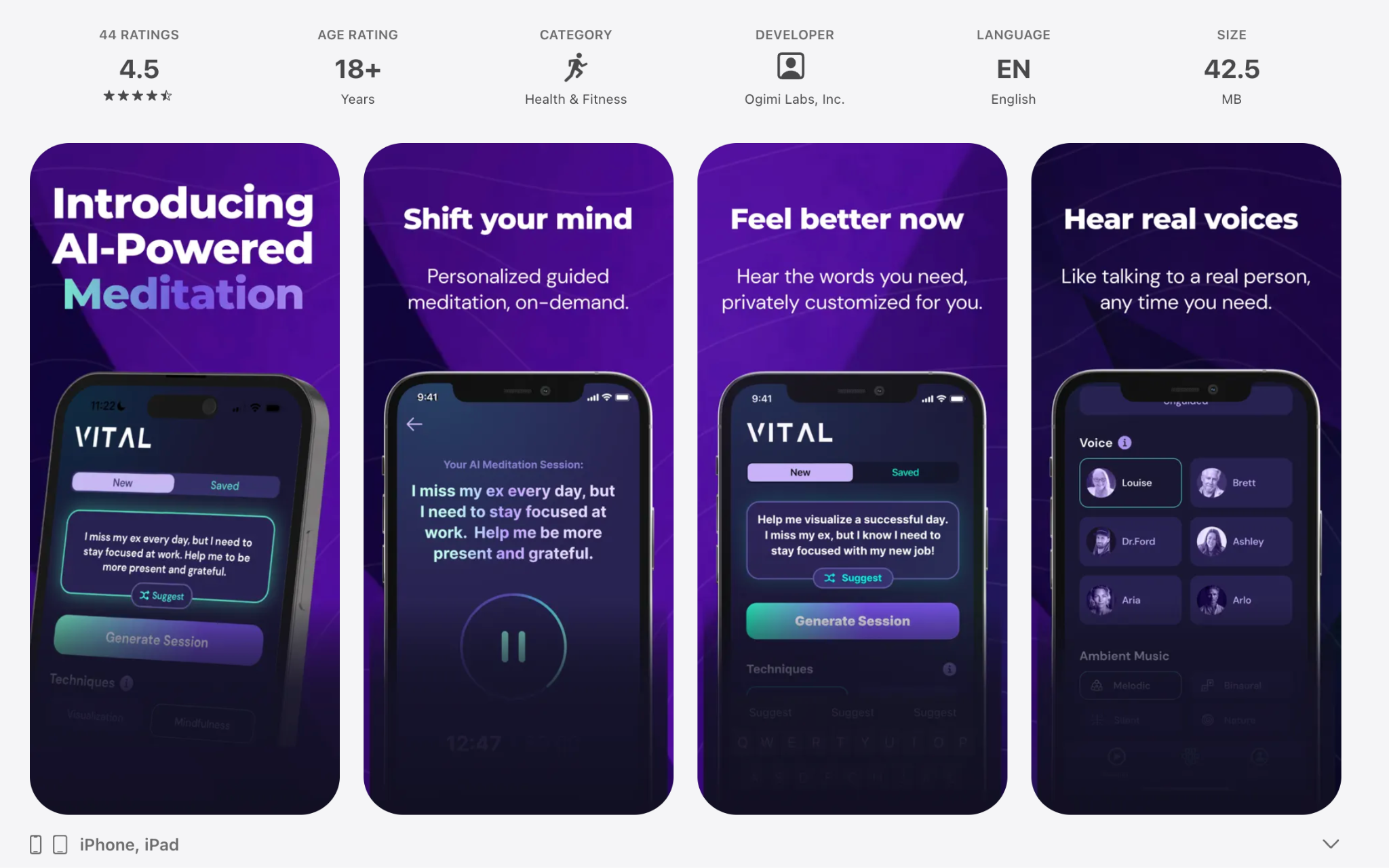
VitalAI developed by Empat is an example of this type of product.
Patient portals and appointment apps
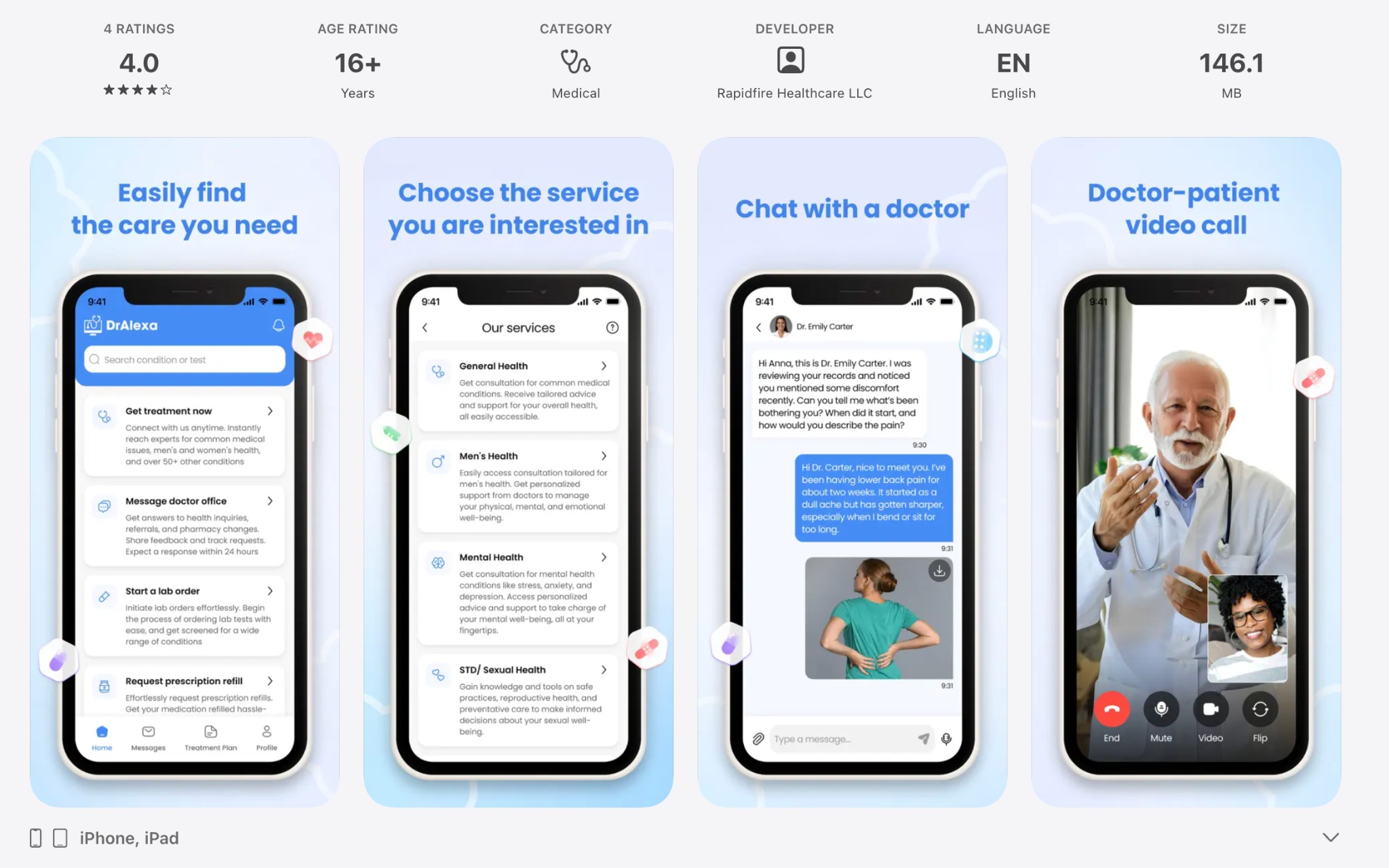
These apps can allow patients to book appointments, access health information, communicate with providers, or manage prescriptions.
The main technical concerns include authentication, authorization, secure access to patient records, and maintaining appropriate audit trails.
Take a look at the Dr.Alexa case, which is an example of a healthcare booking platform.
Telemedicine apps
Telemedicine products add video consultations, messaging, clinical documentation, and potentially file or image sharing to the healthcare workflow.
The security requirements don't stop when the video call ends. Any clinical information generated during the consultation that becomes ePHI needs to be handled according to the same security requirements as other patient data.
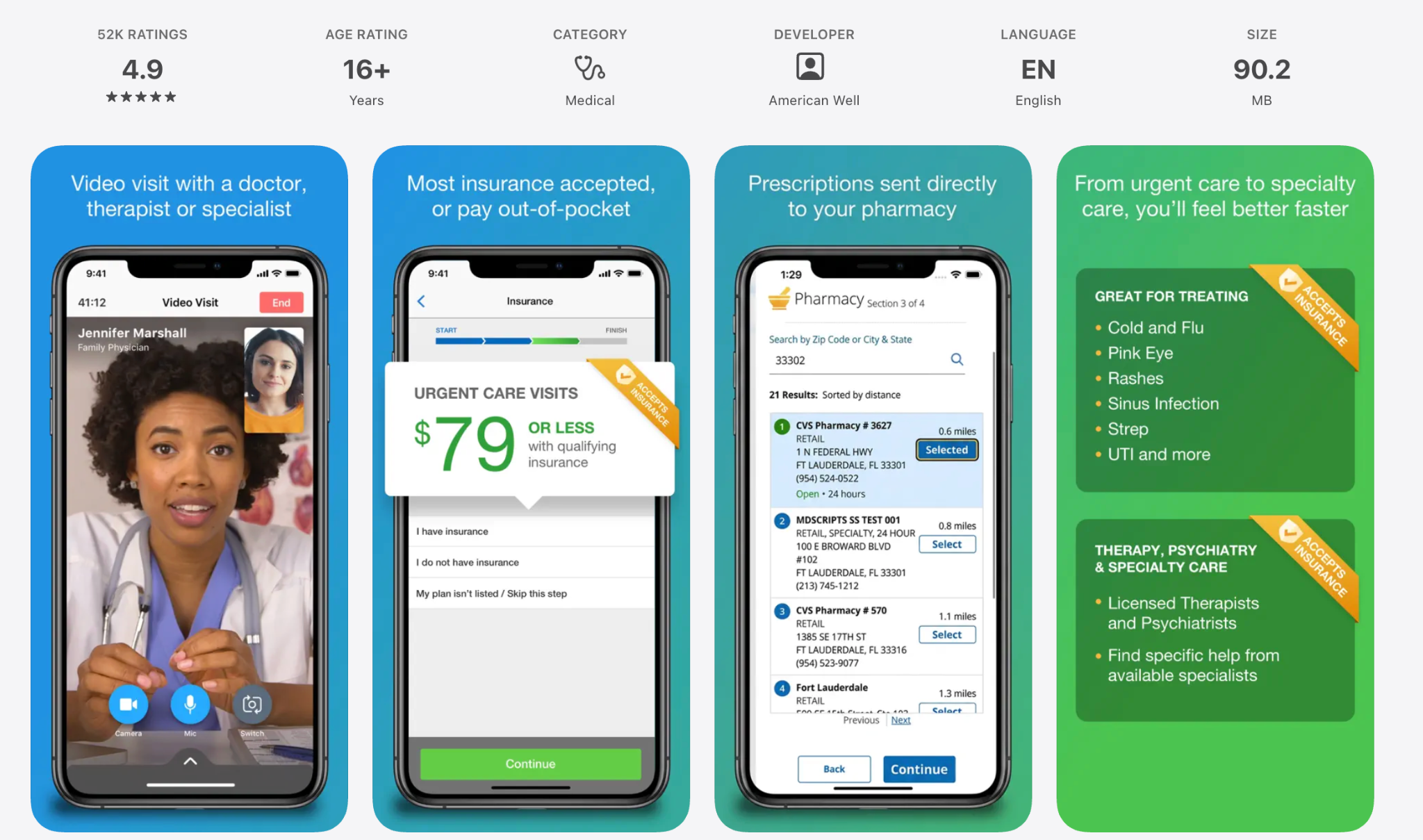
Amwell and Doxy.me are examples of telemedicine platforms that enable patients to connect with healthcare providers remotely. Amwell offers a broader virtual care experience with features such as provider search, scheduling, video consultations, and digital care workflows, while Doxy.me focuses on simple, browser-based access to virtual visits with features such as waiting rooms, messaging, and file sharing.
Medical device and diagnostic apps
Apps connected to medical devices may receive measurements directly from equipment, process them, and pass the results to clinicians or other systems.
Here, data integrity becomes particularly important. The system needs to preserve the reliability and context of measurements as they move between the device, mobile app, backend, and clinical system.
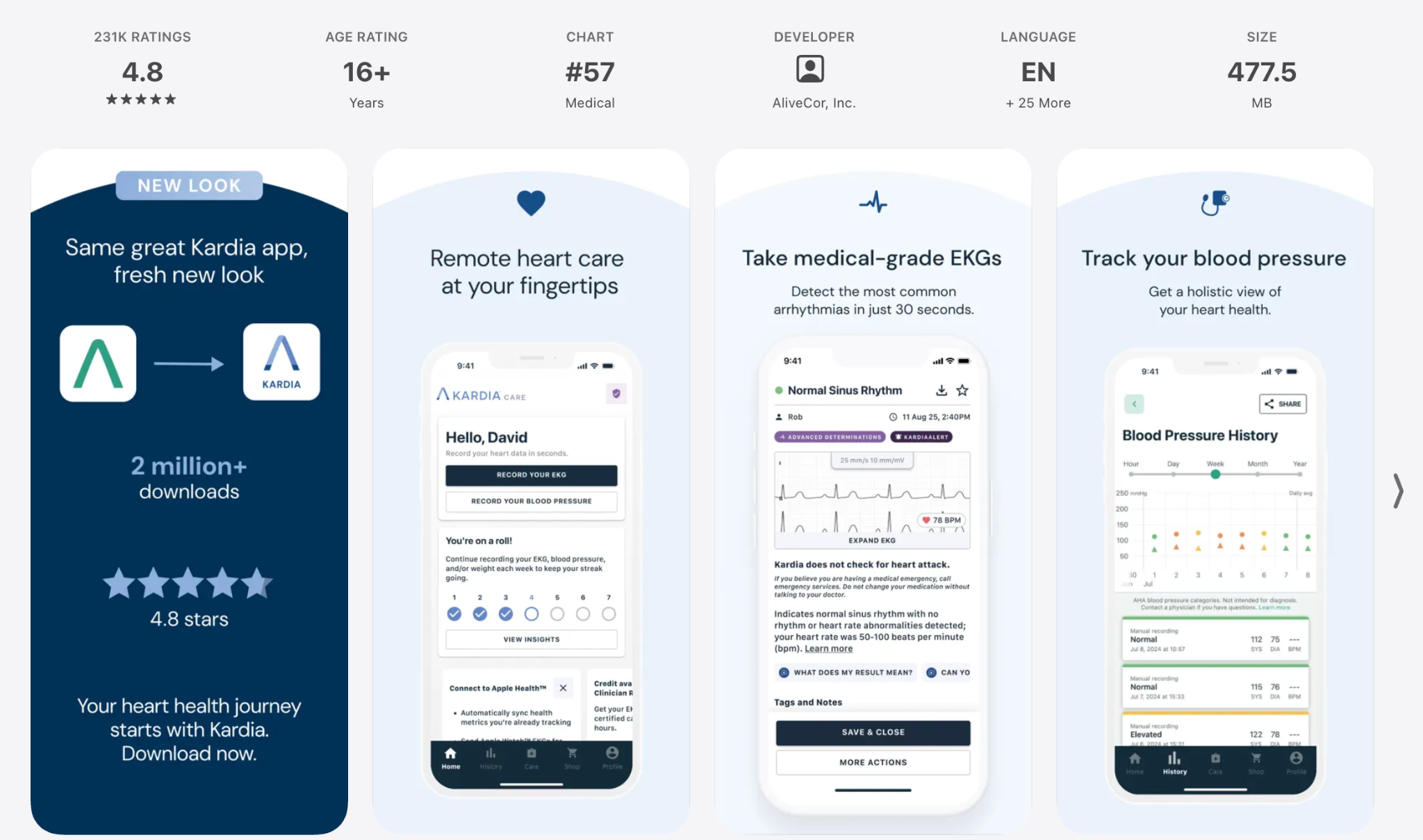
KardiaMobile and Dexcom G7 are examples of medical device and diagnostic apps that connect mobile software with healthcare devices.
EHR-integrated healthcare apps
Apps that exchange information with electronic health records (EHRs) have another layer of complexity: interoperability.
Depending on the integration, this can involve standards such as HL7 and FHIR (Fast Healthcare Interoperability Resources). The integration needs to preserve appropriate authentication, authorization, data integrity, and auditability rather than simply moving data from one API to another.
Epic MyChart and Healow are examples of EHR-integrated healthcare apps that connect patients with their medical records and care providers.
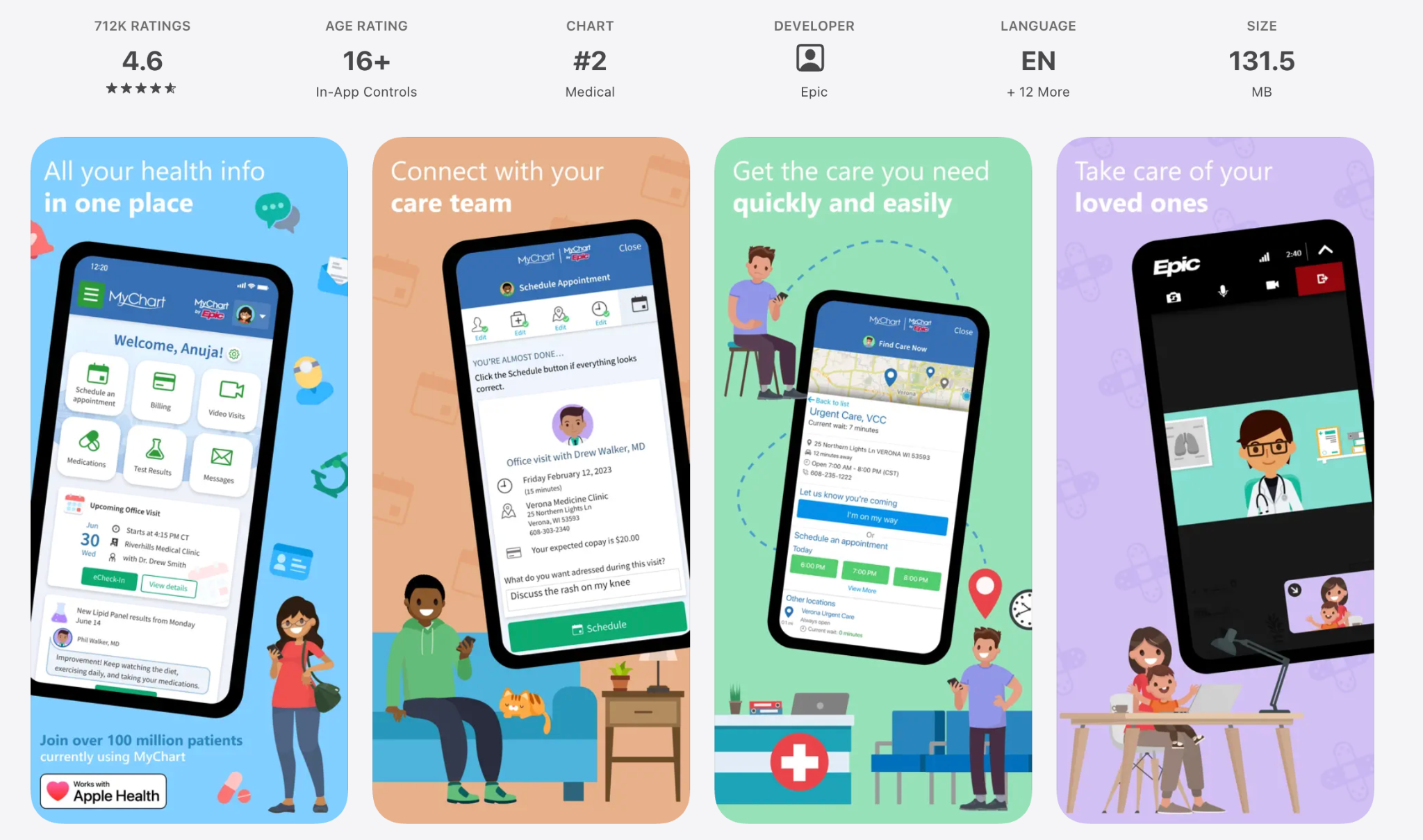
The underlying HIPAA principles remain similar across these products, but the risk profile changes significantly depending on where and how PHI moves through the system.
HIPAA compliance in practice: encryption, access control, and BAAs
There are three areas worth discussing with a development partner before writing the first line of production code.
Encryption
Healthcare apps should protect PHI both when it is stored and when it moves between systems.
The HIPAA Security Rule includes encryption as an addressable implementation specification. That means organizations need to determine whether encryption is a reasonable and appropriate safeguard based on their risk analysis and, if they do not implement it, document the rationale and use an equivalent alternative where required.
In practice, encryption is a core part of a modern healthcare architecture. It needs to be considered across databases, file storage, APIs, mobile-to-server communication, backups, and other places where PHI may exist.
HHS's proposed update to the Security Rule would go further by requiring encryption of ePHI at rest and in transit, subject to limited exceptions. However, this is a proposed change and should not be confused with the current rule.
Access control and authentication
Not every user should have access to every piece of patient information.
Healthcare systems need appropriate access controls that restrict ePHI to authorized users and systems. HIPAA also requires authentication procedures and audit controls for systems containing or using ePHI.
For a healthcare app, that can translate into role-based permissions, strong authentication, session management, authorization checks, and logging of relevant access and activity.
The exact implementation depends on the product. A patient may need access to their own records, while a physician may need access to records for patients under their care. An administrator may need a completely different set of permissions.
These rules are much easier to build into the architecture from the beginning than to retrofit after the product is already handling real patient data.
Business Associate Agreements
A Business Associate Agreement (BAA) is a legal agreement between a covered entity and a business associate that handles PHI on its behalf.
HHS requires covered entities to have appropriate written arrangements with business associates that create, receive, maintain, or transmit ePHI on their behalf. Those arrangements establish requirements around safeguarding PHI, permitted uses and disclosures, security responsibilities, and breach reporting.
This matters when selecting vendors.
If a development partner, cloud provider, or another service will handle PHI as a business associate, the contractual relationship needs to be addressed before that data is shared. HHS also makes clear that business associates can have direct liability for certain HIPAA violations.
“For us, HIPAA compliance starts early in the project. We look at how healthcare data will move through the product, who needs access to it, and what needs to be in place to protect it. We discuss these requirements with the client upfront and make sure they are reflected in the product architecture and development process. If a Business Associate Agreement is required, we also clarify those responsibilities before development begins.”
— Valeriia Cartier, Chief Delivery Officer at Empat
Empat's public MVP development page states that healthcare products are developed with HIPAA, GDPR, and relevant data protection requirements in mind, including encryption, secure authentication, and legal consultation. Empat's Industries page also describes compliance as an architectural consideration from the discovery stage rather than something added after development.
At Empat, we consider compliance from the discovery stage of healthcare app development. We account for HIPAA, GDPR, and other relevant data protection requirements when planning the product architecture and development approach. Depending on the project, this may include encryption, secure authentication, and legal consultation to address compliance requirements as part of the development process rather than adding them later.
Planning a healthcare app? Talk to Empat’s healthcare development team to discuss your product, compliance requirements, and the technical approach that fits your project.
Remote patient monitoring software development
Remote patient monitoring (RPM) is one of the more demanding healthcare app use cases because the product may need to collect and process health information continuously rather than during occasional interactions.
The market is growing accordingly. Grand View Research estimates that the global remote patient monitoring system market was worth $26.0 billion in 2025 and projects it to reach $110.7 billion by 2033, representing a projected CAGR of 20.0% from 2026 to 2033.
For product teams, the interesting part the technical complexity behind an RPM platform.
A typical RPM product may need to:
- collect data from wearable or medical devices;
- communicate with devices over Bluetooth, Wi-Fi, or cellular networks;
- transmit health data securely to backend systems;
- detect abnormal readings or changes in patient status;
- notify patients or healthcare professionals;
- maintain a history of measurements;
- integrate with an EHR or other clinical system; and
- provide appropriate access controls and audit trails.
The AI or machine learning model is only one part of the system.
In many RPM projects, the harder engineering problems are around data consistency, device interoperability, connectivity, secure transmission, integration, and reliability. A model that correctly identifies an anomaly is not particularly useful if the underlying reading never reaches the system or if the resulting alert cannot be delivered to the right person.
This is the type of challenge Empat addressed with VitalAI.
VitalAI: remote monitoring built for clinical use
VitalAI is a remote patient monitoring platform developed by Empat that combines wearable devices and machine learning to monitor patient vitals, identify anomalies, and provide proactive alerts.
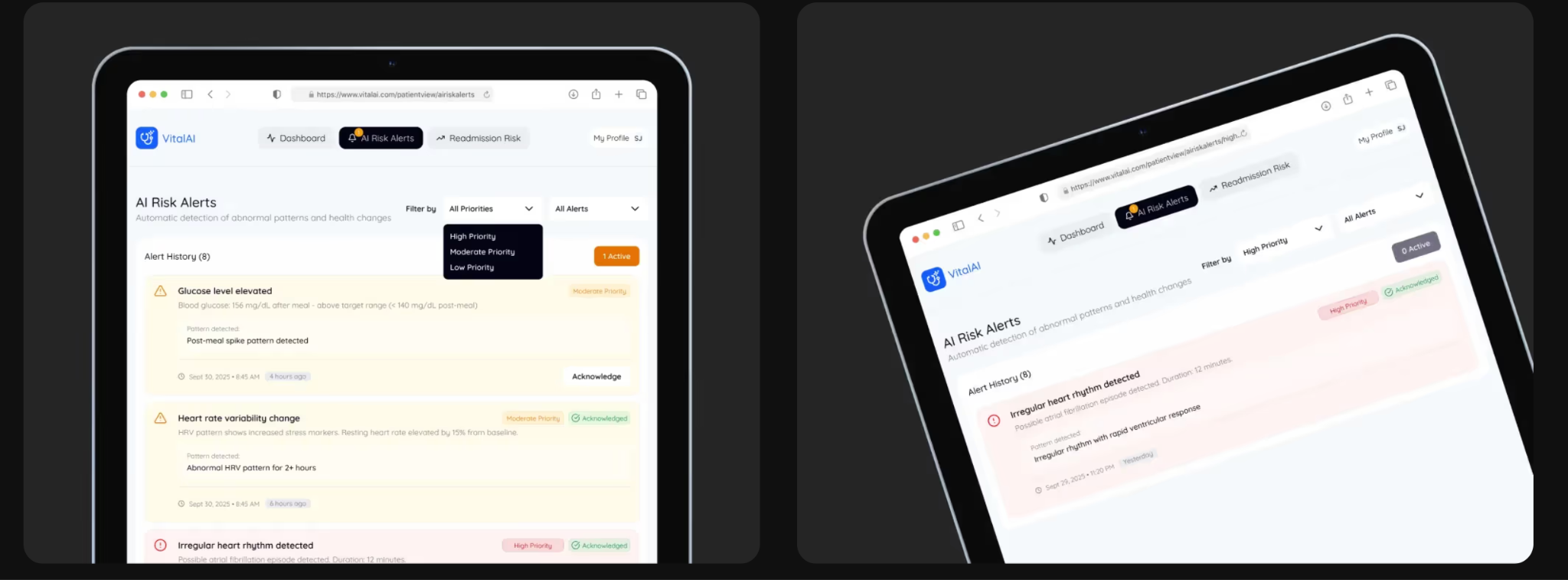
The product was designed around post-discharge monitoring, where patients may need continued observation after leaving a hospital but cannot remain under constant in-person supervision.
The challenge was therefore broader than developing an AI model. The platform needed to bring together health data from different sources, process it in real time, and turn that information into useful alerts for patients and care teams.
The system also uses FHIR APIs for integration with existing healthcare infrastructure.
This is an important distinction when choosing a development partner for an RPM project. General mobile development experience does not automatically translate into experience with healthcare data flows, medical device integrations, or clinical interoperability.
HIPAA-compliant cloud hosting
Cloud infrastructure is another part of the compliance equation, but choosing a HIPAA-eligible cloud provider does not make the application automatically HIPAA-compliant.
AWS, Google Cloud, and Microsoft Azure provide HIPAA-related services and Business Associate Agreement options. However, the application owner remains responsible for configuring and using those services appropriately.
Google Cloud, for example, explicitly states that its BAA supports HIPAA compliance but that customers remain responsible for building and configuring their own HIPAA-compliant solutions.
That distinction is important.
A healthcare app can be hosted on a HIPAA-eligible cloud and still have security problems caused by application configuration, excessive permissions, insecure APIs, poor authentication, inappropriate logging, or third-party services that handle PHI without the required contractual safeguards.
For that reason, cloud selection and application architecture need to be considered together.
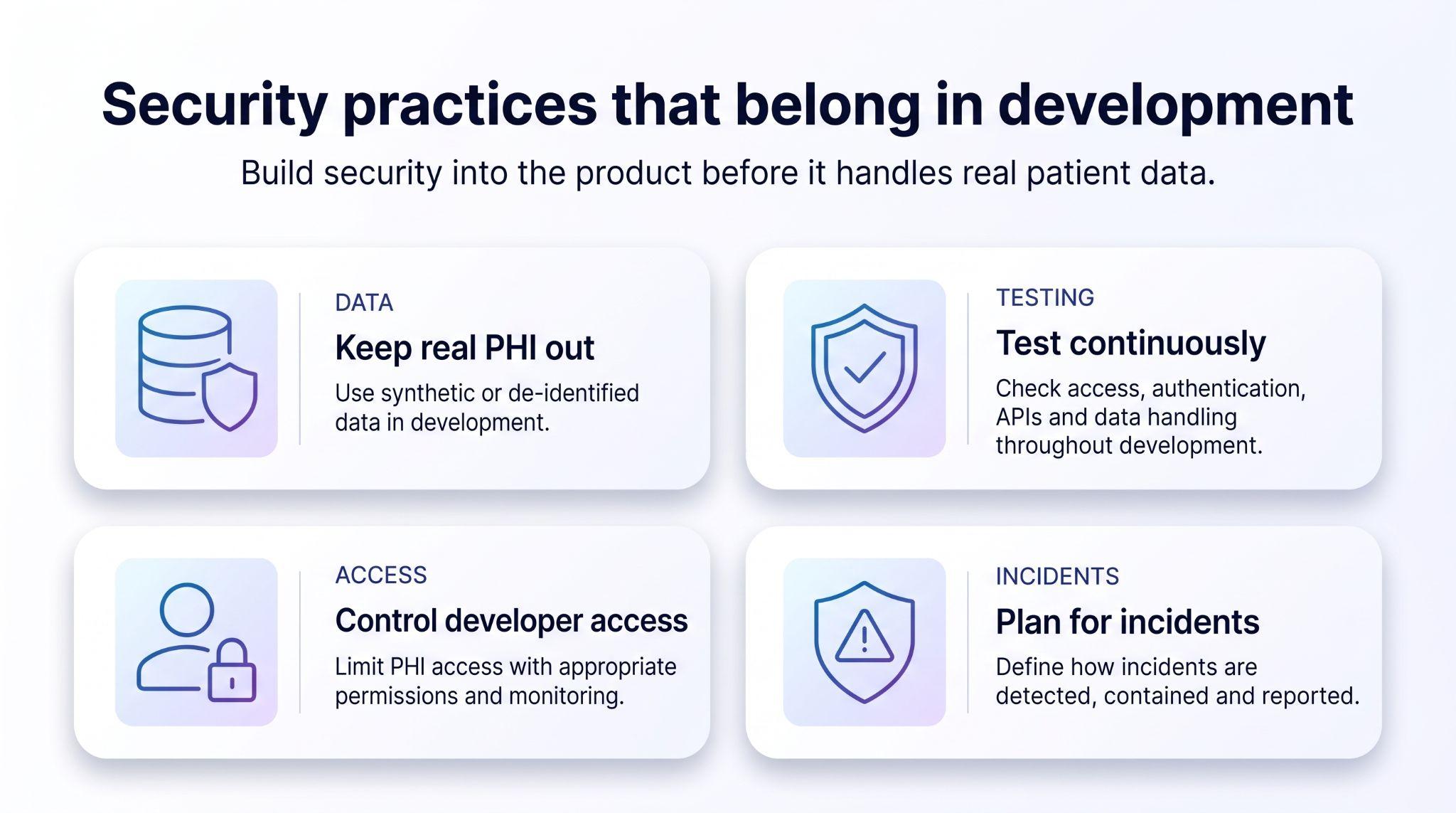
Security practices that belong in development
Security problems are often much more expensive to fix after an application is already processing real patient data.
A few practices are worth discussing with a development partner before the project starts.
Keep real PHI out of development environments
Development and staging environments should not become accidental copies of production.
Where possible, teams should work with synthetic or appropriately de-identified data during development and testing rather than copying real patient records into less-controlled environments.
Test security continuously
Security testing should not be limited to a single audit immediately before launch.
Access controls, authentication, API permissions, data handling, and other security-sensitive functionality should be tested throughout development. Automated checks can catch some issues early, while more comprehensive security testing and penetration testing can be used before launch and after significant changes.
Control developer access
The development team is part of the application's data-security model.
Access to systems containing PHI should be limited to people who genuinely need it, with appropriate authentication, permissions, and monitoring. The exact controls depend on the project and the responsibilities defined between the client, development partner, and infrastructure providers.
Plan for incidents
A healthcare application needs more than preventative controls. The team should also know how security incidents are detected, investigated, contained, and reported.
HIPAA requires covered entities and business associates to have appropriate policies and procedures around security incidents and breach notification.
How to evaluate a HIPAA-compliant healthcare app development partner
Because there is no official HIPAA certification to verify, the best way to evaluate a development company is to ask specific questions.
1. Will you sign a Business Associate Agreement?
If the company will act as a business associate and handle PHI, discuss the BAA before sharing or processing that data.
2. How will patient data be encrypted?
Ask where PHI is stored, how it is transmitted, which systems can access it, and what encryption controls are used.
3. How are permissions and access managed?
The answer should go beyond "we use secure authentication." Ask how roles are defined, how access is restricted, and how activity is logged.
4. Do you have healthcare interoperability experience?
If the product needs EHR integration, ask about actual HL7 or FHIR projects rather than generic API experience.
5. Can you show a relevant healthcare case study?
A real case study can tell you much more than a healthcare logo on a website. Look for details about the problem, architecture, integrations, and measurable outcome.
6. Who is responsible for compliance?
HIPAA compliance is not something the development team can promise on behalf of the entire product. The responsibilities of the healthcare organization, development partner, cloud provider, and other vendors need to be clearly defined.
A strong development partner should be comfortable having this conversation. If a vendor only responds with phrases such as "enterprise-grade security" or "HIPAA-certified," ask for specifics.
How much does a HIPAA-compliant healthcare app cost?
A HIPAA-compliant healthcare app generally requires more planning and engineering than a comparable consumer application because security, access control, auditability, legal requirements, and data handling need to be considered throughout development.
The actual cost depends on the product scope.
A patient appointment app with authentication and a relatively simple backend is a very different project from an RPM platform that collects continuous wearable data, runs anomaly detection, sends clinical alerts, and integrates with an EHR.
The biggest cost drivers usually include:
- number and complexity of mobile and web features;
- custom backend architecture;
- AI or machine learning functionality;
- wearable and medical device integrations;
- EHR and FHIR/HL7 integrations;
- authentication and access-control requirements;
- security testing;
- cloud infrastructure;
- third-party services;
- regulatory and legal review; and
- ongoing maintenance and monitoring.
For a more specific estimate based on your product scope, try our AI Development Cost Estimator. It can help you get an initial idea of the budget for an AI-powered healthcare product before discussing the project with a development team.
Estimate Your AI Development Cost
For a broader breakdown of healthcare product costs and development considerations, see our healthcare app development guide.
Can AI features be HIPAA-compliant?
Yes. Using AI does not automatically make a healthcare application non-compliant.
The important question is how PHI moves through the AI system.
For example, an RPM application might use machine learning to identify an unusual heart-rate pattern or detect a change in patient behavior. The model itself is only one component of the architecture. The data pipeline feeding the model, the model infrastructure, the generated result, and any alert sent to a clinician all need to be considered as part of the overall security design.
This becomes particularly important when using third-party AI APIs. Before sending PHI to an external service, the product team needs to understand how that provider handles the data and whether the relevant contractual and compliance requirements are met.
For products that need more autonomous decision-making or workflow automation, see our AI Agent Development service.
Build a healthcare app with compliance in mind from day one
HIPAA compliance is easier to manage when it is considered during product discovery and architecture rather than added immediately before launch.
The right approach depends on what your healthcare product actually does. A patient portal, telemedicine platform, RPM system, and AI-powered clinical application will all have different data flows and risk profiles.
At Empat, we combine healthcare product development with mobile, cloud, and AI engineering to build digital health products around their specific requirements. Our HealthTech practice includes healthcare products such as VitalAI and Dr.Alexa, while our MVP development process incorporates security and relevant data protection requirements from the early stages of product development.
Talk to Empat about your healthcare app
FAQ
What does HIPAA-compliant healthcare app development mean?
It means designing the application and its supporting processes to meet applicable HIPAA requirements for protecting electronic protected health information. This includes appropriate administrative, physical, and technical safeguards, such as access controls, authentication, audit controls, transmission security, and business associate arrangements.
How is patient data secured in remote patient monitoring apps?
RPM apps typically need to secure data across several stages: collection from wearable or medical devices, transmission to backend systems, storage, processing, and delivery of information or alerts to authorized users. EHR integrations also need appropriate authentication, authorization, and audit controls.
Can AI-powered healthcare apps be HIPAA-compliant?
Yes. AI can be used in a HIPAA-compliant healthcare application when the overall system is designed to protect PHI and meet applicable requirements. The key consideration is not simply the AI model but the complete data flow around it, including data collection, processing, storage, third-party services, access controls, and logging.
What should I look for in a HIPAA-compliant healthcare development company?
Look for experience with healthcare products, PHI handling, security architecture, relevant integrations, and healthcare interoperability standards such as FHIR or HL7. Ask whether the company can sign a BAA where applicable, how responsibilities are divided between the parties, and whether it can demonstrate relevant healthcare projects rather than relying on generic security claims.


