

Magento vs Shopify: Which eCommerce Platform Should You Choose in 2026?
Magento or Shopify? Compare pricing, customization, SEO, scalability, and B2B features. Get expert guidance from Empat’s development team to pick the right platform for your business.

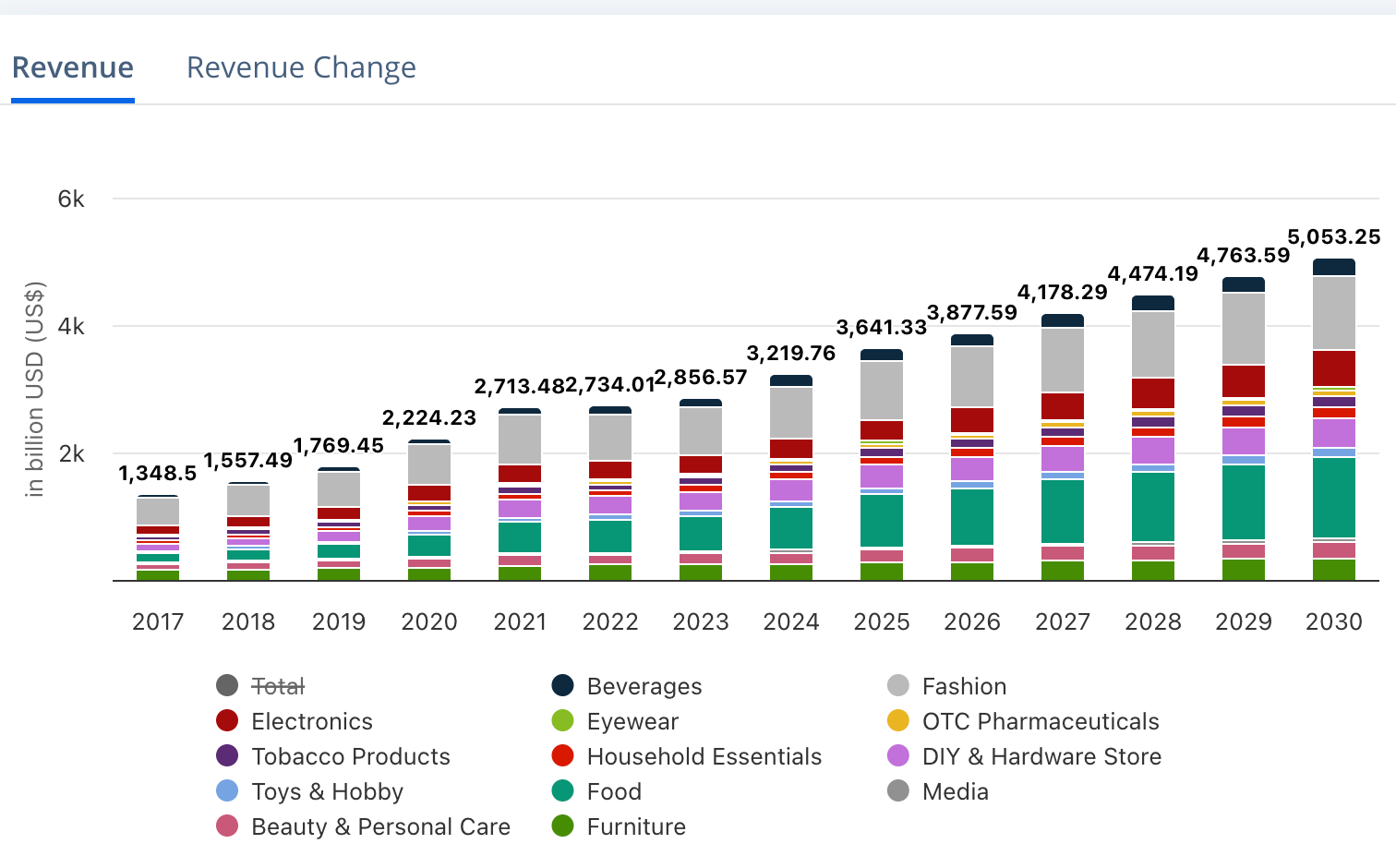
Choosing between Magento vs Shopify is one of the most important decisions for any eCommerce business. The global eCommerce revenue is projected to surpass $3.88 trillion in 2026. So, the platform you choose will directly impact your growth, customer experience, and long-term costs. In case you’re launching your first online store or scaling an existing eCommerce, selecting the right platform is a strategically important decision.
At a high level, Shopify is a fully hosted platform designed for simplicity and fast launches. On the contrary, Magento (now part of Adobe Commerce) is an open source platform that offers deep customization and full control over your technical infrastructure. This Shopify vs Magento comparison will break down everything you need to know, including pricing, customization options, SEO capabilities, performance, and enterprise features.
In short, Shopify is better for speed, ease of use, and predictable monthly costs. Magento is the right eCommerce platform for businesses that need deep customization, complex integrations, and complete control.
As a team specializing in custom software development and web development, Empat has helped startups and enterprise teams build scalable eCommerce operations on both Shopify and Magento. So, this guide is based on real-world implementation, not theory.
Magento vs Shopify at a glance
| Factor | Shopify | Magento (Adobe Commerce) |
|---|---|---|
| Platform type | Fully hosted SaaS ecommerce platform | Open source platform (Adobe Commerce for enterprise) |
| Setup time | A few hours to a few days | 4–16 weeks depending on complexity |
| Pricing starting point | Basic Shopify from ~$39/month | Magento Open Source: free; Adobe Commerce: ~$22,000+/year |
| Customization level | Limited (themes + apps) | Unlimited deep customization options |
| Technical skill required | Low — no coding needed | High — requires technical expertise and developers |
| SEO control | Good but limited URL structure and control | Advanced search engine optimization capabilities and full control |
| Scalability | High (managed infrastructure, automatic scaling) | Extremely high, but depends on hosting provider and server environment |
| B2B features | Available via Shopify Plus and apps | Native enterprise B2B features (Magento Commerce) |
| Ideal business size | Startups and SMBs, DTC brands | Mid-market to large businesses focused on growth, enterprises |
| Support model | 24/7 support, managed platform | Community support (Open Source) + Adobe support (Commerce) |
| Apps & extensions | 8,000+ apps in Shopify App Store | 5,600+ extensions in Magento Marketplace |
| Maintenance & updates | Fully managed by Shopify | Requires ongoing maintenance and security patches |
How to use this comparison to decide
- Choose Shopify if you want a fast, low-maintenance eCommerce platform with predictable monthly costs and minimal technical resources.
- Choose Magento if you need full control, deep customization, and enterprise-level features. But you need to be ready to invest in development and ongoing maintenance.
This Shopify vs Magento overview highlights the core trade-offs, namely simplicity vs flexibility, speed vs control, and managed vs custom-built infrastructure.
What is Shopify?
Shopify is a fully hosted SaaS eCommerce platform that allows businesses to build and manage an online store without worrying about infrastructure, hosting, or server maintenance. Due to its cloud-based solution, Shopify handles all processes that businesses need, making it one of the fastest ways to launch an eCommerce store.
One of the main advantages of Shopify is its simplicity. The platform offers a user-friendly interface where you can set up products, manage inventory, and customize your store without any technical expertise. In practice, this means launching an online store in just a few hours or days, which is a considerable benefit for many companies.
Shopify also includes built-in tools like Shopify Payments. They simplify payment processing and reduce the need for third-party payment gateways. At the same time, it supports multiple payment gateways for global selling, giving merchants flexibility in how they accept payments. However, depending on the plan, transaction fees may apply if you use external providers.
Another major strength is its ecosystem. The Shopify App Store offers over 8,000 apps that extend functionality. There are different apps for marketing strategies, inventory management, advanced analytics, and automation. For larger businesses, Shopify Plus provides enterprise-level features such as advanced automation, custom pricing, and deeper integrations with third-party systems.
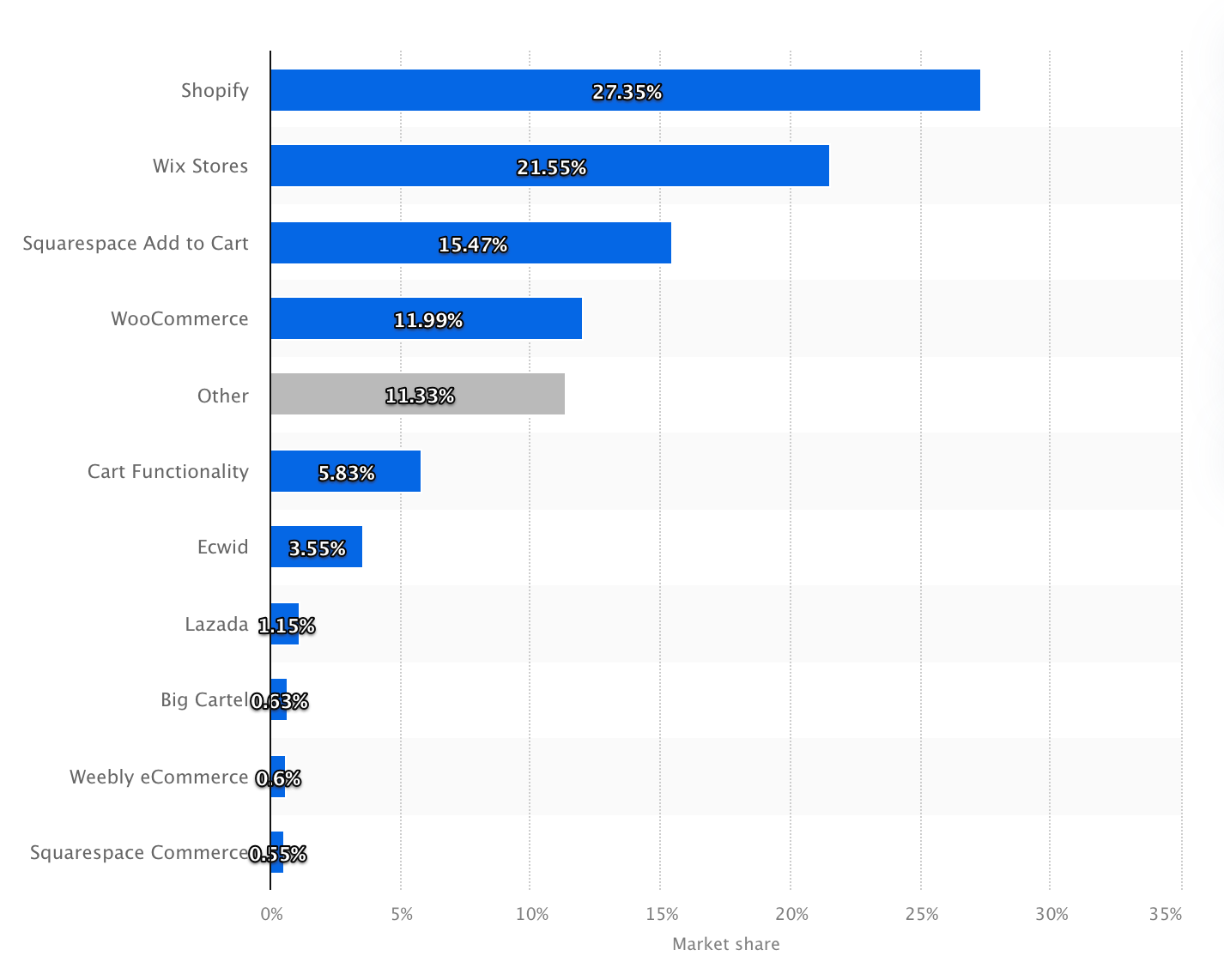
Today, Shopify is an absolute leader among eCommerce software platforms in the United States with more than 27% of the market share.
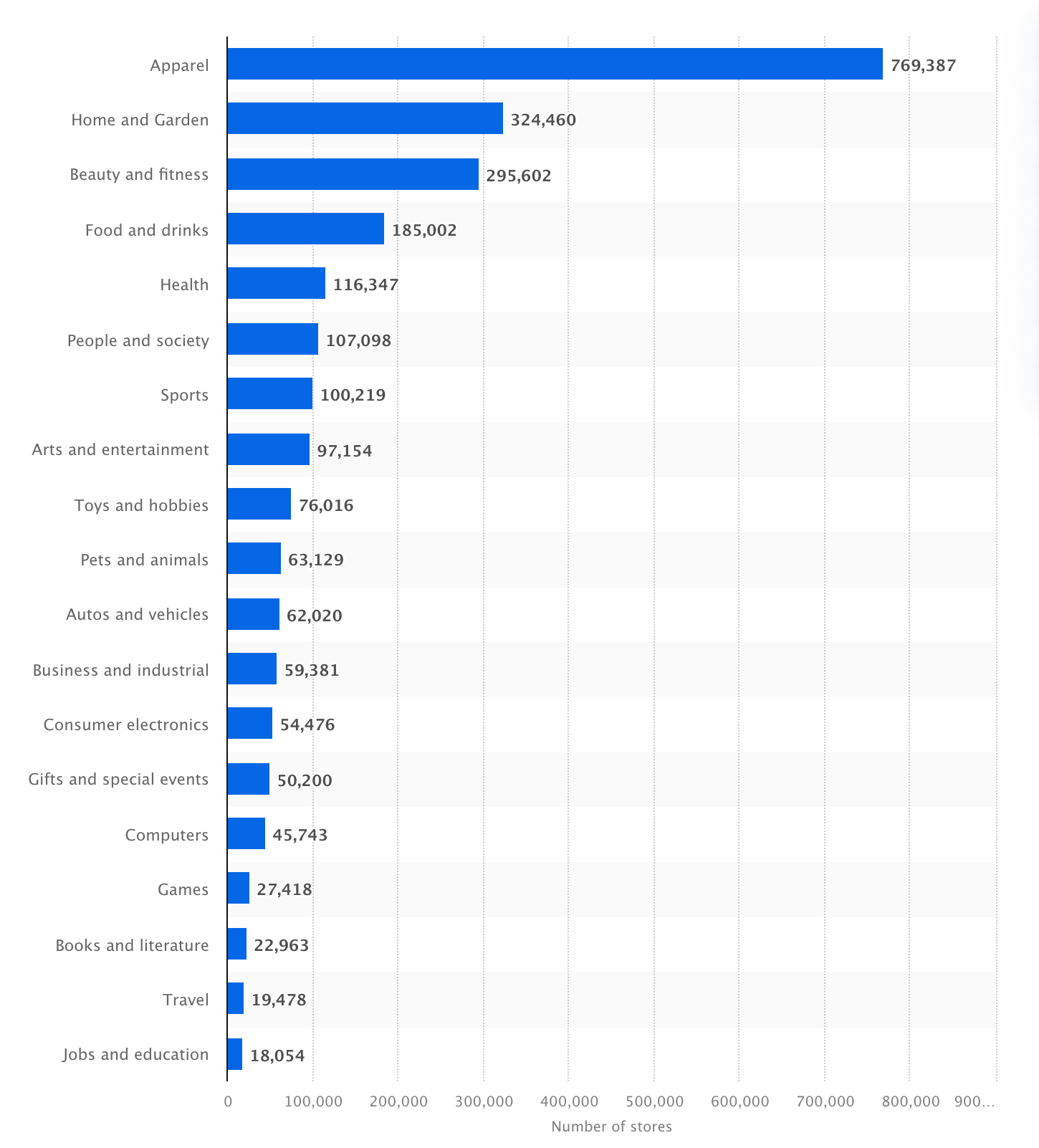
Businesses in the apparel segment choose Shopify the most often. Its combination of speed, scalability, and ease of use makes it especially popular among startups and SMBs.
What is Magento / Adobe Commerce?
Magento is now part of Adobe Commerce after its acquisition in 2018. Magento is a powerful open source eCommerce platform designed for businesses that need full control over their online store and technical infrastructure. Unlike Shopify, Magento offers you complete access to the source code, which enables unlimited customization and flexibility.

There are two main versions:
- Magento Open Source is free to use but requires your own hosting provider, development, and maintenance
- Adobe Commerce is a paid, enterprise-grade version with cloud hosting, advanced features, and dedicated support
Because Magento is PHP-based, it requires strong technical expertise and experienced Magento developers to build, maintain, and scale a store. Most Magento stores are not plug-and-play. It means that they are custom-built to fit specific business needs, often involving complex custom workflows, integrations, and infrastructure decisions.
One of Magento’s biggest advantages is its flexibility. It supports deep customization options that allow businesses to build highly tailored eCommerce experiences, integrate with ERP systems, and manage multiple stores from a single backend. Through the Magento Marketplace, businesses can also extend functionality using thousands of Magento extensions, although many require technical configuration.
Magento is one of the most popular platforms in Europe that powers some of the world’s largest brands, including Nike and Hermès. Companies choose it because they rely on its ability to handle large catalogs, high traffic, and complex eCommerce operations.
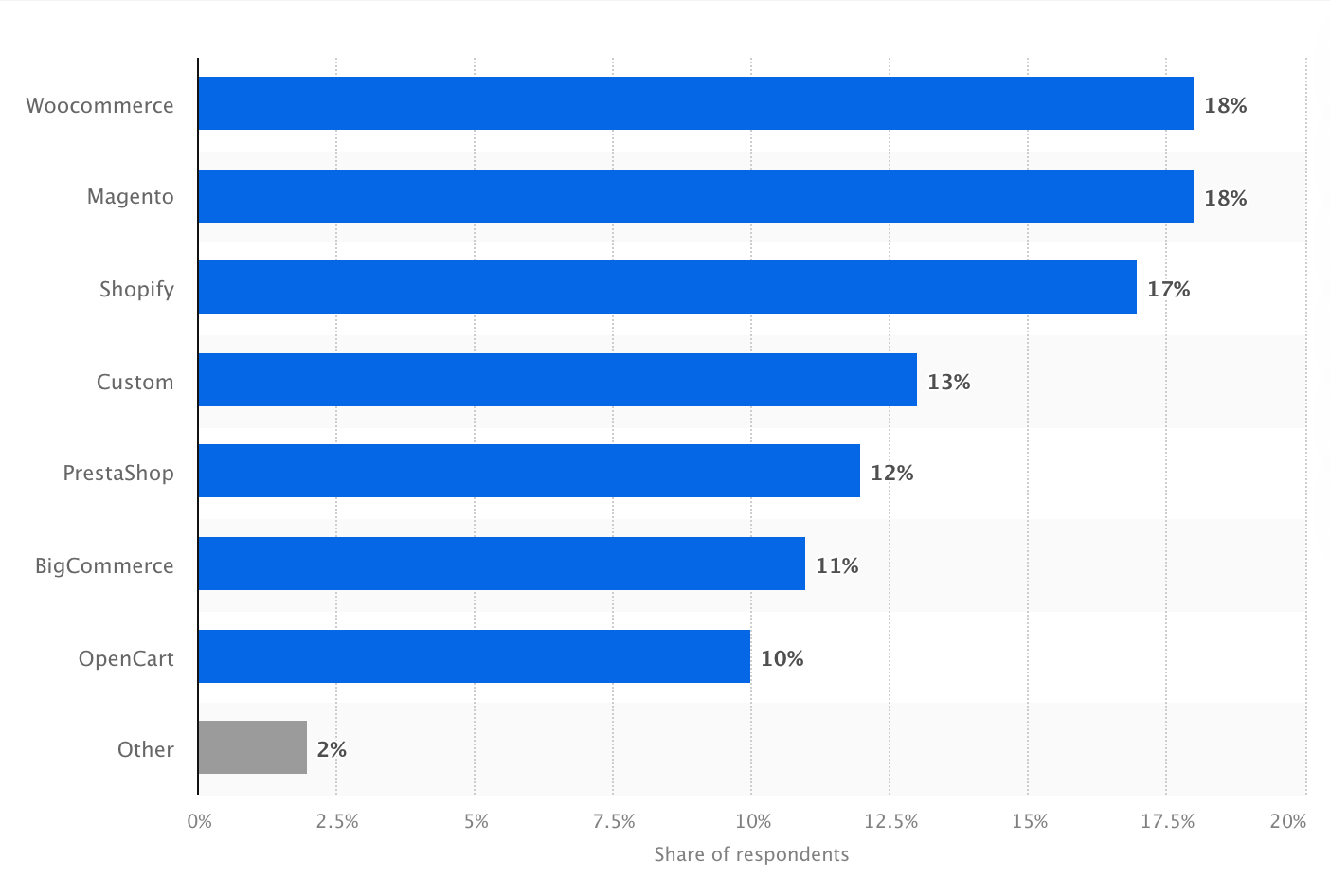
While Shopify focuses on simplicity, Magento is built for control, scalability, and complexity. But this comes with higher development costs, ongoing maintenance, and a greater need for technical resources.
Ease of use: which platform is simpler to manage?
When comparing Magento vs Shopify, ease of use is one of the key differentiators.
Shopify is suitable for non-technical users. Its drag-and-drop interface, intuitive dashboard, and built-in features allow you to manage your online store without coding. Tasks like adding products, editing pages, or setting up marketing tools can be done quickly. For most Shopify merchants, this simplicity is one of the platform’s biggest advantages.
In contrast, Magento is significantly more complex. It requires knowledge of development, server environments, and technical configuration. Setting up a Magento store typically involves working with developers, managing hosting, and handling ongoing server maintenance and security patches.
This is why many businesses using Magento need to hire dedicated development teams or external partners to manage their platform. While this adds flexibility, it also increases dependency on technical resources and ongoing development.
So, Shopify wins for ease of use, fast setup, and minimal technical involvement. And Magento is best at control and flexibility, but requires strong technical expertise.
For startups and non-technical teams, Shopify is often the simpler and more efficient eCommerce platform. For larger businesses with access to developers and complex requirements, Magento offers the depth needed to build highly customized solutions.
Also, read in our blog how to start a tech startup.
Pricing & total cost of ownership
When comparing Magento vs Shopify, pricing is where many businesses can make the wrong decision. On the surface, Shopify looks more expensive because of its monthly fees. However, Magento can quickly become the costlier option once you factor in development, hosting, and everyday maintenance.
Shopify pricing
Unlike Magento, Shopify’s biggest advantage is clarity. Its Shopify pricing structure is straightforward, with fixed monthly plans:
- Basic Shopify — $39/month
- Grow (Shopify) — $105/month
- Advanced Shopify — $399/month
- Shopify Plus — from $2,300/month
These plans include hosting, security, and most of the technical maintenance, which means you don’t need to worry about servers or updates.
That said, there are still extra costs to keep in mind:
- Transaction fees (if you’re not using Shopify Payments)
- Paid apps from the Shopify App Store
- Premium themes and advanced features
Overall, Shopify offers predictable monthly costs, which is a big advantage for startups and teams without technical resources.
Magento pricing
Magento works very differently. While Magento Open Source is technically free, running a real Magento store may become a rather expensive process.
Here’s what you actually pay for:
- Web hosting — typically $50 to $500+ per month
- Development costs (often the biggest expense)
- Ongoing maintenance and security patches
- Paid Magento extensions and integrations
For larger enterprises, Adobe Commerce starts at around $22,000 to $125,000 per year, depending on your revenue.
The key thing to understand:
Magento gives you full control, but you’re responsible for the entire technical infrastructure, from your hosting provider to performance optimization. This is why total costs can quickly grow, especially if you need custom features or complex integrations.
What does it actually cost?
| Business size | Shopify (annual estimate) | Magento (annual estimate) |
|---|---|---|
| Startup | $500 – $3,000 (Basic Shopify + a few apps + low transaction fees) | $5,000 – $15,000 (hosting + basic setup + limited development) |
| Mid-market | $5,000 – $15,000 (Advanced Shopify + growing app stack + transaction fees) | $15,000 – $50,000 (custom features, integrations, ongoing development) |
| Enterprise | $30,000 – $100,000+ (Shopify Plus + apps + scaling costs) | $50,000 – $150,000+ (Adobe Commerce + dedicated development teams + infrastructure) |
The real difference
- Shopify keeps things simple with predictable monthly costs and minimal setup
- Magento gives you flexibility, but ongoing costs are harder to control and often higher long-term
- Transaction fees, apps, and scaling increase Shopify costs gradually
- Magento requires upfront and ongoing investment in technical capabilities
So, in the Shopify vs Magento decision, Shopify is usually more cost-efficient early on. Magento makes sense when your business needs outweigh the simplicity of a hosted solution.
That's why choosing the platform, you should not look for the cheaper option, but you need to understand how complex your business is, and what you are willing to manage long-term.
Customization & flexibility: how much can you modify each platform?
Customization is an important factor when comparing Magento and Shopify. Both platforms let you build a strong online store, but they approach flexibility in very different ways.
Shopify: flexibility within clear boundaries
Shopify is designed to make customization accessible without requiring deep technical knowledge. You can choose from over 100 themes, use the Online Store 2.0 framework to build modular pages, and adjust the frontend using Shopify Liquid. On top of that, the Shopify App Store gives you access to thousands of third-party apps that extend functionality.
For most businesses, this setup is more than enough. You can launch quickly, customize your design, and add features as you grow. But there’s a clear boundary: Shopify doesn’t give full access to its core system. That means certain backend logic, complex custom integrations, or very specific workflows can be difficult. Moreover, sometimes it's impossible to implement without workarounds.
In simple terms, Shopify offers flexibility, but within a controlled environment. It’s optimized for speed and usability, not unlimited modification.
Magento: built for full control
Magento sits on the opposite end of the spectrum. As an open-source platform, it gives you full access to the codebase, which means you can customize every part of your store — from the frontend experience to backend logic. This is why Magento is often chosen by businesses with more complex needs. You can build custom themes from scratch, create advanced custom workflows, and connect your store to ERP, CRM, or other internal systems. It also supports headless commerce and PWA architectures using technologies like React or Vue.js, which opens the door to highly optimized and scalable experiences.
However, this level of control comes with responsibility. Magento requires technical expertise, and most businesses rely on experienced developers or even need to outsource software development to manage the platform. More flexibility also means more involvement in ongoing support, testing, and stability.
💡 Empat Tech insight: For businesses needing complex workflows such as multi-warehouse setups, ERP integration, or advanced custom pricing, Magento customization is unmatched. But it requires a skilled development partner.
What this means in practice
So, comparing Shopify vs Magento, the core difference deals with how much control you actually need.
Shopify works best when your business can adapt to a proven structure, and you want to move fast without heavy technical involvement. Magento makes sense when your processes are unique, your requirements go beyond standard eCommerce logic, and you need a platform that can adapt to you — not the other way around.
So, the real question is whether your business actually needs that flexibility enough to justify the added complexity.
SEO capabilities: which platform ranks better?
Online stores mostly rely on organic traffic compared to other digital channels. That's why, when looking at Magento vs Shopify, SEO can become a deciding factor. Both platforms can rank well in a search engine, but they give you very different levels of control.
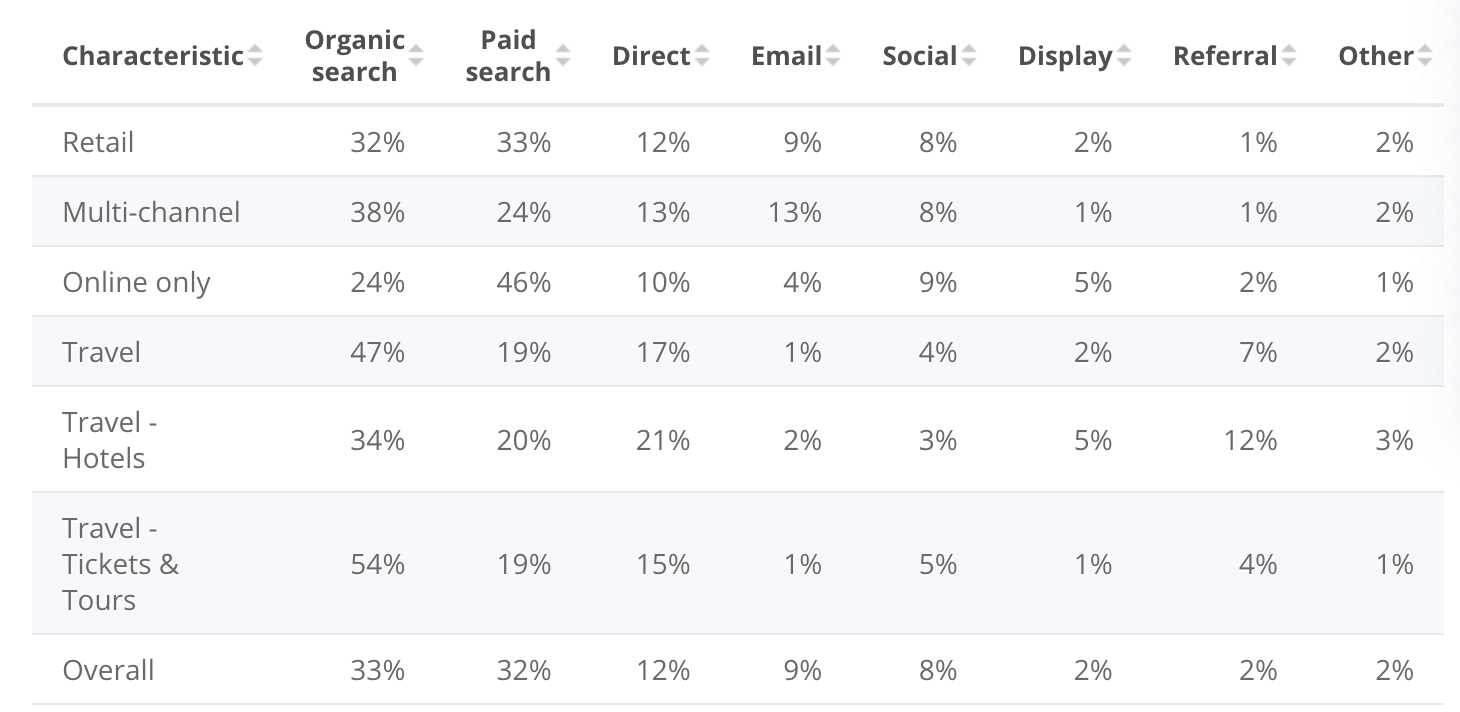
Magento provides considerable flexibility. You can fully control your URLs, edit robots.txt, implement advanced schema markup, and structure your site exactly the way you want. This matters a lot for larger catalogs or businesses operating in multiple markets. In such a case, search engine optimization goes beyond just meta titles and descriptions. Magento also supports server-side rendering and advanced sitemap configurations, which can improve how search engines crawl and index your site.
That level of control isn’t just theoretical. In one real case, a brand that migrated to Magento saw a 42% increase in organic traffic within five months, mainly due to improvements in technical SEO and site structure.
Shopify takes a different approach. It handles most SEO basics for you, including sitemaps, page speed, and core settings, which are all built in. For many businesses, especially smaller ones, that’s enough to perform well. But there are some limitations. URL structures are fixed (you’ll always see paths like /products/ or /collections/). Even though Shopify has improved access to technical settings, it’s still more restricted compared to Magento.
So, Magento gives you full control if SEO is a core growth channel. Shopify keeps things simple and still works. In practice, Magento is better if you have a clear SEO strategy and the team to execute it. On the contrary, Shopify is better if you want solid results without getting into the technical side.
Performance & scalability
79% of organizations state that improved scalability and better user experience are top considerations when choosing the eCommerce platform. When you evaluate Magento vs Shopify, performance and the ability to grow fast and effectively are essential decision factors. And in this case, these two platforms take very different approaches.
Shopify is a fully hosted platform that focuses on performance. It manages hosting, caching, and scaling. Shopify includes a global CDN, automatic scaling during traffic spikes, and an uptime of around 99.98%. For most businesses, this removes a major operational burden because you don’t need to think about servers, traffic surges, or technical infrastructure. Your online store will perform reliably, even during high-demand periods like sales or product launches.
Magento works differently. Here, performance depends on how well your store is built and maintained. Your hosting provider, server environment, and development quality all play a role. With the right setup, Magento stores can outperform many platforms. This platform is especially effective for large catalogs or complex eCommerce operations. However, without proper optimization, performance issues can appear quickly.
Magento also supports advanced setups like Progressive Web Apps (PWA). They allow you to create fast, app-like experiences for mobile users. For businesses investing in mobile-first strategies or even mobile app development, this can significantly improve the overall customer experience.
So, comparing Shopify and Magento, the difference is clear. Shopify offers consistent, hands-off performance with minimal effort. Magento gives you more control and higher potential, however, only if you have the technical team to manage it properly.
Apps, extensions & integrations
Constant development of your eCommerce store requires the use of different apps and integrations. That's why it's critical to compare the offerings of both Magento and Shopify before you choose the platform to move on.
The Shopify App Store has 8,000–10,000+ apps that you can install in just a few clicks. Most of them are plug-and-play, which means you don’t need deep technical knowledge to add new features to your online store. In case you need email marketing, analytics, or inventory management, you can usually connect a tool in minutes. This is a big advantage for teams that want to move fast without worrying about compatibility issues or heavy development work.
Magento takes a more technical approach. The Magento Marketplace offers around 5,600+ extensions. Even though the number is slightly smaller, the real difference is in flexibility. Magento integrations are deeper and more customizable, but they require proper setup and testing. In many cases, you’ll need experienced Magento developers to make sure everything works smoothly.
This difference becomes especially clear when you look at integrations. Shopify is ideal for plug-and-play tools. You can connect payment gateways, marketing tools, or third-party services with minimal effort. Magento, on the other hand, is better suited for complex systems like ERP or CRM integrations (for example, SAP or Salesforce).
Shopify gives you speed and convenience. Magento gives you control and depth. The right choice depends on whether you need quick connections or highly customized integrations that align with your internal eCommerce operations.
Security
Security is one of those things you don’t think about until something goes wrong. However, when starting a new business, you always need to think about possible security issues. In the Magento vs Shopify comparison guide, the key difference is simple: Shopify handles it for you, Magento puts you in charge.
Shopify comes with PCI compliance (Level 1) out of the box. It includes SSL, automatic updates, and the platform takes care of most security risks behind the scenes. For many businesses, this removes a lot of pressure. You don’t need to worry about vulnerabilities, patches, or maintaining a secure server environment. Shopify provides it all as part of the service.
Magento works differently. You’re responsible for your store’s security, including such processes as applying security patches to maintaining compliance standards like PA-DSS. That includes managing your hosting provider, monitoring threats, and making sure your system stays up to date. This gives you more control, but also adds risk if things are not handled properly.
Empat insight: With Magento, you control everything, including security. Without a reliable dev partner, this becomes a liability.
In practice, Shopify is the safer choice for teams without strong technical resources. Magento makes sense if security needs to be tightly integrated into a broader technical infrastructure, but it requires ongoing attention and expertise.
B2B & enterprise features
If you’re running a B2B business or planning to scale into one, the gap between Shopify and Magento becomes much more noticeable.
Magento has long been built with complex business models in mind. It includes a full B2B suite with features like company accounts, custom catalogs, quote requests, and tiered pricing. You can manage multiple stores, set up advanced custom pricing, and integrate directly with ERP systems. For businesses with layered pricing structures or multiple customer segments, this level of control is hard to match.
Shopify has made significant progress here, especially with Shopify Plus. Over the past couple of years, it has introduced wholesale channels, a dedicated B2B portal, and more flexible pricing options. For many brands, these updates are enough to support basic B2B operations.
But once things get more complex, for example, when you need custom workflows, deep ERP integration, or highly specific pricing logic, Shopify often relies on apps or workarounds. At this point, your eCommerce business may focus on some limits.
So, in the Magento vs Shopify decision:
- Magento is better suited for complex B2B setups and enterprise-level requirements
- Shopify Plus works well for simpler B2B models and faster execution
Support & community
Support is one of those factors that doesn’t seem critical at the start, until you run into an issue that blocks your eCommerce operations.
Shopify offers 24/7 support via live chat, phone, and email. There’s also a large community and a marketplace of certified experts who can help with everything from setup to scaling. For many Shopify merchants, this accessibility is a big advantage. If something breaks, you know where to go.
Magento’s approach is less centralized. If you’re using Magento Open Source, support mainly comes from community forums and documentation. There’s a strong developer community, but no built-in live support. With Adobe Commerce, you do get access to official support — but it’s part of a paid enterprise package. In reality, Magento support often depends on your internal team or external partners.
If you want quick answers and direct support, Shopify is the easier option. If you’re comfortable relying on developers and managing your own ecosystem, Magento gives you more flexibility.
Magento vs Shopify: migration considerations
Switching between Shopify and Magento is more common than it might seem. For example, almost 16% of businesses have recently migrated from Magento to another platform. At the same time, almost 70% of all respondents chose Shopify as the next platform to migrate to. Businesses grow, priorities change, and at some point, the platform you started with may no longer fit.
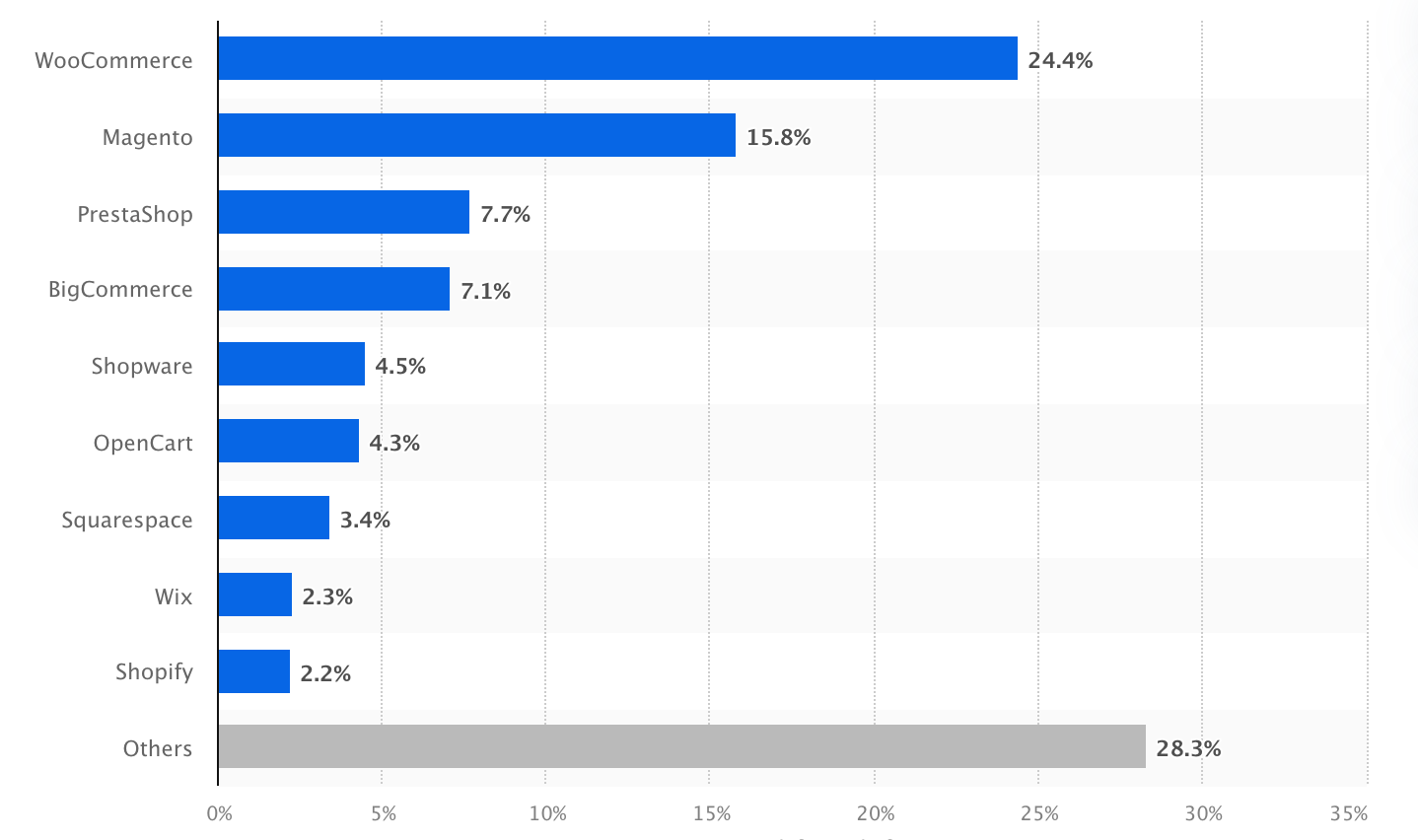
Even though you can move from Shopify to Magento and the other way around, it’s not something you “just do.” Migration means rebuilding parts of your store while carefully carrying over the data that matters.
In most cases, you’ll need to migrate products, customers, and order history. But that’s only part of the job. SEO URLs and redirects are just as important. If they’re handled poorly, you risk losing the organic traffic you’ve worked hard to build. This is where the structure differences between platforms matter — Shopify has its own URL logic, while Magento gives you more control but requires more setup.
Costs can vary quite a bit. A simple migration might start around $5,000. However, for larger stores with custom features and integrations, it can easily go beyond $30,000. The bigger the store and the more systems you rely on (ERP, CRM, custom tools), the more complex it gets.
The direction of migration usually says a lot about a business. Moving from Shopify to Magento often means you need more flexibility, deeper customization, or more advanced B2B functionality. Moving from Magento to Shopify usually means the opposite — simplifying operations and reducing the need for heavy technical maintenance.
One thing is consistent across both cases: migration isn’t just a technical task. It affects your SEO, your user experience, and how your team works with the platform day to day. That’s why many companies choose to work with a development partner who’s done this before, instead of handling it internally.
Which platform should your business choose?
Even though we've compared all important aspects for the best eCommerce platform choice, there's still no universal option. The right choice depends on where your business is today and where you’re trying to go. Instead of focusing on features alone, it helps to look at your setup, your team, and how complex your operations are.
Choose Shopify if:
Shopify works best when speed and simplicity matter more than a high level of customization.
If you’re a startup or an SMB and want to get your store live quickly, Shopify removes a lot of friction. You don’t need a large team to cover startup development services. Most of the setup you can handle without technical expertise. It’s also a strong fit for direct-to-consumer (DTC) brands that rely on multi-channel selling. For example, you can connect your store with social platforms, marketplaces, and ads without heavy configuration.
In short, choose Shopify if you want a system that works without your micro-management and lets you focus on sales rather than infrastructure.
Choose Magento if:
Magento makes more sense when your business has already outgrown standard solutions.
It’s a strong fit for enterprises or fast-scaling B2B companies that need full control over how their store works. If your operations include complex workflows, custom pricing models, or deep ERP integrations, Magento gives you the flexibility to build exactly what you need.
It’s also the better option if SEO is a major growth channel and you want businesses to have complete control over URLs, technical structure, and performance. And if you’re running multiple storefronts or managing different markets, Magento handles that complexity more naturally.
Consider custom development if:
Sometimes, neither platform fully fits your needs. If your business has highly specific logic, unique user flows, or strict performance requirements, a custom solution can be a better long-term investment.
This is often where companies bring in a development partner to design a system around their exact needs, instead of adjusting their business to fit a platform.
In the end, the right choice does not deal only with features. The platform you use needs to support your business model, your team, and your growth plans.
How Empat Tech can help
Choosing between Shopify and Magento is one thing. However, making it work in practice is a considerable challenge that determines the success of your e commerce store. That’s where Empat can help you. At Empat Tech, we work with both platforms and help businesses build stores that actually fit how they operate, not the other way around.
On Shopify, we handle custom theme development, app integrations, and performance optimization for brands that want to move fast without losing quality. On Magento, we support more complex builds that include enterprise architecture, integrations with ERP, CRM, custom internal systems, as well as launching AI app development.
Across 300+ delivered projects, we’ve worked with startups scaling their first store and enterprise teams managing multi-storefront ecosystems. If you’re planning a new build or considering a migration, we can help you map out the right approach before you commit to anything.
Conclusion
When comparing Magento vs Shopify, you need to focus on which platform fits your business right now.
Shopify is built for speed, simplicity, and ease of management. Magento is built for control, flexibility, and complex business needs. If you’re a smaller team or want to launch quickly, Shopify usually makes more sense. If you’re scaling, need advanced customization, or rely on complex integrations, Magento often becomes the stronger choice.
The decision comes down to your business size, your technical team, and how much flexibility you need as you grow.
If you’re still unsure which direction to take, it’s worth talking it through with a team that works with both platforms. Reach out to Empat Tech, and we’ll help you choose and build the solution that actually fits your goals.
FAQ
What is the difference between Magento and Shopify?
The main difference between Magento and Shopify comes down to control vs simplicity. Shopify is a fully hosted platform that handles hosting, security, and maintenance for you, making it easy to launch and manage an online store without technical skills. Magento, on the other hand, is an open-source platform that gives you full control over your store’s functionality, design, and infrastructure — but it requires development work and ongoing maintenance.
In short, Shopify is easier to use, while Magento is more flexible.
Is Magento better than Shopify?
Magento is not universally better — it depends on your business needs. In the Shopify vs Magento comparison, Magento is better for businesses that need deep customization, complex integrations, and full control over their eCommerce operations.
However, Shopify is often the better choice for startups and small to mid-sized businesses because it’s faster to launch, easier to manage, and doesn’t require technical expertise.
So the better platform is the one that matches your resources and growth plans.
Which is better for SEO, Magento or Shopify?
Magento is generally stronger when it comes to advanced search engine optimization. It gives you full control over URLs, site structure, and technical SEO settings, which is important for large or complex stores.
Shopify covers the basics well and works for most businesses, but it has some limitations — like fixed URL structures and less flexibility in technical SEO.
In the Magento vs Shopify debate, Magento is better for SEO flexibility, while Shopify is easier to manage.
What are the disadvantages of Magento?
Magento’s biggest downside is complexity. It requires technical expertise, which means you’ll likely need developers or a dedicated team to build and maintain your store.
Other common challenges include:
- Higher development costs and ongoing maintenance
- Responsibility for hosting, security, and updates
- Longer setup time compared to Shopify
- Dependence on developers for changes and improvements
While Magento gives you more control, it also requires more time, budget, and technical resources to manage effectively.


