
RAG Implementation Guide for Enterprises
How enterprises actually implement retrieval-augmented generation in 2026: the pipeline, how to choose a vector database and chunking strategy, how to evaluate for hallucinations, the mistakes we see most often, and realistic costs and timelines.

Retrieval-augmented generation (RAG) has become the default way enterprises get large language models to answer questions using their own data, without retraining the model itself. If you are a CTO or engineering lead scoping a RAG project in 2026, the decisions that matter are less about which LLM to call and more about how you retrieve, chunk, evaluate, and guard the pipeline around it.
This guide walks through a working RAG architecture, how to choose a vector database and chunking strategy, how to evaluate the system for hallucinations, the mistakes we see teams make most often, and what realistic cost and timeline ranges look like.
What Is RAG and Why Do Enterprises Use It?
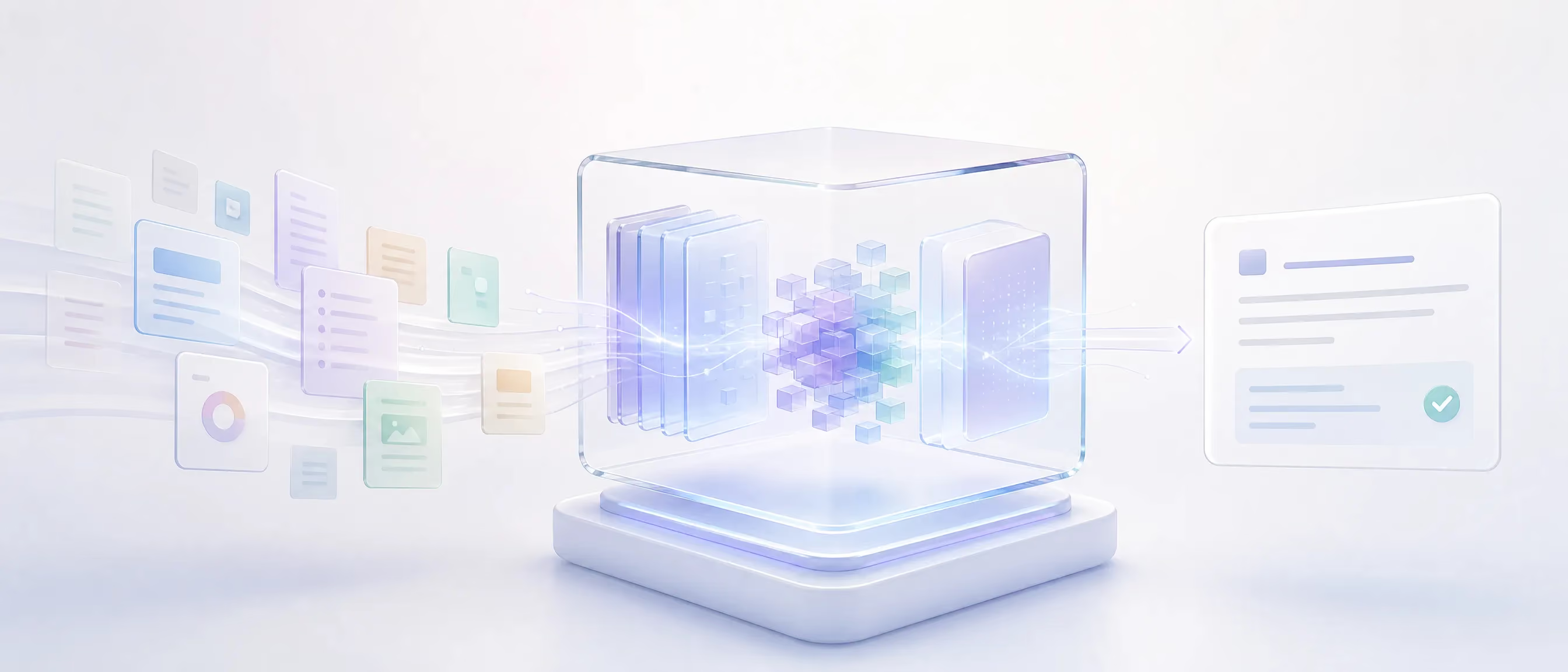
Retrieval-augmented generation is an architecture that retrieves relevant chunks of your own documents or data at query time and feeds them to a large language model alongside the user's question, so the model answers from your current, verifiable information instead of only what it learned during training. Enterprises use it because it lets them change the underlying data — policies, product docs, support tickets, contracts — without retraining or fine-tuning a model, and because it lets answers be traced back to a source document. RAG is also the foundation most AI agents rely on to stay grounded in real data — see Empat's explainer on what an AI agent actually is for how the two fit together.
Industry analysis in 2026 puts RAG as the right first choice for roughly 80% of enterprise LLM applications, precisely because it decouples the model from the data: you can swap the base model, update the knowledge base daily, and cite the source of every answer. Fine-tuning still has a role, but mostly for shaping tone, format, and behavior rather than for injecting fast-changing facts (Winder.ai, 2026 RAG vs. fine-tuning framework).
How Does a RAG Pipeline Work?
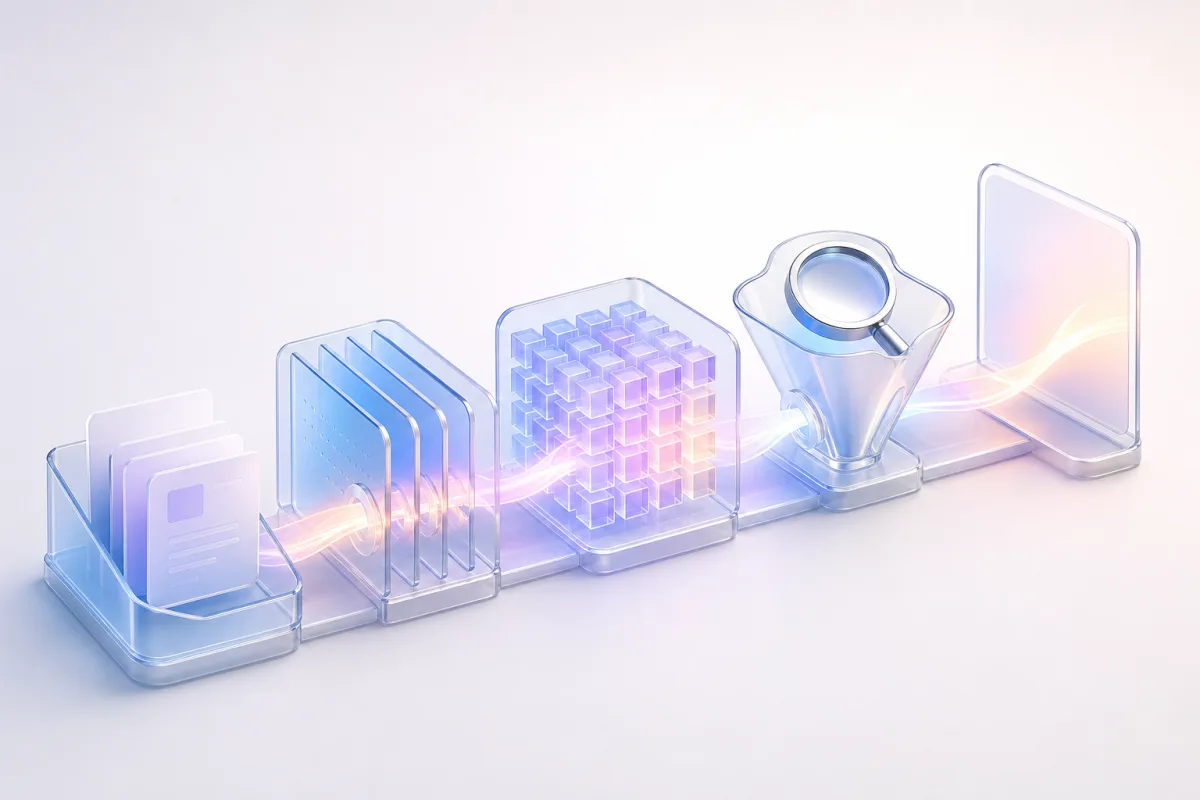
A production RAG pipeline has five stages, and most implementation problems trace back to one of them being under-engineered: ingest, chunk, embed, retrieve, and generate.
- Ingest. Documents (PDFs, wikis, tickets, CRM records) are pulled in and normalized into clean text, with metadata (source, date, owner, access level) preserved for filtering and citations.
- Chunk. Text is split into smaller passages sized for retrieval — see chunking strategy below.
- Embed. Each chunk is converted into a vector representation using an embedding model, capturing its meaning rather than just its keywords.
- Retrieve. At query time, the user's question is embedded the same way, and the system finds the most relevant chunks, typically combining vector similarity with keyword search and a re-ranking step.
- Generate. The retrieved chunks are passed to the LLM along with the question, and the model generates an answer grounded in that retrieved context, ideally with citations back to source documents.
Microsoft's own reference architecture for RAG in Azure AI Search follows this same shape, and it is a useful sanity check when reviewing a vendor's proposed design (Microsoft Learn, Retrieval Augmented Generation overview).
How Do You Choose a Vector Database, Embedding Model, and Chunking Strategy?
Pick the vector database based on your team's operational capacity and data residency needs, not on benchmark leaderboards: a managed service gets you moving fastest, a self-hosted option gives you more control, and a Postgres extension avoids adding a new system entirely if you are already running Postgres at scale.
| Approach | Best fit | Trade-off |
|---|---|---|
| Managed vector DB (e.g. Pinecone, Weaviate Cloud) | Teams that want to move fast without running infrastructure | Recurring cost scales with data volume and query traffic |
| Self-hosted open-source (Qdrant, Milvus, Weaviate OSS) | Teams with DevOps capacity or strict data-residency requirements | More operational overhead; you own uptime and tuning |
| Postgres extension (pgvector) | Teams already running Postgres who want one less system | Fine at small-to-mid scale; less optimized for very large similarity search |
| Hybrid retrieval layer (vector + keyword/BM25) | Layered on top of any of the above | Adds engineering effort but meaningfully improves recall on IDs, codes, and rare terms |
For chunking, size the passages to the question type: 256–512 tokens works well for narrow factual questions, while 1,000–1,500 tokens preserves more context for complex, multi-part questions. A pattern that consistently performs well in practice is to embed small child chunks for precise matching but return the larger parent passage they belong to, so the model gets enough surrounding context to answer accurately. Recursive chunking — splitting on natural boundaries like headings and paragraphs before falling back to character limits — outperforms fixed-size splitting because it avoids cutting a fact in half between two chunks.
Whichever embedding model you choose, re-run retrieval quality tests whenever you change it — embedding models are not interchangeable, and swapping one without re-embedding your whole corpus silently degrades retrieval.

How Do You Evaluate and Guard Against RAG Hallucinations?
RAG alone typically cuts hallucination rates substantially compared to an ungrounded model, and combining it with guardrails, structured evaluation, and human review can reduce hallucinations far further in a well-engineered stack. The mechanism matters more than the exact number: grounding answers in retrieved text only helps if the retrieval is actually relevant, so evaluation has to test retrieval and generation separately.
- Retrieval evaluation. Test whether the system fetches the right chunks for a set of known questions before you ever look at the generated answer.
- Faithfulness checks. Verify the generated answer is actually supported by the retrieved chunks, not just plausible-sounding — this catches the model quietly adding facts that were not in the source.
- Citation enforcement. Require the model to cite the specific chunk or document it used, which both improves user trust and makes faithfulness easier to audit automatically.
- Human-in-the-loop review. For high-stakes domains (healthcare, finance, legal), route low-confidence or high-impact answers to a human reviewer before they reach an end user.
The Mistakes We See Enterprises Make with RAG
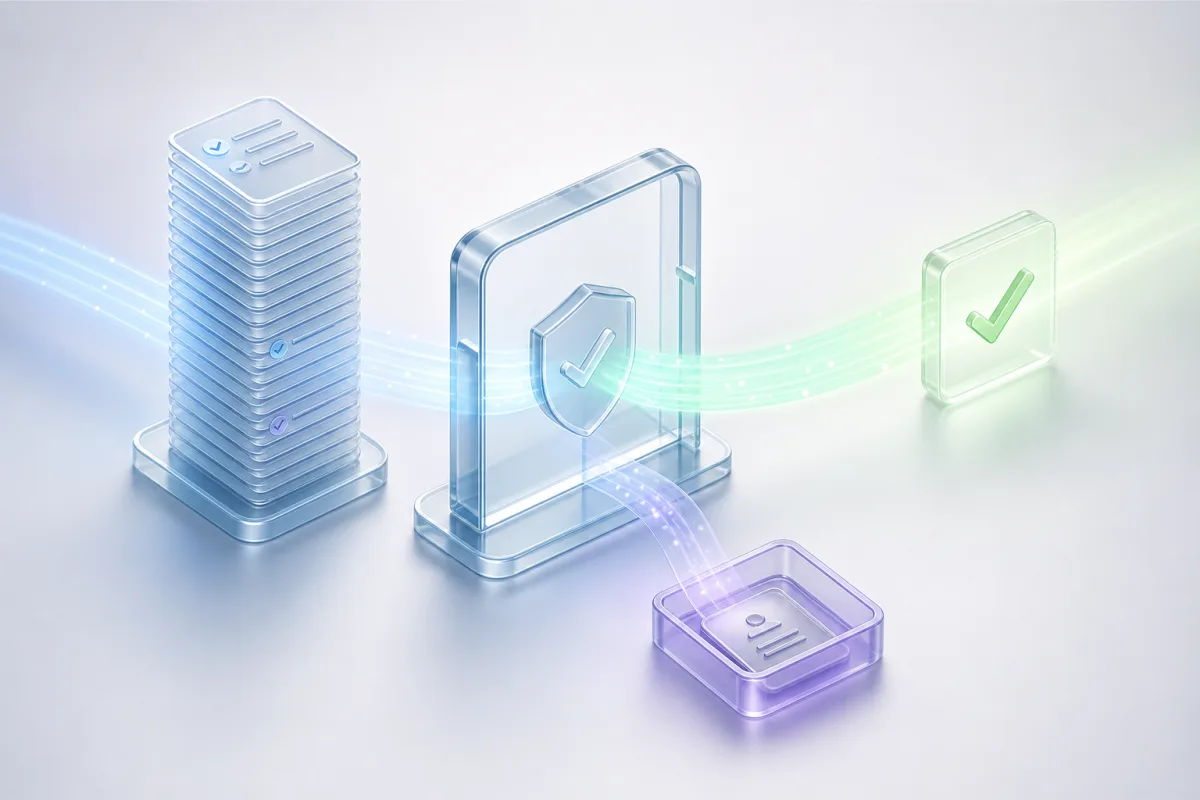
The most common mistake we see is treating RAG as a retrieval problem to solve once and then forget, when it is actually a data-quality problem that needs ongoing maintenance: stale documents, duplicate or conflicting sources, and missing access controls on retrieved content all quietly degrade answer quality long after launch, and none of them show up until a user asks the wrong question at the wrong time.
Two other patterns show up repeatedly in the RAG builds we have worked on. First, teams under-invest in evaluation up front, launching on a handful of manually-checked examples instead of a real test set, so retrieval regressions go unnoticed until a customer complains. Second, teams pick a single fixed chunk size for an entire, varied document set — a support ticket and a compliance contract do not chunk the same way — which quietly caps retrieval quality no matter how good the embedding model is. Building the evaluation set and the chunking strategy before writing the retrieval code, not after, is the single highest-leverage decision in the whole project.
How Much Does RAG Implementation Cost, and How Long Does It Take?
A scoped RAG proof of concept typically takes a few weeks and lands in the same range as other AI proofs of concept — Empat scopes AI-driven discovery and PoC work starting from about $5,000–$15,000, with a production-hardened build (evaluation pipeline, guardrails, access controls, and monitoring included) closer to the $30,000+ range depending on data volume, integration complexity, and how many source systems need to be connected. Timelines follow the same pattern: a working PoC in 2–4 weeks, then several more weeks to months to harden it for production traffic and sensitive data. Treat any RAG project as an MVP with its own build-measure-evaluate loop — Empat's AI MVP development services follow the same fixed-scope discovery-to-launch model — rather than a one-off integration task.
Empat's broader AI development services and the team's guide to building an AI app cover how this fits into a wider AI product roadmap beyond a single RAG feature.
FAQ
Should we use RAG or fine-tune our LLM?
Use RAG when your knowledge changes often, needs to be traceable to a source, or spans documents the model was never trained on — which covers most enterprise use cases. Fine-tuning is better suited to changing the model's tone, output format, or behavior on a stable task. Most production systems in 2026 combine both: RAG for facts, light fine-tuning for style.
How much does RAG implementation cost?
A scoped proof of concept typically falls in the same $5,000–$15,000 range as other AI PoCs, with a production-ready build starting around $30,000 depending on data volume, number of source systems, and how much evaluation and guardrail work is required. Ongoing costs also include vector database hosting and per-query embedding and generation calls.
How do we reduce hallucinations in a RAG system?
Ground every answer in retrieved text, require citations back to source chunks, and evaluate retrieval and generation quality separately rather than only checking whether the final answer sounds right. Routing low-confidence or high-stakes answers to human review closes most of the remaining gap for regulated use cases.
How long does it take to implement RAG in production?
A working proof of concept is realistic in two to four weeks. Hardening it for production — real evaluation sets, access controls on retrieved content, monitoring, and guardrails — typically takes several additional weeks to a few months, depending on how many data sources need to be connected and how regulated the domain is.


