

Turing Alternatives (2026): 12 Platforms Compared by Price, Vetting & Flexibility
Compare 12 Turing alternatives — Toptal, Empat, Arc.dev & more. Side-by-side pricing, vetting, and engagement models to find your best hiring fit.

Turing promises AI-powered matching with pre-vetted developers from a global talent pool. And really it delivers, at least for some companies. On practice, many CTOs and founders quickly discover the gap between the pitch and reality: developers who look great on paper may struggle with your project’s scope, pricing models that aren’t transparent, or an engagement structure that only supports full-time placements. Only 16% of companies work fully remote. And hiring remote developers who fit both your technical and cultural needs is a considerable challenge.
On one hand, Turing’s strengths include fast access to highly vetted developers and a rigorous vetting process, limitations remain. It also has some disadvantages like high hourly rates, inconsistent project management support, and AI matching that doesn’t always capture niche technical stacks. These issues have created demand for Turing alternatives. Businesses look for more flexibility, better alignment with their project goals.
This guide covers the best Turing alternatives for 2026. We compare tech professionals marketplaces like Toptal and Lemon.io with full-service development partners. You’ll get a detailed comparison of pricing, hiring process, trial periods, and engagement models. By the end, you’ll understand which platform or partner truly aligns with your goals for software development outsourcing, startup MVP development, and remote team scaling.
What is Turing and how does it work?
Turing is an AI-powered talent marketplace that connects companies with pre-vetted remote developers from a global talent network. Turing was founded in 2018. It focuses on providing full-time remote developers across a wide range of tech stacks. Businesses may use a platform to hire backend developers, find an app developer, leverage AI app development, hire React JS developers, or employ mobile apps developers. The platform aims to reduce the hassle of international hiring. It ensures initial screening, coding challenges, and matching candidates according to project requirements.
Turing's AI-powered matching model
Turing’s core differentiator is its AI-driven vetting process. Developers go through rigorous screening, which includes technical interviews, coding challenges, and soft skills assessments. Then, Turing uses algorithms to match talent with a company’s technical needs and project’s scope. It also considers time zones and cultural alignment. This system provides access to top-tier talent rather quickly. However, some companies report that AI matching doesn’t always consider industry requirements or team dynamics.
Pricing and engagement structure
Turing primarily offers full-time developer employment under monthly or annual contracts. Their rates range from $30–$100+ per hour depending on seniority and tech stack. Pricing transparency can vary, and upfront costs or deposits may apply. The platform focuses on long-term placements. However, it doesn't offer flexible engagement options. For some businesses, it can be a limitation for projects that require short-term support or managed project teams.
Why companies look for Turing alternatives
For some teams, Turing works well for hiring remote developers. For others, it becomes clear fairly quickly that the model doesn’t fit how they actually build software. Cost structure, flexibility, and day-to-day execution are usually where concerns start to show up.
High costs and opaque pricing
One of the most common issues is pricing. Turing does not publish clear rates, which makes early planning harder. Companies often learn the real cost only after several calls and candidate reviews. Hourly rates can look reasonable at first, but total costs grow fast once you factor in long-term commitments, replacement cycles, and management overhead.
AI matching limitations and quality inconsistency
Turing relies heavily on AI to run its vetting process and candidate matching. While the screening process includes technical interviews and coding challenges, results can vary.
Some companies report strong senior developers with solid technical skills. Others run into gaps between what was promised and what they get in practice. AI can filter resumes efficiently, but it struggles with context — problem-solving style, communication skills, and how a developer works inside a real remote team.
Limited flexibility
Turing is built around full-time remote developers. That works if you need long-term hires and already have strong project management in place.
It becomes a problem when the project’s scope changes or when you need flexible engagement options. Many teams want to start with a trial period, scale gradually, or bring in a mix of senior and junior developers. With Turing’s model, those options are limited.
Talent pool gaps for niche tech stacks
Turing promotes access to a global pool, which is valuable. Still, availability can be uneven for niche technologies or less common combinations of skills.
If you’re hiring remote tech talent for a very specific use case, such as legacy systems, uncommon frameworks, or early-stage product work, matching speed slows down. In those cases, companies often look beyond Turing to platforms or partners with more varied expertise or hands-on involvement in team formation.
Key factors to consider when evaluating Turing competitors
1. Vetting process and talent quality
Every platform claims to offer highly vetted developers, but the details matter. Look beyond promises and investigate how the screening process works in practice.
Strong providers combine technical interviews, skills tests, and real coding challenges as key stages of rigorous screening process. The best results usually come from a vetting process that also checks communication skills and problem solving capabilities, not just raw technical capabilities.
2. Pricing transparency and total cost of ownership
Hourly rates alone don’t tell the full story. Some platforms charge per hour with hidden margins. Others bundle costs into monthly contracts.
When evaluating pricing, consider total cost of ownership: onboarding time, replacements, project management effort, and ongoing dedicated support. Transparent pricing for software outsourcing makes it easier to compare vendors and avoid unexpected upfront costs that appear after contracts are signed.
3. Hiring speed and flexibility
Hiring speed matters, but flexibility matters more. Some platforms can introduce candidates within days but lock you into rigid contracts. Others allow flexible hiring options, hourly contracts, or short-term test projects before committing long term.
The best Turing competitors let you adjust team size, roles, and engagement length as your needs change.
4. Time zone alignment and communication
Time zone alignment has a direct impact on delivery. Teams working within overlapping business hours move faster and resolve issues earlier. According to the research maintaining at least four hours of overlap in time zone improves productivity by around 32% and collaboration effectiveness by 47%.
This is why many companies look at Latin American tech talent or Eastern European developers when hiring remote developers. Shared working hours improve collaboration, while strong communication skills reduce friction in distributed teams.
5. Project complexity and team scalability
Not every project needs a single developer. More complex products often require a full tech team, including backend, frontend, QA, and a dedicated project manager.
Some platforms focus only on individual freelance hires. Others support team scaling, managed delivery, and structured software engineering processes. Your choice should match the complexity of what you’re building, not just today’s needs but six months ahead.
6. Trial periods and risk mitigation
Risk management is often overlooked during hiring. Trial periods and free trial options reduce uncertainty and protect your delivery timeline.
Look for platforms that offer replacement guarantees, trial periods, or low-risk entry options. These safeguards make it easier to test collaboration quality before committing to long-term placements.
Best Turing alternatives at a glance
| Platform | Pricing model | Vetting level | Best for | Trial period | Engagement type |
|---|---|---|---|---|---|
| Empat Tech | Custom, transparent | Senior-only, multi-step | Full-cycle product teams | Yes | Managed teams, long-term |
| Toptal | Hourly, premium | Top 3% | Enterprise freelance hires | Yes | Freelance, contract |
| Lemon.io | Hourly | ~98% rejection rate | Startups needing fast top tier tech talent | Yes | Freelance |
| Arc.dev | Hourly / monthly | Platform-vetted + AI | Flexible remote hiring | Limited | Freelance, full-time |
| Andela | Monthly | Platform-vetted | Scaling distributed teams | No | Full-time remote |
| CloudDevs | Hourly ($45–70) | Senior-focused | Nearshore LatAm developers | Yes | Freelance |
| Upwork | Hourly / fixed | Open marketplace | Short-term, budget work | No | Freelance |
| Index.dev | Monthly | Senior-only | Long-term contractors | Yes | Contract |
| Revelo | Monthly | Platform-vetted | US time zone LatAm hires | No | Full-time |
| Fiverr Pro | Per project | Curated Pro tier | Small, defined tasks | No | Freelance |
| Flexiple | Hourly | Top 1% | Senior freelancers | Yes | Freelance |
| Remotebase | Monthly | Platform-vetted | Fast team assembly | Limited | Contract |
Top 12 Turing alternatives for 2026
Empat Tech — best for managed development teams and full-cycle projects
Overview
Empat Tech is not a marketplace, it’s a partner who helps hire dedicated developers for projects of different size. You hire a full team, including developers, QA, and a project manager. They take ownership of the whole project. You don’t have to coordinate freelancers individually or worry about gaps in workflow.
Services
Empat can take an idea from concept to live product. It covers product discovery, UX/UI design, MVP development, full software engineering, QA, and DevOps. They also provide software development outsourcing, ongoing support and scaling as your project grows.
Vetting
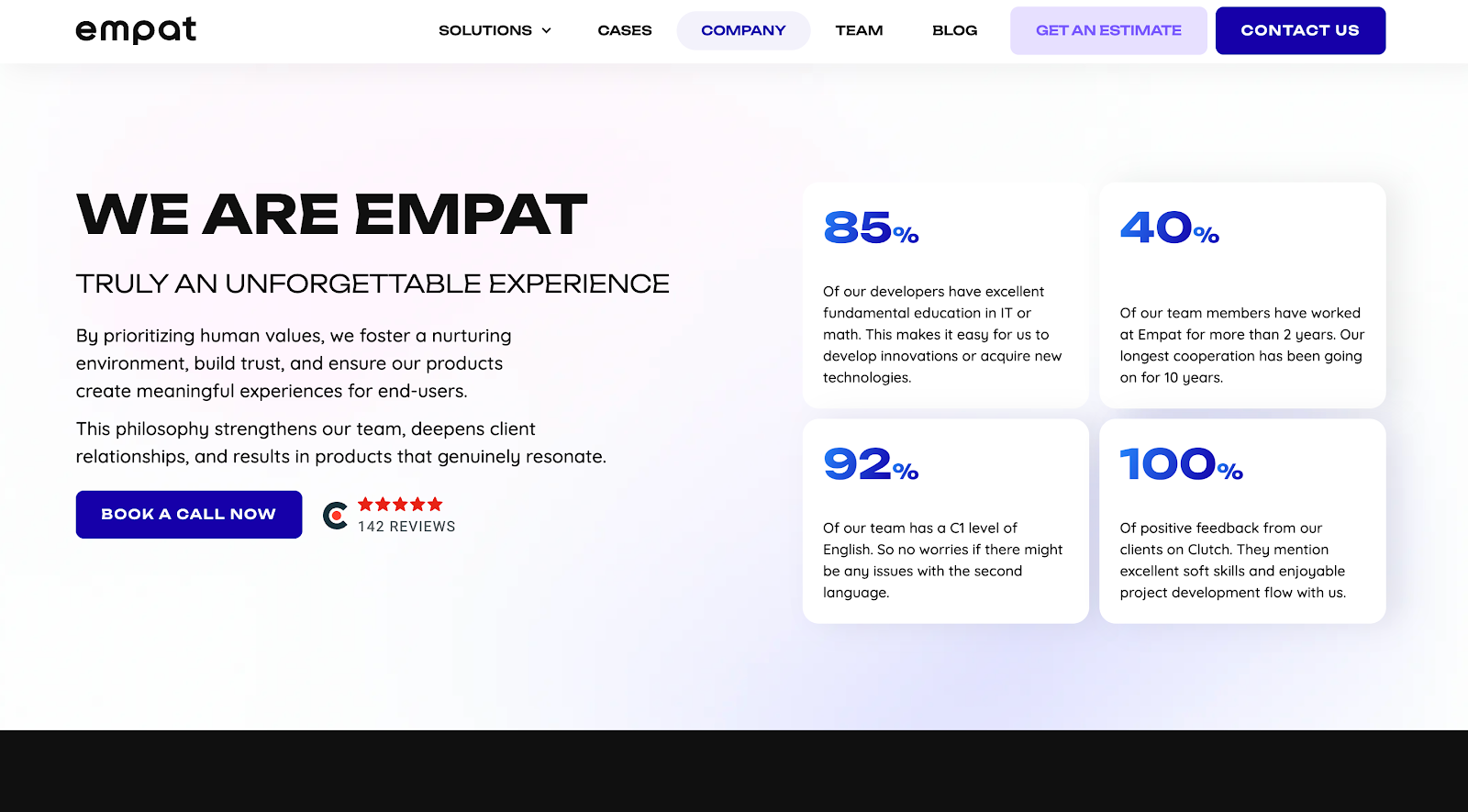
Considering the fact that 85% of developers have education in IT or math, Empat offers only world class talent and senior developers. Each candidate goes through a rigorous screening process, coding challenges, and real-world test projects. English proficiency, communication, and problem-solving skills are assessed to ensure smooth collaboration.
Pricing model
Empat offers custom, transparent pricing tailored to your project’s scope. It has no hidden fees or platform margins. You just cover clear costs aligned with your team’s composition.
Best for
Startups and companies that want a single point of accountability, reliable project management, and a cohesive, full-cycle team. Read how to hire developers for a startup or how to outsource software development for a startup in our blog post.
Why choose Empat over Turing
Turing provides individual placements; Empat provides a complete, managed team with hiring full-stack developers. This eliminates hiring overhead, reduces project risk, and ensures continuity even if team members change.
Toptal — best for enterprise-grade freelance talent
Overview
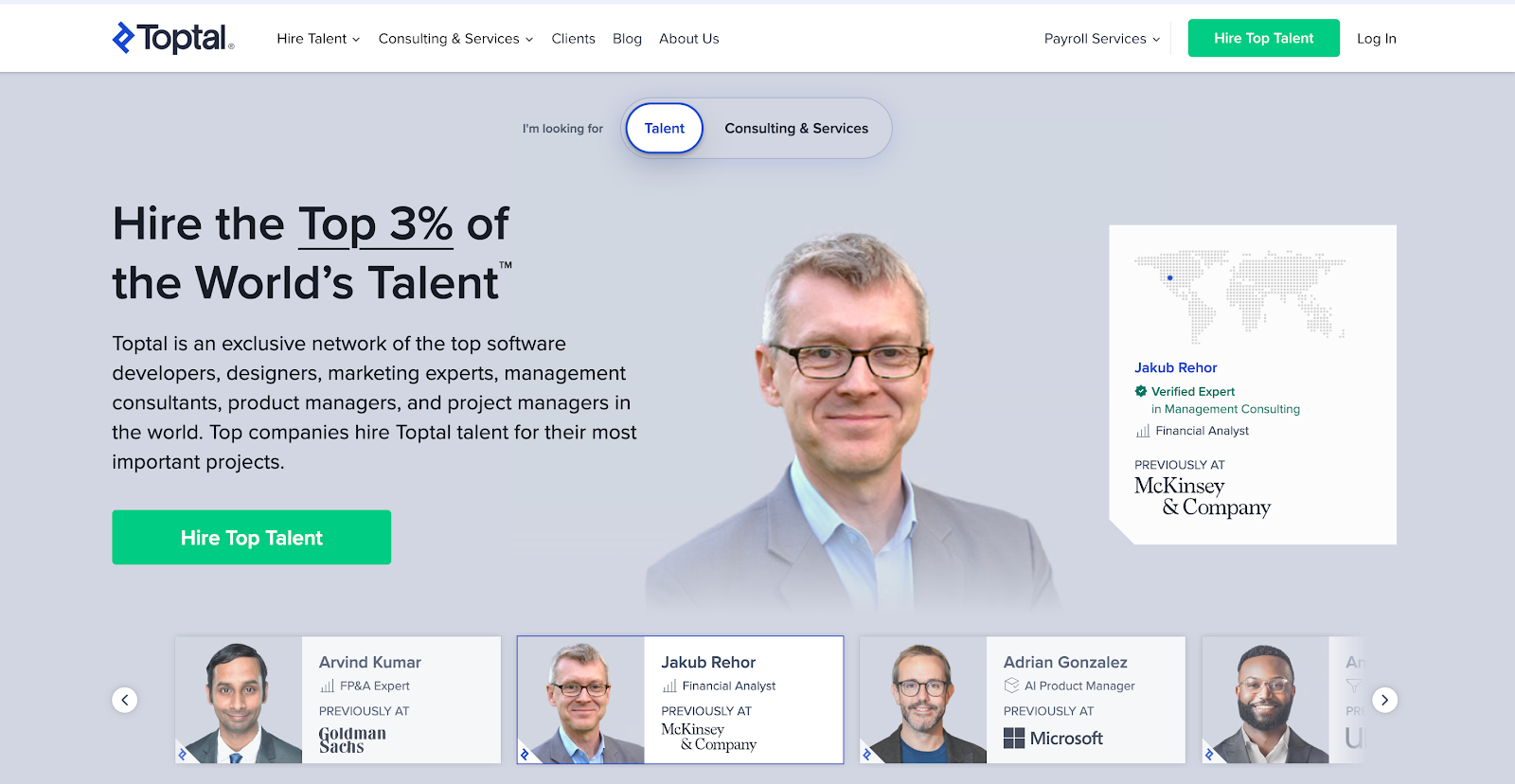
Toptal is a premium freelance network geared toward enterprises. It promises access to the top 3% of developers, designers, and finance experts, which is useful if you need high-level specialists for precise tasks.
Vetting
Candidates undergo language tests, technical interviews, and live screening. While rigorous, quality still depends on how well you manage them after hire.
Pricing
Toptal is expensive. Hourly rates vary and platform fees add on top. Pricing isn’t fully transparent until matching begins, so budgeting can be tricky.
Best for
Enterprises looking for individual experts to plug into existing teams.
Pros / Cons
✔ Top-tier specialists
✖ High cost, limited team support — you handle project management
View other Toptal competitors.
Lemon.io — best for startups needing fast senior developer matching
Overview
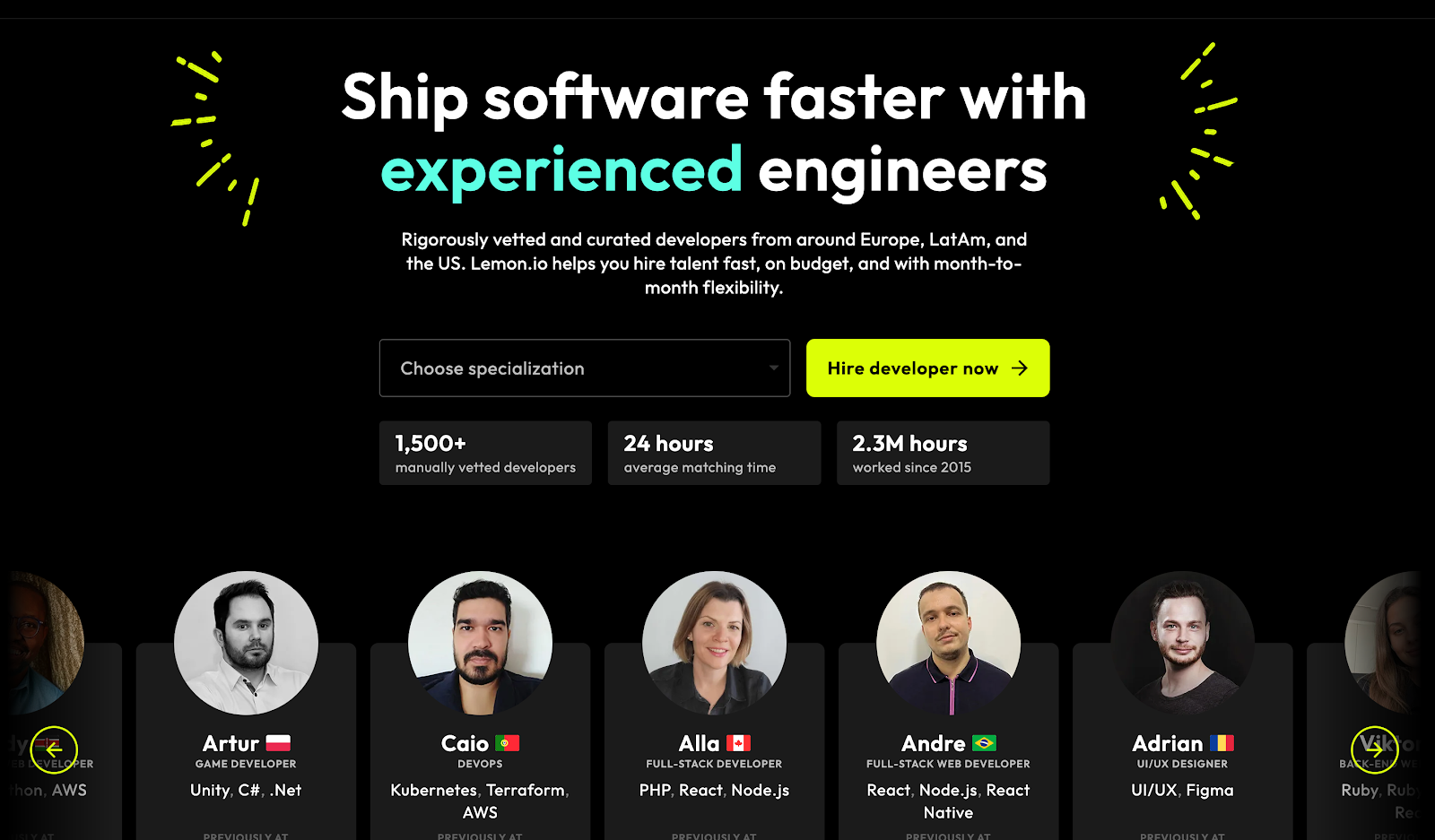
Lemon.io targets early-stage startups that need experienced developers quickly. If you need one or two senior developers for and don’t want to wait weeks for hiring, this platform can save time.
Vetting
The platform states that it rejects 98% of applicants. At the same time, selected developers undergo technical interviews and coding challenges to confirm skills.
Pricing
Hourly rates with a set platform fee. Fairly predictable for small teams.
Best for
Startups that need fast hires for defined short- or mid-term projects.
Pros / Cons
✔ Quick matching, top talent
✖ Not suitable for building full teams or long-term support
Arc.dev — best for AI-powered matching with flexible hiring models
Overview
Arc blends AI matching with human vetting. It’s flexible, allowing freelance, full-time, or contract hires across different locations.

HireAI feature
Shortlists candidates automatically based on skills, availability, and experience, reducing the screening workload.
Pricing
Hourly or monthly rates depending on engagement type.
Best for
Companies that need flexibility in hiring multiple developers for varied durations.
Pros / Cons
✔ Quick filtering, multiple engagement models
✖ Quality varies depending on region and role
Andela — best for scaling distributed engineering teams
Overview
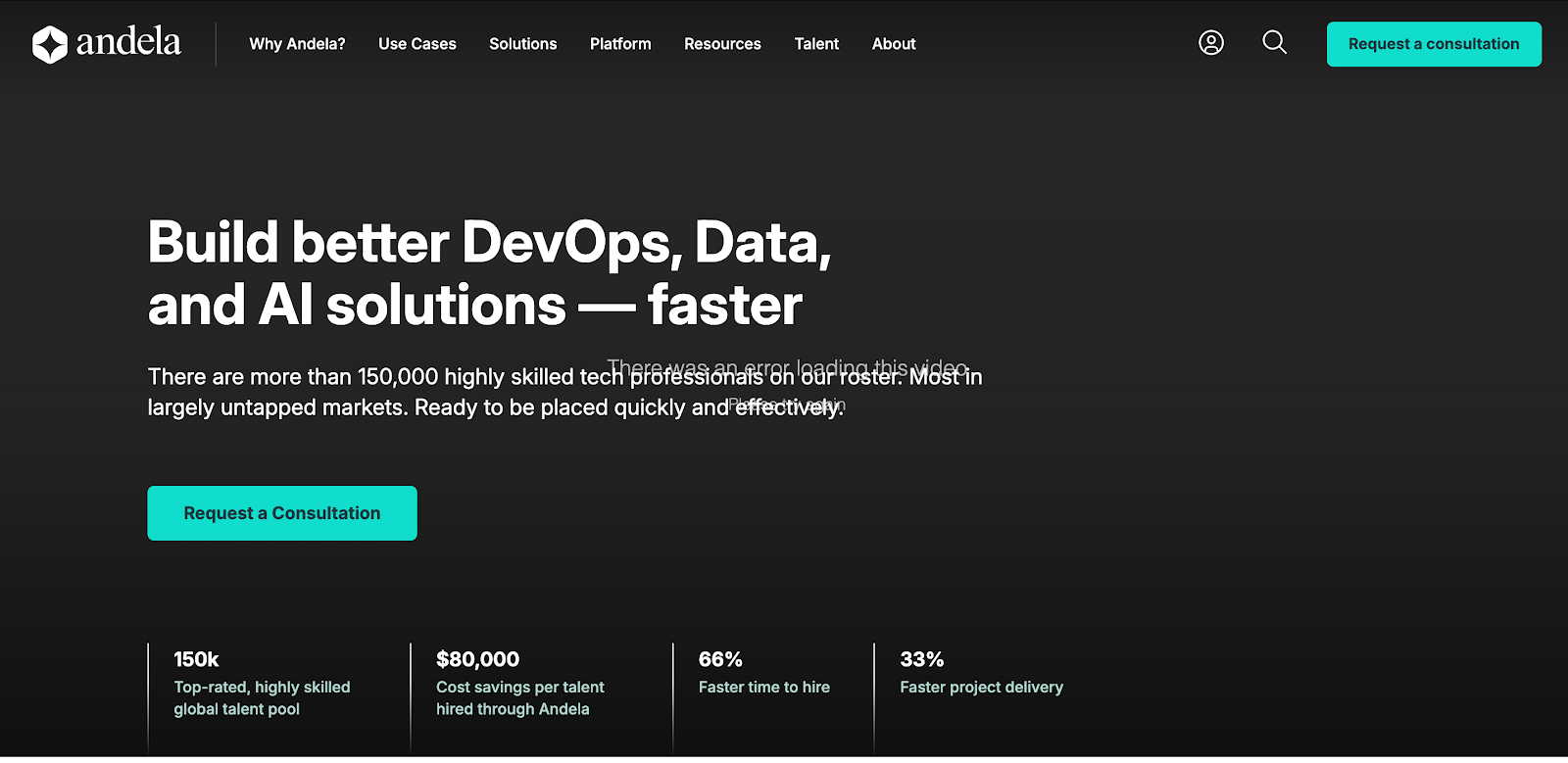
Andela specializes in connecting companies with skilled developers across Africa, Latin America, and Asia. Ideal for large-scale distributed teams.
Global talent network
Focus on long-term placements and team growth. The platform has over 150K developers vetted and supported by Andela during engagement.
Pricing
Monthly full-time contracts.
Best for
Organizations looking to scale engineering teams sustainably.
Pros / Cons
✔ Strong scale and retention
✖ Less suitable for short-term or single-role projects
CloudDevs — best for nearshore Latin American developers
Overview
CloudDevs emphasizes senior developers from Latin America, often aligned with US time zones.
LatAm focus
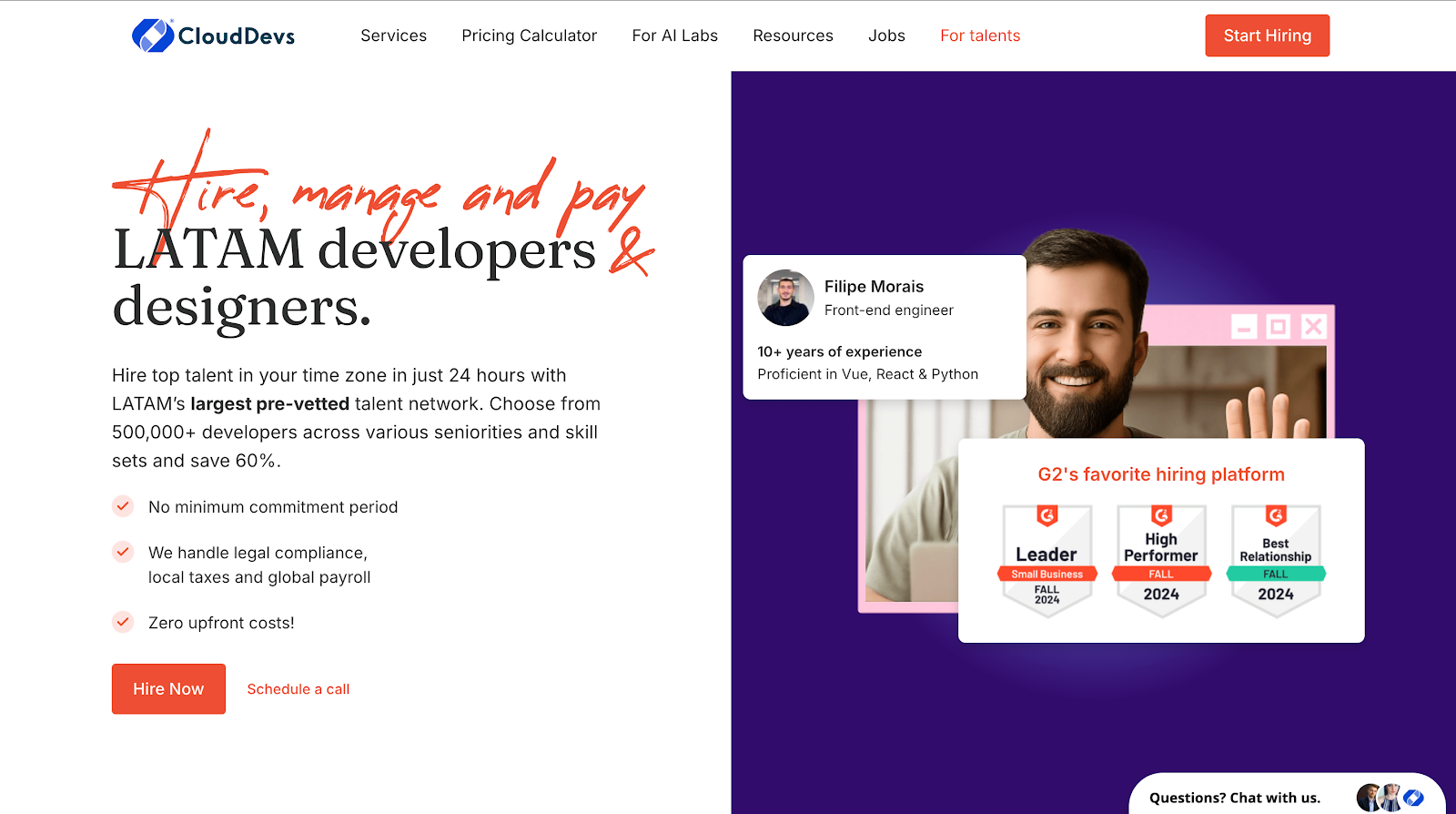
Eases collaboration across business hours and reduces communication friction.
Pricing
$45–70/hr depending on seniority.
Best for
US-based companies that want nearshore talent without paying enterprise rates.
Pros / Cons
✔ Cost-effective, timezone-friendly
✖ Individual hires only, not full managed teams
Upwork — best for budget-friendly short-term projects
Overview
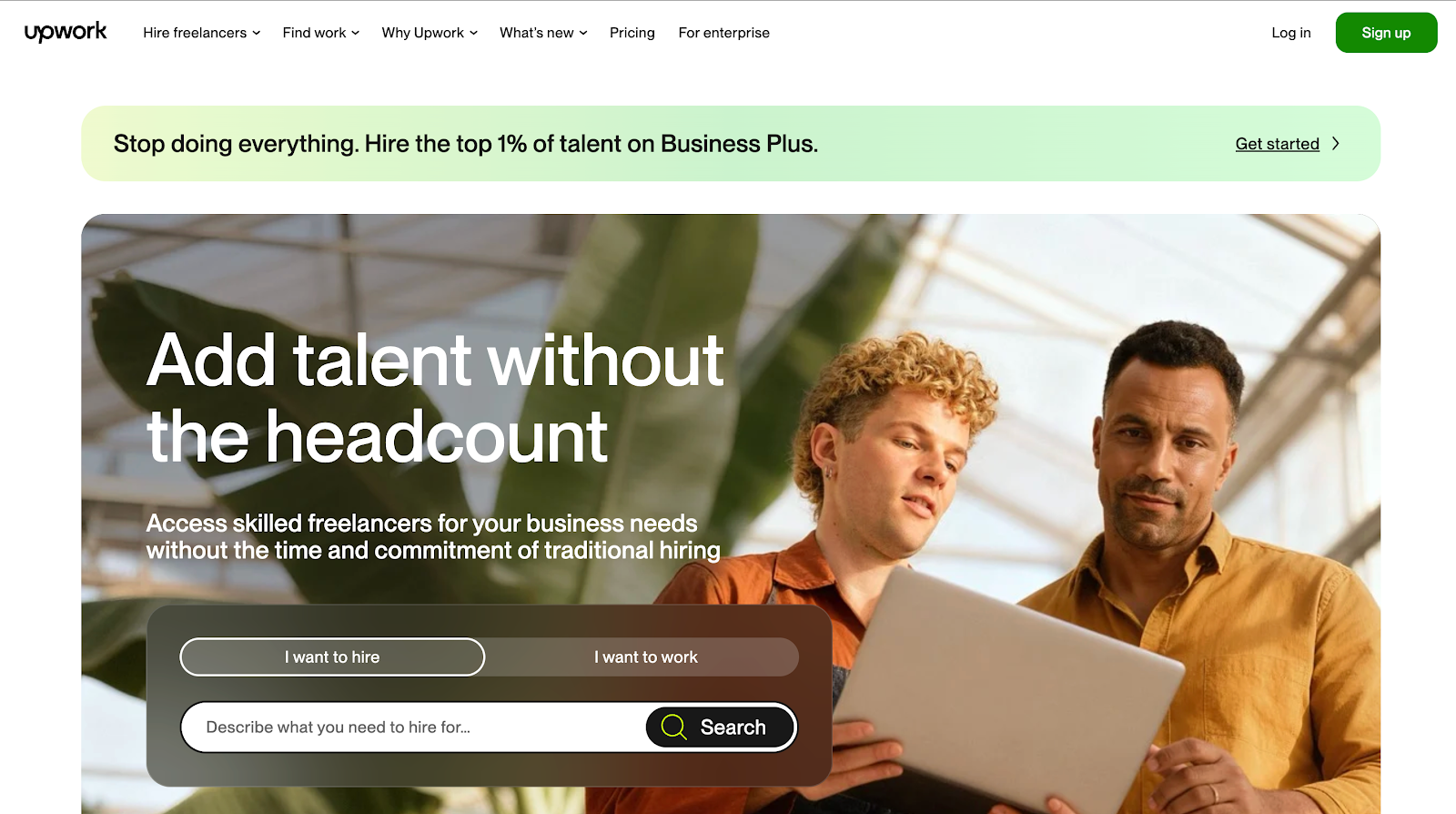
Upwork is the largest freelance marketplace. It offers the widest variety of talent but very little vetting.
Marketplace model
Clients are responsible for screening and managing freelancers themselves.
Pricing
Hourly or fixed-price contracts; 3–20% platform fee applies.
Best for
Small experiments, short-term tasks, or low-budget projects.
Pros / Cons
✔ Massive talent pool
✖ High variance in quality, you manage everything
Index.dev — best for long-term senior contractor retention
Overview
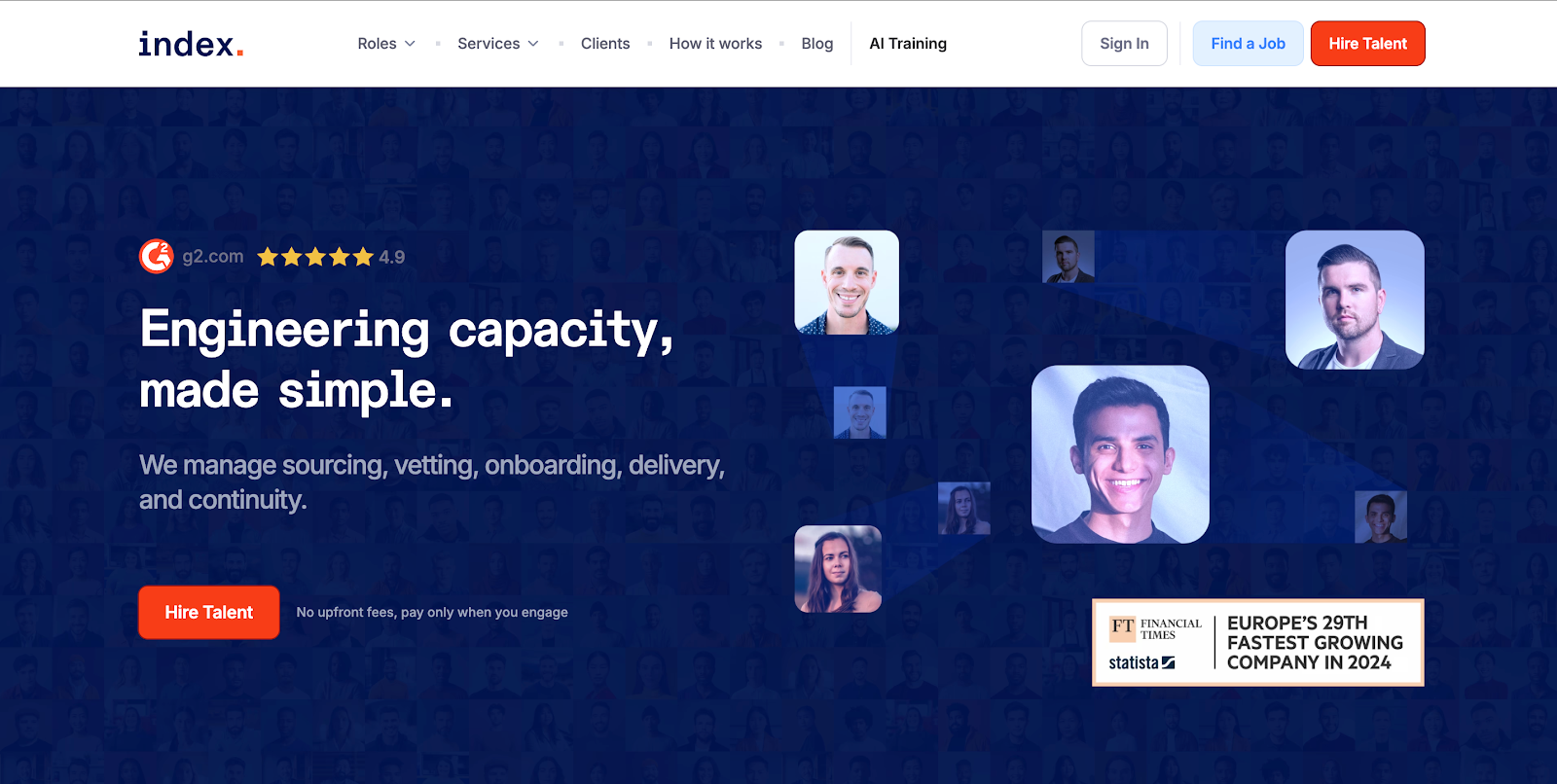
Index.dev focuses on long-term placements of senior developers. The goal is to reduce churn and keep contractors engaged.
Vetting
Rigorous technical interviews, emphasis on long-term compatibility.
Pricing
Monthly contracts.
Best for
Teams looking for continuity with experienced contractors.
Pros / Cons
✔ Strong retention
✖ Smaller talent pool
Revelo — best for US time zone-aligned LatAm talent
Overview
Revelo focuses on full-time Latin American developers who work during US business hours. Great for collaboration-intensive projects.

Nearshore model
Ensures minimal overlap issues and smooth daily communication.
Pricing
Monthly full-time rates.
Best for
Companies building a long-term, nearshore development team.
Pros / Cons
✔ US-aligned time zones
✖ Limited engagement flexibility
Fiverr Pro — best for quick, small-budget deliverables
Overview
Fiverr Pro offers curated freelancers for well-defined, single-task projects.
Pro tier
Screened for quality and reliability beyond standard Fiverr listings.

Pricing
Per-project, upfront.
Best for
Short-term design or technical tasks with clear deliverables.
Pros / Cons
✔ Fast delivery
✖ Not for long-term or complex software development
Flexiple — best for hiring top 1% freelance developers and designers
Overview
Flexiple is invitation-only, focusing on top-tier freelance developers and designers.
Vetting
Technical interviews and test projects ensure only the top 1% of applicants are accepted.
Pricing
Hourly, with platform margin.
Best for
Hiring highly skilled freelancers for targeted roles without committing to a full team.
Pros / Cons
✔ Very strong talent quality
✖ Limited scale
Remotebase — best for rapid 24-hour team assembly
Overview
Remotebase emphasizes speed. Teams can be assembled and start working within 24 hours.
Speed focus
Developers are pre-vetted and ready for immediate deployment.
Pricing
Monthly contracts.
Best for
Projects with urgent deadlines or rapid MVP launches.
Pros / Cons
✔ Extremely fast onboarding
✖ Less focus on long-term team
Hiring marketplace vs. development partner: which model is right for you?
Before comparing vendors, it helps to be honest about what you actually need. Some teams need one developer to fill a short-term gap. Others need a group of people who can take ownership of a product and move it forward without constant supervision. These are two very different problems, and they require different models.
Below is a practical way to decide.
When to choose a talent marketplace
A talent marketplace makes sense when you already have strong internal leadership and clear processes.
This model works best if you:
- Need one or two people for a narrow, well-defined role
- Already have a CTO or engineering manager who can onboard, review code, and manage delivery
- Are comfortable handling interviews, replacements, and performance issues yourself
- Are working on short-term tasks or incremental improvements, not a full product build
Marketplaces give you access to many profiles, but they also shift most responsibility to you. You manage the hiring process, daily communication, deadlines, and quality control. If something goes wrong, fixing it is also on your side.
When to choose a development company like Empat
A development partner is the best fit when quality of execution is important.
You'd better outsource web development, if you:
- Need to build or scale a complicated product
- Need staff augmentation services or CTO as a service
- Don’t want to manage individual developers day to day
- Need predictable high quality delivery
- Want one team that covers engineering, QA, and project coordination
That reliability is why companies consistently rate partners like Empat highly. It is reflected in numerous successful cases studies and its 5-star client satisfaction rating on Clutch and repeat engagements from long-term customers.
Total cost comparison: freelancer management vs. managed team
On paper, freelancers often look cheaper. In reality, the total cost is usually higher than expected.
With freelancers, you pay for:
- Interview time
- Onboarding and ramp-up
- Ongoing management and reviews
- Context switching and communication overhead
- Replacements when someone drops off mid-project
With a managed team, costs are more visible. You pay for delivery, coordination, and stability in one package. Project management, QA, and continuity are built in, which reduces risk and saves time over the full project lifecycle.
How to switch from Turing to a better-fit alternative
Switching platforms doesn’t have to mean disruption. The key is to treat the transition as a structured change, not a rushed replacement. These steps help reduce risk and keep delivery moving.
Evaluating your current needs
Start by reviewing what’s working and what isn’t. Look beyond individual developer performance and focus on the system around them.
Ask practical questions:
- Are delays caused by skill gaps or by lack of coordination?
- How much time does your team spend on hiring, onboarding, and supervision?
- Do you need individual contributors, or a team that can own delivery end to end?
This clarity helps you decide whether you need another talent marketplace or a development partner that can take on more responsibility.
Running a trial or pilot project
Before making a full switch, test the new model on a small but real piece of work. A good pilot project has clear scope and reflects the type of work you plan to outsource long term. This lets you evaluate communication, delivery speed, and quality without committing fully. It also shows how well the team handles feedback and adapts to your workflow.
Transitioning your team smoothly
Once you decide to move forward, plan the handover carefully.
Document key technical decisions, access, and processes. Keep knowledge transfer structured and time-bound. If you’re moving from individual contractors to a managed team, align expectations early around ownership, reporting, and timelines.
A smooth transition minimizes downtime and helps the new team start delivering value quickly, without forcing your internal team to pause or backtrack.
Conclusion
There’s no best option among Turing alternatives. And that’s the point. The right choice depends on what you’re building, how complex the product is and how quickly you need to move. Throughout this guide, we’ve looked at two distinct paths: talent marketplaces, where you hire individual developers and manage delivery yourself, and development partners, where a dedicated team owns execution end to end. Understanding which model fits your situation is what actually leads to better outcomes.
A simple way to decide is to work backward from your needs. If you’re filling a short-term gap or handling a clearly scoped task, a marketplace can work. If speed is critical and you need a vetted senior developer quickly, platforms focused on fast matching make sense. For enterprise teams that already have strong internal processes, premium freelance networks can plug into existing workflows. But if your goal is to build or scale a product without adding management overhead, a dedicated development team is usually the more reliable option.
That’s where Empat Tech fits. It has 300+ completed projects, a 5-star client rating, and experience across full-cycle software development outsourcing. Empat works as a long-term partner — not a staffing platform. The team handles engineering, QA, and project management under one roof. If that sounds aligned with what you’re building, the best next step is a free initial consultation via their services page or directly at /contact-us.
The best hiring decision isn’t the cheapest or the fastest — it’s the one that matches your project’s real needs. Get clear on what you’re building, and the right partner will follow.
Frequently Asked Questions
What is Turing and why do companies use it?
Turing is an AI-powered talent cloud that connects companies with pre-vetted remote developers. It uses a global matching system to pair businesses with engineers across 100+ technical skills. Companies use Turing to speed up hiring, access global talent, and avoid running a lengthy vetting process internally.
Why are companies looking for Turing alternatives in 2026?
Many companies explore Turing alternatives due to rising costs, limited pricing transparency, and mixed results from AI-based matching. Some teams report quality inconsistency between hires. Others need more flexibility than full-time placements allow. As hiring needs become more complex, businesses look for models that offer better alignment, clearer pricing, or managed delivery.
What is the best Turing alternative for startups?
It depends on what the startup needs. For managed MVP development and full product delivery, Empat is often a strong fit. If the goal is fast senior developer matching, Lemon.io works well. For AI-assisted matching with flexible contracts, Arc.dev is another option. The right choice depends on budget, speed, and internal management capacity.
How much does Turing charge per developer?
Turing does not publicly disclose detailed pricing. Reported hourly rates generally range from $30 to $100+ per hour, depending on seniority and tech stack. Some industry reports suggest the platform may retain a significant percentage of client payments, potentially up to 55%, though exact figures are not officially confirmed.


