
Mobile App Development Cost in 2026: Full Breakdown (US Guide)
Pricing ranges, timeline, what affects budget, and a checklist to estimate your app realistically.

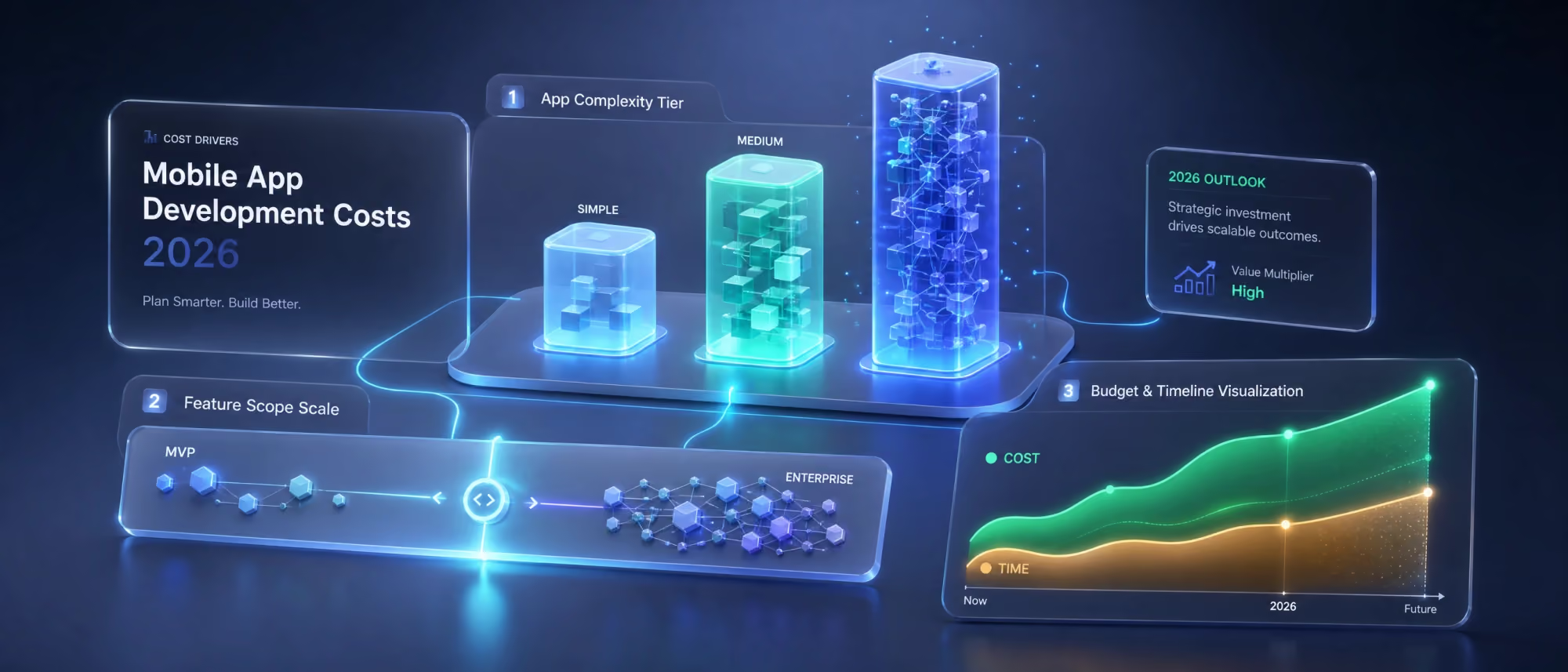
Building a mobile app in 2026 can cost anywhere from $20,000 for a simple MVP to $500,000+ for a complex enterprise platform development. Communicating with different businesses every day, we know for sure that many of them have received the widespread answer: "It depends…". As a result, companies that are looking for custom mobile app development services don't really understand what actually changes the budget. That's why we've prepared a detailed and informative guide on mobile app development costs in 2026.
Really, we need to admit that the issue of cost formation is rather complicated. Two apps can look similar on the surface and still have completely different development costs underneath. For example, a healthcare app with HIPAA compliance, secure infrastructure, and integrations with medical systems has considerable technical differences from a simple marketplace MVP. The situation is the same for fintech products, AI-powered apps, or internal enterprise tools.
In this guide, we'll break down realistic app development costs in the US market for 2026, explain the main pricing factors, and show how to estimate your project more accurately. We are more than sure that it will help you avoid expensive scope mistakes, in case you're already planning a product build or looking for a development partner.
Mobile App Development Cost at a Glance
Here's a simplified breakdown of general app development pricing in 2026.

These numbers reflect realistic US-market expectations for professional product teams. At the same time, keep in mind that freelancers or offshore agencies may quote less. However, in such a case, the final cost often increases later because of delays, technical mistakes, or missing functionality.
Try to avoid a common mistake that founders make, which is comparing app estimates without understanding what's included in the price structure. For example, one development agency may include discovery, QA, DevOps, and release support, while another software company includes only the price of development hours.
That's why a detailed pricing scope is one of the core decision factors when choosing a mobile app development company. So, let's figure out its components in more detail.
What Drives Mobile App Development Cost the Most
1. Scope of Features and Functions
According to Statista, global app market revenue is projected to reach $781.7 billion by 2029, growing at a 7.25% compound annual growth rate (CAGR) between 2022 and 2029. However, the competition grows as well. That is why, in order to capture the share of global revenue, your app needs to be qualitative and filled with beneficial features.
Consequently, the feature scope is the biggest factor that influences the mobile app development cost.
A simple scheduling app with email login and notifications is rather straightforward and simple in development. On the contrary, a marketplace with messaging, payment systems, admin panels, delivery tracking, and multi-role permissions is not that simple. The more business logic and functions your app requires, the more engineering time and qualifications it needs.
Let's view the well-known example. Apps similar to WhatsApp may cost around $80,000. At the same time, the applications with more complicated functionality, like *Uber, may cost $950,000.*
2. Platform Complexity
Platform choice is another major factor that forms the mobile app development cost for your project. When you need an app for just one platform, building either iOS or Android is usually the most affordable. The reason is that the team only needs to develop, test, and maintain a single codebase. In the US market, a basic iOS or Android MVP often costs from $20,000 to $50,000.
If you need both iOS and Android apps, costs naturally increase. To build two fully native apps, you need separate development work for each platform. It can raise the budget by 30–60% compared to a single-platform product.
To reduce time and budget, many startups choose cross-platform frameworks such as React Native or Flutter. These frameworks allow teams to reuse much of the same code across both iOS and Android. As a result, it can lower development costs by roughly 20–40% and speed up launch timelines. This is one reason why cross-platform remains a popular choice for MVP development in 2026.
3. Backend Architecture and Integrations
Even though users only see the frontend, backend systems often consume the largest share of development effort and mobile app development budget.
Payment processing, authentication systems, cloud infrastructure, user management, data synchronization, third-party APIs, AI integrations, etc. All these components determine how comfortable, effective, and competitive your app will be in the final result.
At the same time, a product with multiple integrations can quickly become expensive because every external service deals with:
- Security considerations
- Maintenance overhead
- API limitations
- Testing requirements
Fintech and healthcare app development are especially backend-complicated because they require secure data handling and regulatory compliance.
For example, integrating Stripe is relatively simple. On the contrary, building a custom payment routing system with fraud prevention is not.
The same logic can be applied to AI-powered apps in 2026. Adding a chatbot API may be easy and rather cheap, but creating reliable workflows around AI is much more complicated and expensive.
4. UX/UI Design and Brand Systems
According to Forrester research, every $1 invested in UX can return up to $100 in 2026.
With 10+ years of experience in communicating with business owners, at Empat, we've noticed that business owners often underestimate the importance of UX. They mostly expect good-looking pages, when the major functions of UX/UI design are improved conversion rates, retention, and reduced redesign costs.
The design work has a direct impact on both budget and development speed. The design teams usually work on:
- user research and competitor analysis
- wireframes and app structure
- user journeys and navigation logic
- clickable prototypes for testing
- accessibility standards
- design systems and reusable components
- responsive behavior across devices
- animations and interaction states
If you want to better understand how design choices affect timeline and budget, read the guide on mobile app design and development.
5. Security, Compliance, and Infrastructure
Security and compliance can significantly increase mobile app development costs because they add extra technical requirements besides core functionality.
For apps in healthcare, fintech, and other regulated industries, teams often need to implement:
- HIPAA compliance for handling medical data
- PCI DSS standards for payment security
- GDPR privacy requirements
- SOC 2 preparation
- data encryption
- audit logs
- multi-factor authentication
These components are not optional if you're estimating mobile app development costs for regulated industries. They directly affect how the app is built and whether it can legally operate.
For example, a healthcare app doesn't just store user data, they must have the technical ability to control who can access it. They also need to track every action, provide secure messaging between users, and protect file uploads like medical documents. As a result, it impacts database architecture, hosting setup, user permissions, logging systems, file storage, and messaging infrastructure. All these components add to the final app development cost.
Fintech apps have similar challenges. In addition to payment functionality, they often need fraud detection, identity verification, transaction monitoring, and stronger security layers.
Scalability is another factor that affects cost. If your app is expected to grow quickly, the backend needs to handle future traffic from day one.
Building an app for 5,000 users is very different from building one that may need to support 5 million users. If you have considerable growth expectations, you need to be ready for more investment in cloud infrastructure, database performance, server architecture, and monitoring systems early on.
6. Maintenance and Iteration
Most companies spend roughly 15–25% of initial development cost annually on maintenance and iteration. So, don't underestimate this factor and include it in your mobile application development budget.
Basically, launch is usually only the beginning.
You may need ongoing procedures, such as bug fixes, OS updates, performance optimization, security patches, analytics improvements, or user feedback implementation. All these services will add cost to the final mobile app development price.
For example, a $100,000 application may require $15,000–$25,000 per year in support.
We recommend not neglecting the stage of maintenance and improvement, because products that continuously improve usually outperform apps that are one-time development projects.
Mobile App Development Cost by App Type
Marketplace Apps
At first glance, marketplaces may seem to be simple: you only need a platform where users can list products or services and complete purchases. In fact, marketplace apps need to support multiple user groups, which significantly increases development complexity and budget.
A typical marketplace app often includes:
- buyer and seller accounts
- product or service listings
- payment processing
- in-app messaging
- reviews and ratings
- search and filtering systems
- order tracking
- admin dashboards
Each of these features requires separate logic, integrations, and testing. For example, payments alone may involve subscriptions, split payments, refunds, and transaction history. Messaging adds real-time functionality, and admin dashboards require moderation and analytics tools.
As a result, marketplace apps usually cost more than standard mobile products. The cost of the MVP marketplace varies from $40,000 to $90,000. What's more, the full-scale marketplace can cost up to $400,000.
Fintech and Payment Apps
Fintech apps are among the most expensive categories in mobile app development because security and compliance are non-negotiable.
The list of typical features of mobile apps includes identity verification, banking APIs, payment systems, fraud monitoring, transaction history, financial analytics, security layers, etc. All these backend infrastructure and legal requirements increase the prices of mobile app development.
As a result, the estimated cost for a basic fintech MVP can be $80,000–$150,000. When the enterprise fintech platform can cost up to $300,000–$1M+
Healthcare Apps
Healthcare apps require specialized development because of privacy and regulatory standards. If you are working in the medical sphere, your mobile app development will probably include patient portals, appointment systems, telemedicine, medical record integrations, secure messaging, and wearable integrations. etc. And all these features increase prices.
That's why the estimated cost for basic healthcare MVP is from $60,000 to $120,000. The HIPAA-compliant healthcare platform is more expensive, namely $250,000–$700,000.
B2B Internal Tools
Even though Internal enterprise tools may look visually simpler than consumer apps, they still often involve complex workflows. And it obviously affects the prices because of logistics dashboards, inventory systems, operations management tools, or internal CRMs that they may need. The main complexity comes from permissions, reporting systems, integrations, and business logic.
The mobile app development costs for internal MVP may reach $30,000–$80,000, while enterprise operational platforms can cost up to $120,000–$350,000.

Timeline vs Cost: What Speeds You Up (and What Slows You Down)
Timelines and budgets are closely connected. If you need fast delivery, you probably need to be ready to pay more.
Here's a simplified breakdown of how mobile app timelines work in practice.
Even though the development timing is preliminarily settled, you still have an opportunity to speed it up. It usually depends on how clear the project is from the very beginning and how stable the decisions are during the process.
Below is a simple comparison of what typically speeds up delivery and what usually delays it:

In our practice at Empat, the majority of delays don't come from complications with the code writing or development. Usually, we spend much time on figuring out what needs to be built, how these solutions will benefit the overall business model, and how stable those decisions are over time.
At the same time, the major cost driver is rebuilding features because of poor discovery work. This is why experienced product teams invest in planning before development begins.
How to Estimate Your App Budget Realistically
Separate Must-Haves From Nice-to-Haves
First of all, you need to focus only on functions that your business really needs. On the contrary, founders often try to implement every idea into the first version of the product. As a result, such an approach causes larger budgets, longer timelines, slower launches, and more technical risk.
We recommend launching only the core functionality that users absolutely need. Leave features that improve retention and user experience later. Finally, only after a successful launch can you move on to the experimental ideas.
Such an approach will keep MVP costs manageable while accelerating market validation.
Confirm Assumptions Early
Discovery workshops help validate technical and business assumptions before the development processes begin.
You may ask the following questions because they affect pricing:
- Do you need real-time functionality?
- Will users upload media files?
- Are there compliance requirements?
- Which systems need integrations?
- What scale should infrastructure support?
- Are there multiple user roles?
Small assumption errors can create massive budget differences later.
Watch for Unrealistically Low Estimates
Cheap estimates are attractive, especially if you are a startup. But let's be honest: low pricing can cause different problems, such as missing QA, weak architecture, no discovery phase, poor scalability, hidden post-launch costs, etc.
In order to avoid such threats, a reliable estimate should clearly explain scope assumptions, timeline, team structure, deliverables, technical risks, and maintenance expectations. In such a way, both sides understand what is included and what is not from the start.
If you're comparing vendors, this article on how to find an app developer can help you evaluate development partners more effectively.
How Empat Can Help
At Empat, we support teams with development services at every stage. We help them with early discovery as well as provide full product delivery. If you're still shaping your idea, we can help you find the real business opportunity, define the scope, prioritize features, and create a clear development plan. If you already have requirements, we'll prepare a realistic estimate and timeline based on actual technical complexity.
Our discovery process is structured and efficient. Due to AI-assisted workflows, it now takes 1–2 weeks instead of the typical 2–4. This helps teams move faster without losing clarity.
We also provide an AI-based cost estimator so you can quickly understand potential budget ranges even before we start a full engagement. From there, we help you move into design, development, and scaling with a predictable, transparent process.
Where the budget actually gets decided
The average mobile app development cost in 2026 ranges from roughly $20,000 for a simple MVP to several hundred thousand dollars for complex platforms. The list of the biggest cost drivers includes feature scope, backend systems, integrations, and compliance requirements.
The most successful app projects usually begin with careful discovery and realistic prioritization. A clear roadmap, experienced technical guidance, and accurate estimation can save months of delays and avoid budget overruns later.
If you're planning a mobile app development, contact Empat to get a quote.
FAQ
How much does it cost to build an app in the US?
In 2026, a basic app MVP in the US typically costs between $20,000 and $60,000. More advanced applications with custom backend systems, integrations, or compliance requirements often range from $100,000 to $500,000+.
What is the cheapest type of mobile app to build?
Simple content-based or utility apps are usually the least expensive because they require limited backend functionality and fewer integrations. Apps with payments, real-time systems, or multiple user roles are significantly more expensive.
What increases mobile app development cost the most?
The biggest cost factors are:
- Complex features
- Backend architecture
- Third-party integrations
- Security requirements
- Compliance standards
- Frequent scope changes
Poor planning can also increase costs substantially through rebuilds and delays.
How long does it take to build an app?
Most MVPs take 2–4 months to build. Standard products usually require 4–8 months, while complex enterprise platforms can take a year or longer, depending on scope and integrations.


