

Mobile App Development Team Structure: Roles, Sizes, and Costs
Mobile app development team structure for 2026: required roles, team size by app complexity, what each role costs, and team scaling tips.
A mobile app rarely fails because of the tech stack. It fails because of who's on the team and how they connect. With the global app market projected to top $600B by 2027, the cost of mis-staffing a mobile build keeps climbing. Get the people, the roles, and the headcount right, and an $80K MVP ships in 12 weeks. Get them wrong, and the same project burns through $200K and 8 months with a product nobody uses.
This guide walks through what a working mobile app development team structure looks like in 2026: the roles you actually need (and the ones you can skip at MVP stage), realistic team size by app complexity, what each role costs at US and Eastern European rates, and which engagement model fits which stage of growth. Use it before you start hiring, or as a sanity check on a team you've already assembled.
What a Standard Mobile App Development Team Looks Like
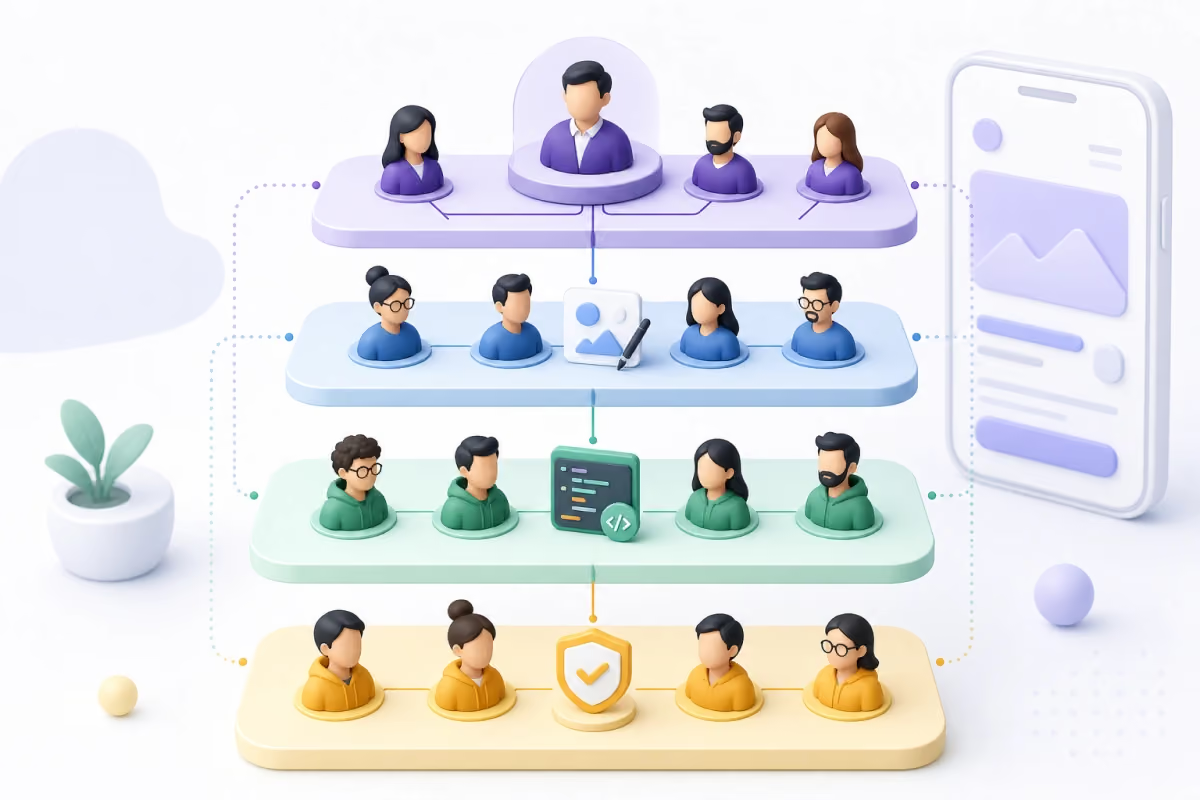
A working mobile team has four functional layers: leadership, design, engineering, and quality assurance. Each layer maps to a role or two at MVP scale, and to a small group at production scale.
The leadership layer covers product direction and delivery rhythm: a project manager keeping sprints on track and a tech lead owning architecture and code quality. Design covers user flows, visual design, and motion. Engineering covers the actual product build, split by platform (iOS, Android, backend, cross-platform). QA covers testing, automation, and release readiness.
What changes with project size isn't the number of layers, it's the depth. An MVP runs with one person per layer, often double-hatted. A standard mobile product needs 1–2 people per layer plus a DevOps function. An enterprise mobile platform needs a full team of specialists per layer, with a tech lead and a delivery manager coordinating across them.
Required Roles and What Each One Actually Does
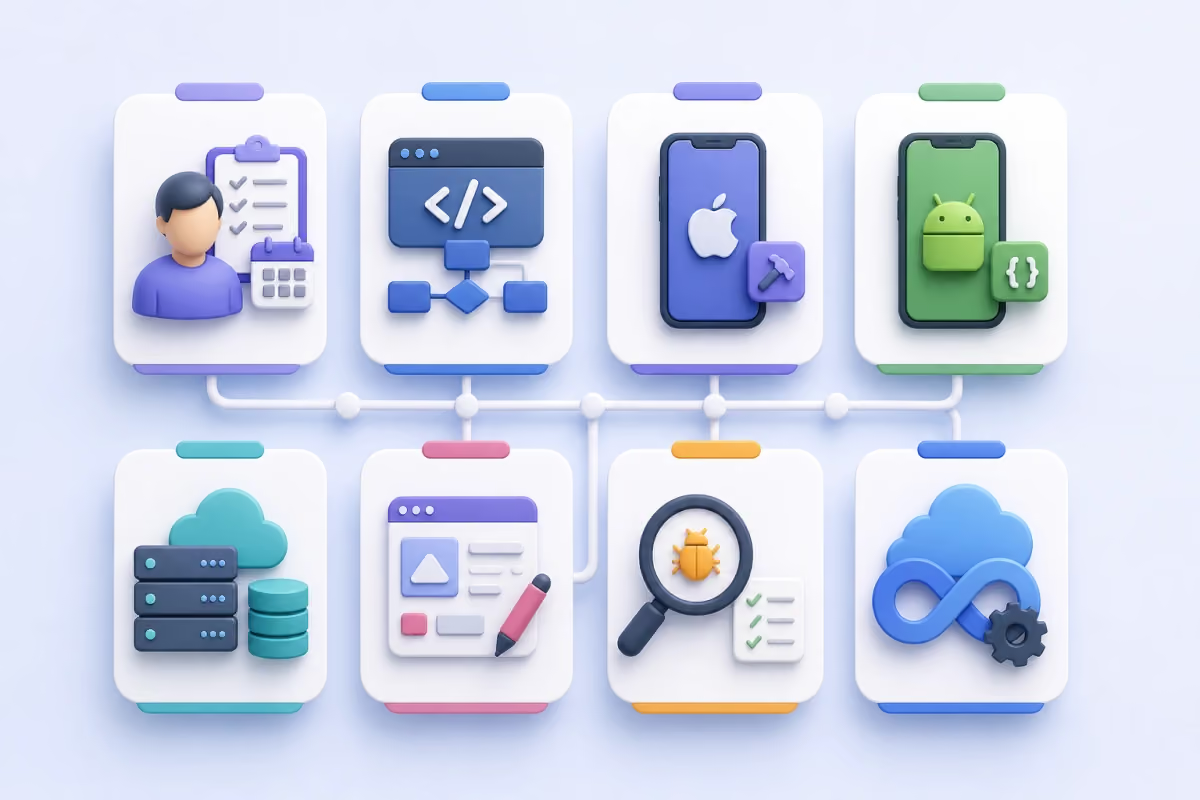
These are the core roles a mobile app development team relies on most. Headcount varies, but the responsibilities below stay constant.
Project manager (PM). Runs sprint planning, retros, and stakeholder communication. Acts as the single point of contact for the client or internal sponsor. US rate: $60–90/hr. Eastern European rate: $40–60/hr. Skip at solo-founder MVP stage; the founder does this. Add when team crosses 4 engineers or when sprint chaos starts costing velocity.
Tech lead. Owns architecture decisions, code review standards, integration design, and post-launch performance. Senior engineering background, usually 7+ years in mobile. US rate: $100–150/hr. EE rate: $60–85/hr. Mandatory from day one, even at MVP scale. Skipping the tech lead is the most common reason MVPs become unsalvageable by year two.
iOS developer. Native iOS development in Swift. Knows App Store submission, push notifications, in-app purchases, and platform-specific UI conventions. US rate: $90–130/hr. EE rate: $50–75/hr.
Android developer. Native Android development in Kotlin. Knows Play Store submission, Material Design, ProGuard, and the Android device fragmentation tax. US rate: $80–120/hr. EE rate: $45–70/hr.
Cross-platform developer (alternative to native iOS+Android). Flutter or React Native specialist. Reduces team size by combining iOS and Android into one engineering hire instead of two. US rate: $85–125/hr. EE rate: $50–75/hr. Statista's framework adoption data shows Flutter and React Native have absorbed the bulk of new mobile starts since 2022. Our cross-platform mobile development guide covers the framework trade-offs in detail. Cross-platform makes sense for 70–80% of consumer apps; native still wins for performance-critical apps (real-time AR, heavy ML inference, high-end gaming).
Backend developer. API design, data persistence, auth, server-side business logic, third-party integrations. Stack varies: Node.js, Python, Laravel, Go (the Stack Overflow 2024 Developer Survey tracks current adoption across each). Pick whatever fits team expertise and product complexity. US rate: $90–130/hr. EE rate: $50–75/hr.
UI/UX designer. Handles user research, wireframes, prototypes, and visual design. Mobile-first design thinking, not "we'll port the website to a smaller screen." US rate: $75–110/hr. EE rate: $45–65/hr.
QA engineer. Functional testing, automation where applicable, regression, App Store and Play Store release readiness. US rate: $50–80/hr. EE rate: $30–50/hr. The role most often skipped at MVP, and the reason most MVPs ship with embarrassing bugs.
DevOps engineer. CI/CD pipeline, environment management, observability, security baseline. The Puppet State of Platform Engineering report finds high-performing teams release multiple times per day, which is impossible without a dedicated DevOps function. Often a shared specialist working across two or three projects. Added at standard project scale (6+ engineers). US rate: $100–140/hr. EE rate: $55–80/hr.
Team Size by App Complexity
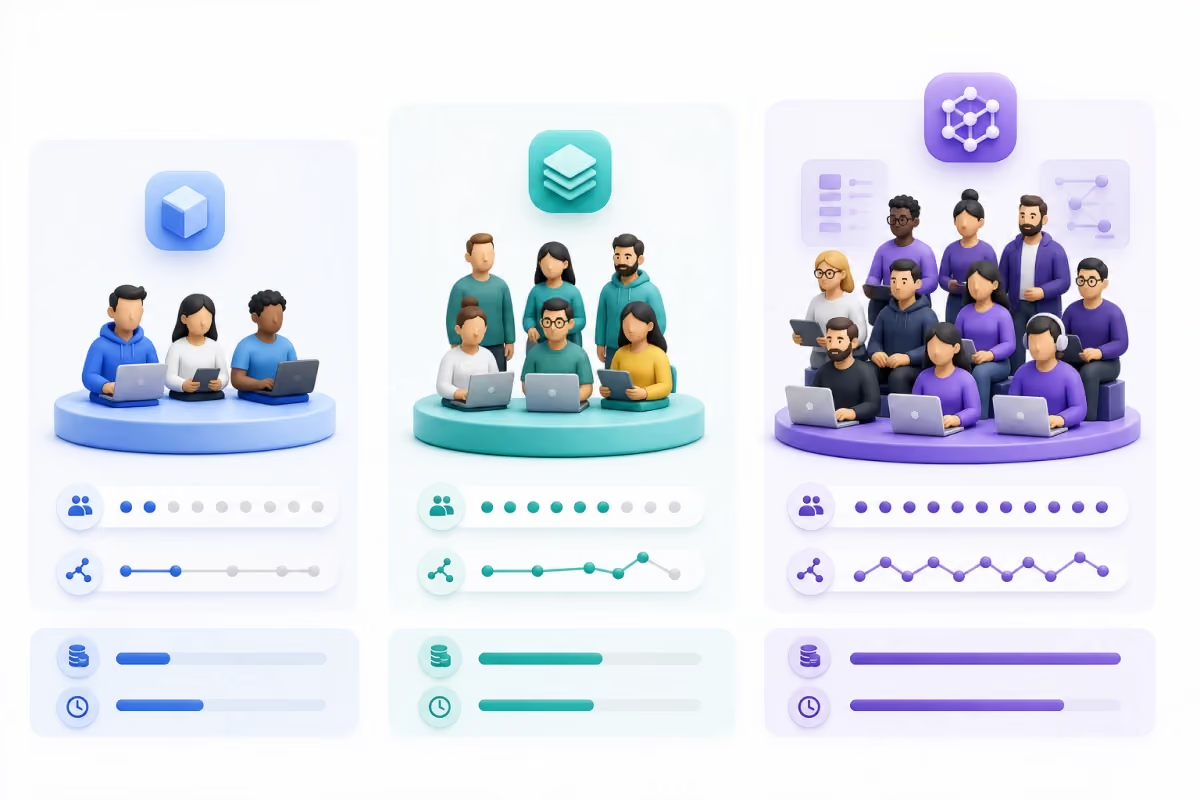
Headcount scales with what the product needs to do, not with what you wish it did. Here's what the typical mobile project looks like at three different tiers.
MVP mobile team (3–5 people). Tech lead, one cross-platform engineer, UI/UX designer, part-time QA. Optional: backend engineer if the product has more than a thin server layer. PM duties handled by the founder or tech lead. Timeline: 2–4 months. Total budget: $40–80K. See our mobile app development cost guide for the full budget breakdown, or how to find an app developer if you're still sourcing the first engineer.
Standard mobile product team (6–9 people). PM, tech lead, native iOS dev, native Android dev (or two cross-platform devs), backend dev, UI/UX designer, QA engineer, shared DevOps. Timeline: 4–8 months. Total budget: $120–250K.
Enterprise mobile platform team (10–15 people). Delivery manager plus PM, tech lead, 2 iOS devs, 2 Android devs, 2 backend devs, dedicated DevOps, UI/UX designer plus UX researcher, 2 QA engineers (one for automation), and a security specialist for regulated industries. Timeline: 8–18 months. Total budget: $350K and up. Regulated verticals tighten these requirements further; see our healthcare app development guide for HIPAA-specific staffing notes.
Where teams go wrong: hiring an enterprise-scale team for an MVP-scale product. Senior-heavy MVP teams over-engineer the product, drive up burn, and miss launch windows. The fix is honest scope: match team depth to feature scope, not to ambition.
In-House vs Outstaffed vs Hybrid Team Models
Three viable models for assembling a mobile team in 2026. Each works for a specific company stage and risk profile.
In-house team. All roles employed directly. Full cultural integration, deepest IP control, longest hiring timeline (Glassdoor time-to-hire research pegs senior engineer hiring at 35+ days even in healthy markets, and the BLS software developer outlook suggests demand will keep that number elevated through 2032). Best for: companies where the mobile app is the entire business and is expected to scale for 5+ years.
Outstaffed team. External engineers integrated into your sprints under your management. They work for you in practice, employed by a vendor. Standard onboarding time: 1–2 weeks (our developer onboarding checklist covers the playbook). Lower upfront cost, faster scaling. Best for: scaleups that need engineering depth without a 60–90 day hiring cycle. See IT outstaffing services for how this works in practice, and staff augmentation for shorter engagements. For the model-choice trade-offs, see outstaffing vs outsourcing.
Hybrid team. Senior leadership in-house (PM, tech lead, sometimes lead designer), specialists outstaffed (iOS, Android, QA, DevOps). The most common production setup for mid-stage product companies. Combines cultural continuity at the top with cost-efficient scaling at the engineering layer.
For most companies launching their first mobile product, hybrid is the practical default. Hire one PM and one tech lead in-house, outstaff the rest. Adjust the in-house core as the product matures.

Common Team Composition Mistakes
Five mistakes show up in almost every team-structure audit we run.
Skipping QA at MVP stage. "We'll have engineers test their own code." That works for the first sprint. By sprint four, the team is rewriting the same feature for the third time because nobody owns regression. Add a QA engineer at half-time from day one. Even one day a week beats none.
Over-loading on seniors. Three senior iOS engineers on a 4-month MVP isn't speed, it's friction. Senior engineers want to debate architecture; product velocity comes from a senior tech lead plus mid-level executors.
No DevOps until the launch crisis. CI/CD, environment management, observability are not optional in 2026. The team that ignores DevOps spends week 11 of a 12-week sprint figuring out App Store provisioning. Bring in DevOps at week 4.
Designer attached at the end. Designers shape product behaviour, not just visuals. A designer brought in to "skin" an already-built app produces a worse product than a designer involved from week one.
Missing PM at 5+ engineers. Engineers can run their own standups for a sprint or two. Past that, communication overhead eats velocity. Hire a PM (even half-time) the moment the team has 5 engineers.
How Empat Structures Mobile Teams
At Empat, we've assembled mobile teams for 300+ projects across 23 markets, from Obimy (10M+ downloads, #1 US App Store) to Monitree (100K+ NHS users) to Aurora (3.9× conversion lift via AR). What works in practice:
We default to hybrid teams for early-stage and scale-up clients. A senior tech lead and PM stay close to the product, while iOS, Android, backend, design, and QA roles come from our outstaffed pool. Most are senior, all are vetted, and 92% have C1-level English for daily standups with US clients.
Onboarding from contract to first sprint commit averages 1–2 weeks. Rates land in the $25–$300/hr range depending on role and seniority, with monthly invoicing and 10% advance payment. Engagements typically start at $30,000 for MVP and scale to $500K+ for enterprise platforms.
If you're scoping a mobile project, see our custom mobile app development services or book a free 30-minute consultation. We'll walk through the team structure that fits your scope, timeline, and budget, with no sales pitch.
Team first, tech second
You can pick the wrong tech stack and still ship a working product if the team is strong. You cannot pick the right tech stack and ship a working product if the team is wrong. Architecture serves the team that builds it, not the other way around.
For first-time founders: don't over-hire. Start with a tech lead, one cross-platform engineer, a designer, and a part-time QA. Add specialists when scope demands them, not when ambition does.
For scaling product teams: get the leadership layer in-house, and outstaff the rest. The combination handles both continuity and cost.
FAQ
What roles do I need on a mobile app development team?
The core roles are: project manager, tech lead, iOS developer (or cross-platform), Android developer (or cross-platform), backend developer, UI/UX designer, and QA engineer. DevOps is added at standard project scale. At MVP scale, a tech lead, one cross-platform engineer, a designer, and a part-time QA cover what you need.
How many people are on a typical mobile app development team?
An MVP team is 3–5 people, a standard mobile product team is 6–9 people, and an enterprise platform team is 10–15 or more. Headcount scales with feature scope, not with ambition. Over-hiring at MVP stage is the most common cause of burn.
Should I hire a native iOS+Android team or a cross-platform team?
For 70–80% of consumer apps, cross-platform (Flutter or React Native) is the better trade-off: one team, faster delivery, 20–40% lower budget. Native is worth the extra cost for performance-critical apps: real-time AR, heavy ML inference, high-end gaming, or apps that need deep platform-specific integrations.
When should I add a DevOps engineer?
At standard project scale (6+ engineers), and not at the launch crisis. Bring DevOps in at week 4 of the project, well before App Store submission. CI/CD, environment management, and observability are not optional in 2026 even for small mobile teams.


