

Top Fintech and Healthtech Software Development Partners (2026)
A shortlist of 11 engineering partners actively building regulated fintech and healthtech products for US clients in 2026, with named case studies, verifiable review profiles, and a side-by-side comparison table. Includes what to check on compliance, case evidence, and delivery model before you sign.

Fintech and healthtech software development partners are engineering teams that build regulated digital products such as payments platforms, lending tools, EHR-connected apps, and remote monitoring systems. The core challenge is to develop digital products under compliance regimes like PCI DSS and HIPAA.
This list profiles 11 companies actively delivering fintech and healthtech software for US clients in 2026, Our rating has named case studies and verifiable facts, so you can shortlist a partner without spending weeks on discovery calls.
How we picked these companies
There's no single authority that ranks software vendors objectively. That’s why treat any list, including this one, as a starting point, not a verdict. We included companies that:
- have a public, verifiable Clutch or G2 profile with client reviews rather than only self-reported testimonials;
- show documented fintech or healthtech delivery, namely case studies with specifics, not just a service page;
- have been active in the US market within the last 12 months.
We believe that the research that we’ve conducted will help you find the right software development partner in the healthtech and fintech niches.
Top fintech and healthtech software development partners
Empat
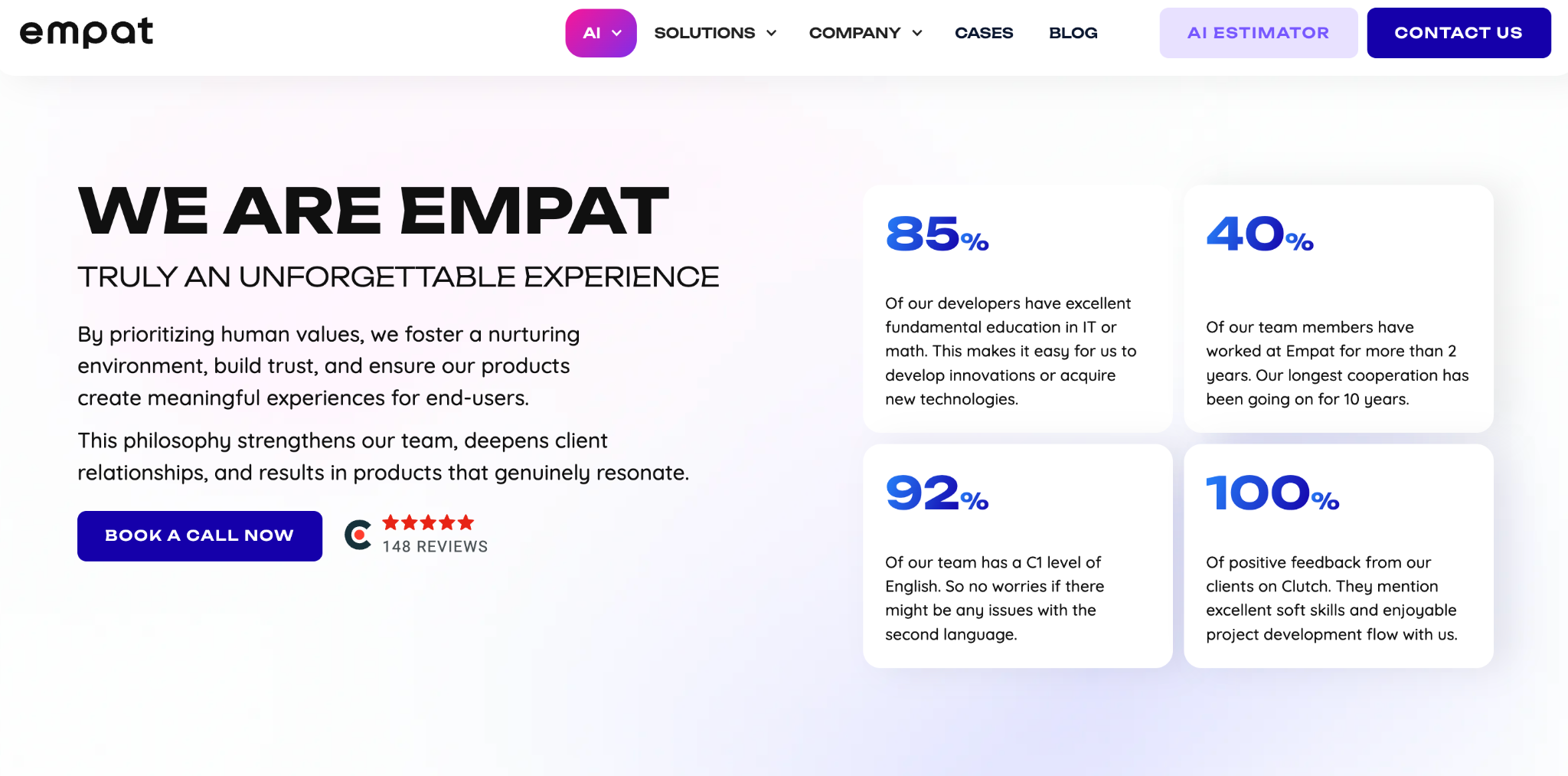
Location: an international company with headquarters in the US, UK, and Ukraine.
Clutch rating: 5.0
Empat is a full-cycle development company that builds fintech and healthtech software for startups and mid-market companies. The agency runs projects from AI-assisted discovery through MVP and full product builds. Its industry recognition includes back-to-back Clutch 100 Global awards and back-to-back Clutch 100 Fastest Growth awards.
Empat has a 5.0 Clutch rating based on 149 reviews and extensive verified client feedback. Its current Clutch profiles also place the company among software developers serving the US fintech market. Client-reported strengths on Glassdoor (71 ratings), GoodFirms (79 reviews), and Techreviewer (53 client reviews) include on-time delivery, proactive communication, and measurable business outcomes, with no material recurring complaints identified across the review dataset; over half of team members have worked at Empat for more than two years, and its longest client relationship has run for a decade.
Its healthtech flagship case study is VitalAI, a remote patient-monitoring platform built for hospitals and care teams: it connects wearables, glucometers, and blood-pressure cuffs to an AI layer that detects anomalies (irregular heart rate, glucose spikes) and issues predictive readmission scores, with full FHIR API support for EMR integration. The stack was React, Laravel, PostgreSQL, and Redis on AWS.

The VitalAI project by Empat
You can explore Empat’s expertise in the HealthTech industry through successful projects in the healthcare sector, includingHealthUA,Dr. Alexa,Dental Care,along with other healthcare case studies available on the company’s website.
On the fintech side, Empat built Shadowbanking, an embeddable financial-services SDK that lets B2B SaaS platforms offer balances, transfers, and approval flows without becoming a regulated fintech company themselves.
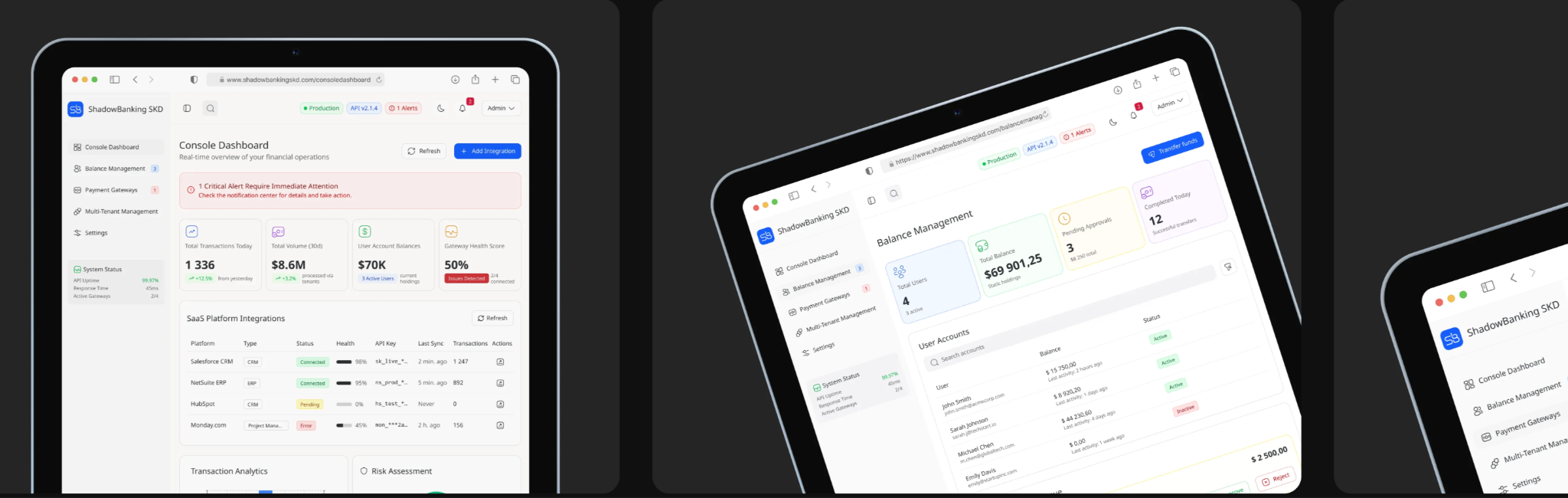
The Shadowbanking project by Empat
PayFlow Engine is a modular, white-label payment platform for marketplaces, supporting seller payouts, commissions, multi-currency transactions, and integrations with providers such as Stripe and Wise.
Other projects demonstrate the breadth of Empat's fintech experience. Lumi is a financial automation platform that uses smart contracts to manage revenue sharing and automate payouts for distributed teams, while FuelFinance is a SaaS product focused on financial planning, cash-flow analysis, P&L, projections, and unit economics.
Why consider Empat: a suitable option if you want one development partner across product discovery, UX/UI, engineering, AI, and post-launch development, with demonstrated experience across both fintech and healthtech products.
DICEUS
DICEUS specializes in fintech, healthcare, and insurtech and core-system modernization, is US-incorporated, with a delivery center in Wrocław, Poland.
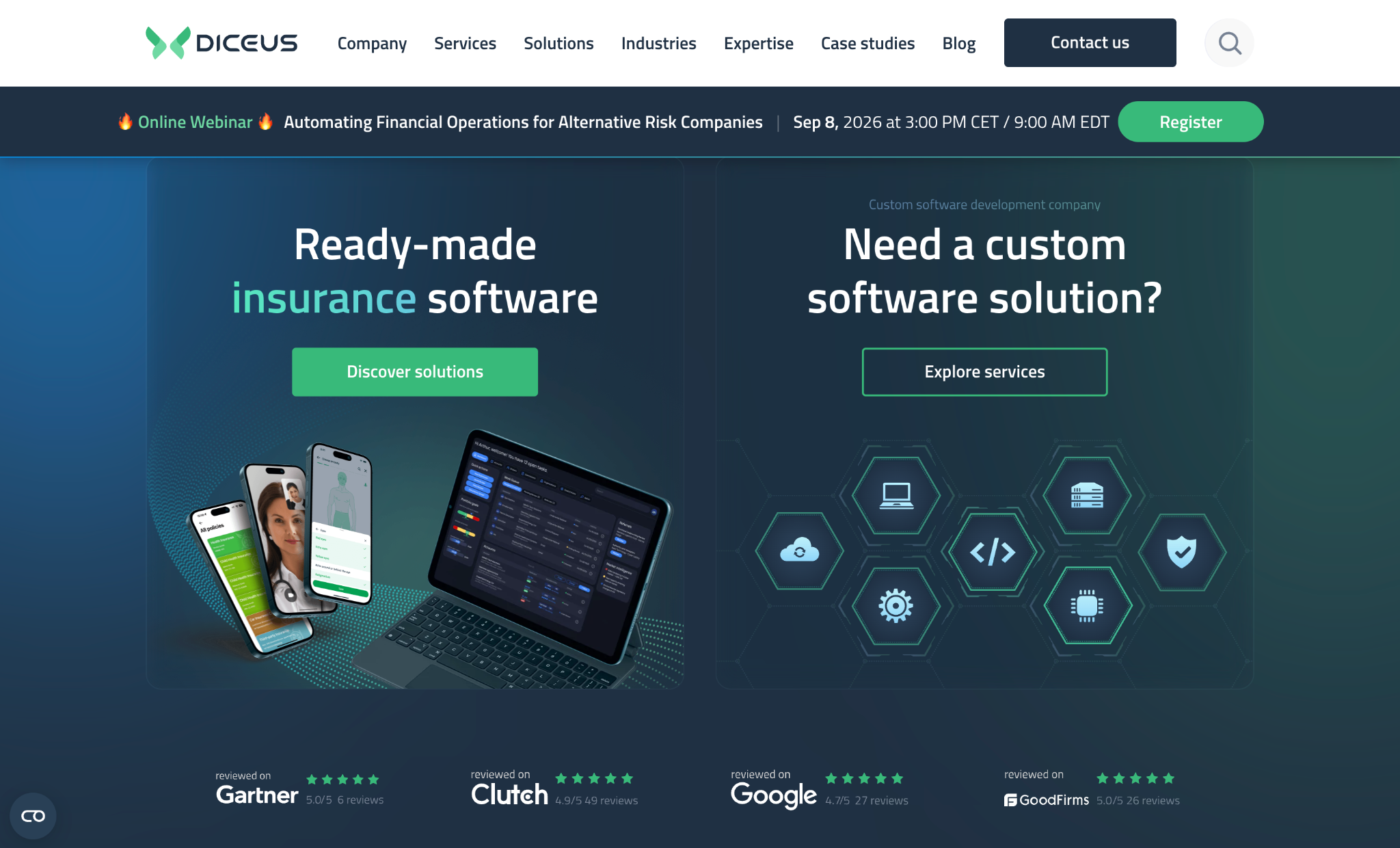
Its client list is unusually well-documented for this space: UNIQA Insurance Group, Vienna Insurance Group, and a Raiffeisen Bank contract signed in 2021. Its most detailed public case study covers a mobile app built for UNIQA, shifting customer support from call centers toward self-service, following a discovery phase built on user interviews and journey mapping.
DICEUS is also a certified partner of Microsoft, Google Cloud, and Oracle, and in 2026 partnered with insurance API platform InsureMO to offer carriers ready-made policy administration systems.
Best for: insurers and banks needing core-system modernization with named enterprise references.
Computools
Computools runs a fintech-only practice (no named healthtech work found in this research) built around banks, insurers, and investment firms, with several unusually specific, numbers-backed public case studies.
For a Caribbean bank, it implemented Visa-processing microservices and PCI DSS-compliant UX changes, resulting in a 12% increase in market share among 18-to-30-year-old customers.
For CrypDrift, a crypto/fiat trading platform, its work helped the client expand to more than 50,000 retail users in its first year.
For Moblet, a challenger bank, it built biometric authentication and streamlined KYC onboarding.
Best for: fintech-only buyers who want named clients and hard numbers, not just a service description.
Zoolatech
Zoolatech works across fintech, healthcare, retail, and media from a Miami, Florida HQ, with delivery hubs in Poland, Ukraine, Mexico, and Turkey.
Its most specific healthcare claim: it rebuilt an FDA-governed platform into cloud-native microservices, scaling the engineering team to 60 people and cutting review cycles by 80% (the client isn't named).
On the fintech side, a named client, CognitOps (a B2B SaaS supply-chain company in Austin, Texas), used Zoolatech for team augmentation on Ruby on Rails, React, and MySQL.
Best for: companies needing an FDA- or otherwise-regulated platform re-architected without a ground-up rebuild.
Simform
Simform is a digital engineering firm headquartered in Orlando, Florida, holding Azure Expert MSP status — a certification fewer than 105 of Microsoft's 400,000+ partners carry.
Its named fintech work involves modernizing legacy applications for a UK financial services platform, converting discovery findings into a prioritized architecture roadmap. At the same time, no numeric business outcome is published for that engagement. It doesn't have a specific named healthtech case study in this research.
Simform differentiates on speed, shipping from a library of 15+ pre-built accelerators rather than starting from a blank repository.
Best for: enterprises that want faster delivery cycles from pre-built components rather than custom architecture from zero.
N-iX
N-iX is a Ukraine-headquartered outsourcing firm. It has 2,400+ engineers across 10 countries, per its own 2025 figures. The company has a healthcare practice covering HL7/FHIR interoperability and HIPAA-compliant architecture.
Its strongest published case study: a company monitoring clinical-trial data for tampering and systemic errors saw 115% revenue growth in 2023 and a 14.5x improvement in platform performance after N-iX re-architected its Big Data monitoring system on Python, Angular, Azure, and Kubernetes (the client isn't named).
A second case describes migrating a US healthcare company's EMR data infrastructure from SQL Server to Google Cloud Platform.
Certifications: SOC 2 Type I.
Best for: large, multi-year healthcare data and interoperability engagements.
eSparkBiz
eSparkBiz is an India-based development company with a dedicated HIPAA-compliance practice covering EHR/EMR platforms, telemedicine, and remote monitoring.

It has integration with Epic, Cerner, Meditech, and Allscripts via HL7, FHIR, and Redox APIs. It reports 15+ years in business, ISO 27001:2013 and CMMI Level 3 certification, and 60+ healthcare projects. On the contrary, unlike several companies above, its public case material describes work generically rather than naming specific clients with measurable outcomes. It’s common under healthcare NDAs but means a direct reference call matters more here than a published case study.
Best for: buyers comfortable verifying healthcare depth through references rather than published case studies.
KMS Healthcare
KMS Healthcare, part of the KMS Technology group (Atlanta, Georgia HQ, delivery in Vietnam), works exclusively in healthcare rather than treating it as one vertical among several.

Its named product work is the CONNECT interoperability platform, built for health technology developers, and it reports having served 50+ healthtech companies. It's working toward HITRUST certification in addition to existing HIPAA/SOC 2 compliance.
Best for: buyers who specifically want a healthcare-only vendor rather than a multi-industry generalist.
ScienceSoft
ScienceSoft, headquartered in McKinney, Texas, was founded in 1989 and has focused on healthcare since 2005.
It's the most certification-dense company on this list: ISO 13485, ISO 27001, and ISO 9001, plus documented HIPAA, GDPR, FDA, and MDR compliance work, and recognition in Quadrant Knowledge Solutions' SPARK Matrix for Healthcare IT Services alongside Athenahealth and Oracle Cerner. Named case studies include a DICOM file-sharing module for RIVANNA delivered in four months, and a lung-cancer detection application for bioAffinity Technologies. In a separate case, a New York healthcare provider's telemedicine-enabled patient portal, integrated with its existing athenahealth EHR, attracted over 1,500 patients within three months of launch. It has almost no named fintech work, despite Clutch data showing financial services accounts for a meaningful share of its reviewed client base.
Pricing (vendor-published): roughly $150,000–$400,000 for telemedicine platforms, $120,000–$2,000,000+ for EHR systems.
Best for: hospital systems and enterprise healthcare organizations with heavy compliance documentation needs.
Leobit
Leobit, based in Lviv, Ukraine, positions itself around legacy modernization rather than greenfield builds. Its healthcare case study describes a Canada-based healthcare practice-management software provider whose EC2-based architecture had outgrown its original design.
Leobit migrated it to the cloud with containerization and automated deployment, reporting lower infrastructure costs and a larger end-user base (no specific numbers published). It reports 150+ solutions delivered and 70+ modernization projects, GDPR/HIPAA/CCPA-aligned processes, and ISO 27001:2022 certification, and was ranked among Clutch's Top 1,000 global B2B providers in 2023.
Best for: healthcare or fintech companies with an existing product that needs to scale or modernize, not a founder starting from zero.
Relevant Software
Relevant Software runs a fintech and banking practice covering digital and core banking, lending, wealth management, and RegTech, on ISO 27001 and GDPR-aligned processes, with delivery teams in Poland and Ukraine (public sources conflict on its exact headquarters city, so we're not stating one).
Its published work includes a digital mortgage platform integrating credit-reporting agencies and open banking APIs on a TypeScript microservices backend. It has no named healthtech work in this research, and its fintech case material is written in generalized "the client" form rather than naming the business — ask directly for a reference in your specific niche before committing.
Comparison table of healthtech and fintech software companies
| Company | Main focus | Fintech/healthtech relevance | Location | Clutch rating |
|---|---|---|---|---|
| Empat | Fintech + healthtech product development | VitalAI (healthtech), Shadowbanking/Lumi/PayFlow Engine (fintech) | Headquarters in London/NY/Warsaw/Kyiv | 5.0 (146 reviews) |
| DICEUS | Insurtech, core-system modernization | UNIQA, Vienna Insurance Group, Raiffeisen Bank | US-incorporated, Wrocław, Poland delivery | 4.9 (49 reviews) |
| Computools | Banking, trading platforms | Caribbean bank (+12% market share), CrypDrift (50K+ users) | Global delivery, no confirmed single HQ | 4.9 (100 reviews) |
| Zoolatech | Fintech + healthcare team augmentation | FDA-governed platform rebuild, CognitOps | Miami, FL (+PL/UA/MX/TR) | 4.9 (18 reviews) |
| Simform | Digital engineering, accelerators | UK fintech platform modernization | Orlando, FL | 4.9 (86 reviews) |
| N-iX | Healthcare data, HL7/FHIR | Clinical-trials platform (+115% revenue) | Lviv, Ukraine | 4.8 (35 reviews) |
| eSparkBiz | HIPAA-compliant telemedicine, EHR | 60+ healthcare projects (generic case material) | India | 4.9 (69 reviews) |
| KMS Healthcare | Healthcare-only interoperability | CONNECT platform, 50+ clients | Atlanta, GA (Vietnam delivery) | 4.8 (17 reviews) |
| ScienceSoft | Enterprise healthcare software | RIVANNA, bioAffinity, NYC patient portal (1,500 patients/3mo) | McKinney, TX | 4.8 (42 reviews) |
| Leobit | Healthcare/fintech legacy modernization | Canadian healthcare practice management platform | Lviv, Ukraine | 5.0 (60 reviews) |
| Relevant Software | Digital/core banking, lending | Digital mortgage platform, open banking APIs | Poland/Ukraine delivery | 4.9 (32 reviews) |
Ratings and figures reflect the most recent data we could independently confirm at time of writing.
How to choose a fintech or healthtech development partner
Choosing a development partner for a fintech or healthtech development product is much more complicated than finding a team that can write good code. These products usually involve sensitive data, complex integrations, and compliance requirements that can affect the architecture from the very beginning.
Here’s what we’d look at before signing a contract.
Relevant industry experience
Start with the company’s actual work, not the list of industries on its homepage. A team that has already built a payment product, banking platform, telemedicine app, or healthcare system will understand the specifics of the industry much faster than a generalist team starting from scratch.
Look for case studies that are close to your product. Building a payment platform and building a hospital scheduling system are completely different challenges, even though both fall under “software development.”
Security and compliance
For healthcare products, ask how the team handles protected health information, HIPAA requirements, access control, encryption, and audit logs. If your product needs to integrate with healthcare systems, experience with standards such as HL7 or FHIR can also be important.
For fintech development, look at payment security, PCI DSS requirements, data protection, and the regulations that apply to your particular product. A good development partner should be able to explain how these requirements affect the technical solution instead of simply saying that they “work with compliant solutions.”
Compliance requirements vary from product to product, so it’s also worth involving your legal and compliance teams early.
Real case studies
Case studies are one of the easiest ways to separate industry experience from marketing claims. Look for specific products, client names, technologies, and measurable results.
For example, Ema, Computools, Empat, and ScienceSoft publish detailed examples of their work. Some companies can only share limited information because of NDAs, which is common in fintech and healthcare. In that case, ask what they can demonstrate privately during the sales process.
End-to-end product development
Check what happens after you say, “We have an idea.” Does the team help with discovery and UX/UI? Can it design the backend architecture, build web or mobile applications, handle integrations, testing, cloud infrastructure, and launch?
This matters particularly for fintech and healthtech products, where the architecture and integration decisions made during discovery can have a major impact on the final product.
How the team actually works
The delivery model can make just as much difference as technical expertise. Find out who will be working on your product, whether you get a dedicated team, how project management works, how often you communicate, and how much timezone overlap you have.
It’s also worth asking who stays involved after launch. Production support, monitoring, bug fixes, and further development are part of the product lifecycle — not an afterthought.
Budget and project risks
Comparing companies only by their hourly rates can be misleading. A cheaper team may cost more if the project needs significant rework or takes twice as long to reach the same result.
Instead, compare what is included in the estimate: discovery, design, development, QA, integrations, infrastructure, and post-launch support. The more clearly the scope is defined, the easier it is to compare proposals.
Want to get a rough idea of your project budget? You can use Empat’s AI cost estimatorto get an initial estimate, or talk to the Empat teamabout your product, architecture, and development requirements.
FAQ
Who are the top fintech software development companies in the US in 2026?
There isn’t one ranking that can objectively determine the “best” fintech development company. A better approach is to compare companies based on their fintech portfolio, technical expertise, client reviews, and experience with products similar to yours.
DICEUS, Computools, Empat, and other companies have documented fintech experience. Before making a decision, look at their recent projects and ask for references where possible.
How is healthcare software development different from regular software development?
Healthcare software has additional requirements around patient data, security, interoperability, and compliance.
For products operating in the US, this can include HIPAA requirements for protected health information. If the product needs to exchange data with EHR systems, standards such as HL7 and FHIR may also become part of the architecture.
These requirements are much easier to handle when they are considered during discovery and system design. Adding them after the product has already been built can mean significant architectural changes and additional costs.
How much does it cost to build a fintech or healthtech MVP?
There is no useful universal price for a fintech or healthtech MVP. The range can be very wide depending on what the product needs to do.
The biggest cost drivers are usually the number and complexity of integrations, compliance requirements, user roles, platforms, and custom business logic.
For example, connecting a product to a payment provider is very different from integrating it with several banking systems or EHR platforms. Wearables, biometric data, complex financial calculations, and AI features can also significantly change the scope.
As a rough reference, Empat's public estimates start at around $15,000 for a proof of concept and $30,000+ for an MVP. More complex healthcare platforms can cost substantially more.
The best way to get a meaningful estimate is to define the MVP scope first and then estimate the individual features, integrations, and technical requirements.
How long does it take to build a fintech or healthtech MVP?
A relatively focused MVP can take around 6–12 weeks, but this is only a starting point.
The timeline can increase considerably when the product requires complex integrations, EHR connectivity, banking infrastructure, extensive compliance work, or approval from third-party providers.
The fastest way to get a realistic timeline is to break the MVP into features and identify the integrations and compliance requirements before development starts.


