
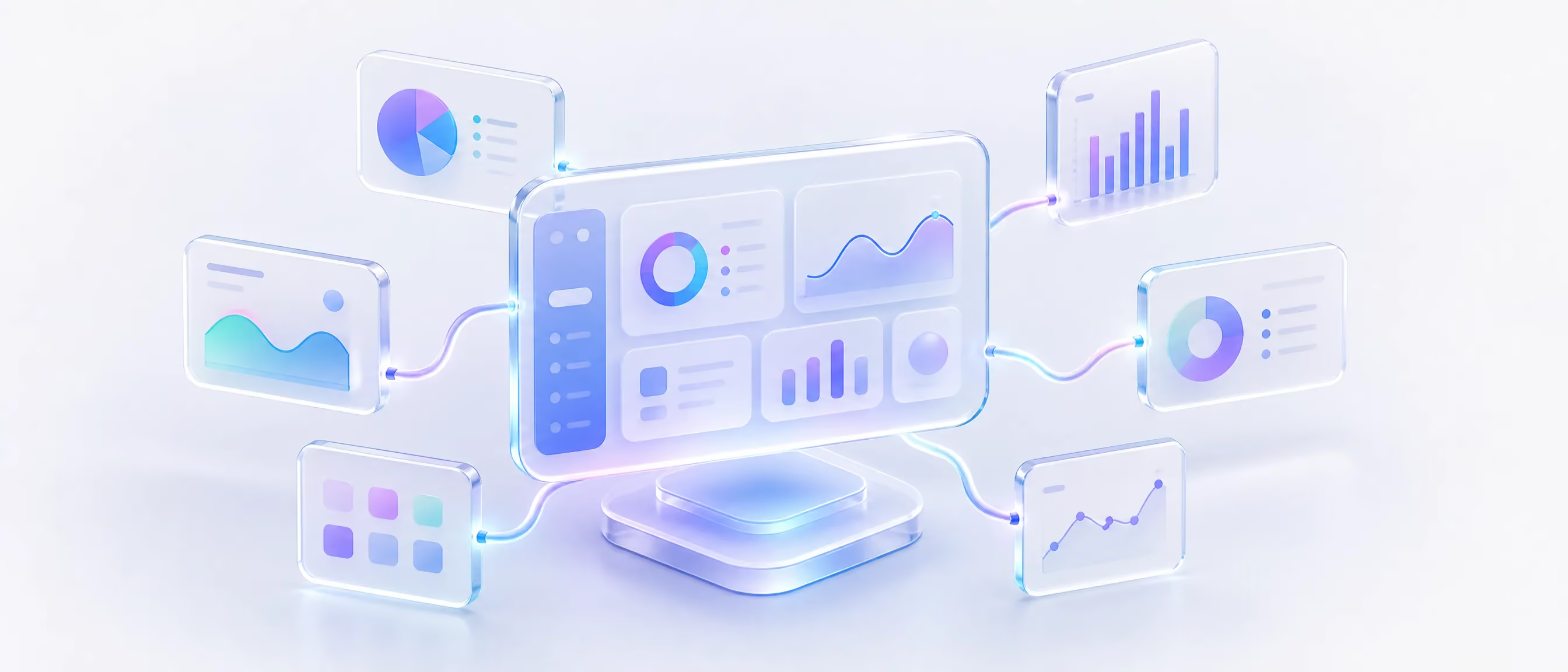
Business Intelligence & Data Analytics Development Services in 2026
What business intelligence and data analytics development services actually include in 2026 — data pipelines, dashboards, AI-powered insight generation, and how to decide between custom BI and off-the-shelf tools.

Business intelligence and data analytics development services in 2026 cover the full stack from raw data to a decision someone actually acts on: pipelines that pull and clean the data, a warehouse to hold it, dashboards and embedded analytics to surface it, and increasingly an AI layer that answers questions directly instead of waiting for someone to build a report. Here's what's actually included, what it costs, and where AI is changing the category.
What is a business intelligence development service?
A business intelligence development service builds the pipeline, data model, and reporting layer that turns raw operational data into dashboards and insights your team can act on. That's different from just buying a BI tool license — the service covers connecting your actual data sources, modeling the metrics correctly, and building the specific views your business needs, on top of a commercial platform or as a fully custom system.
What's included: from data pipeline to AI-powered insight
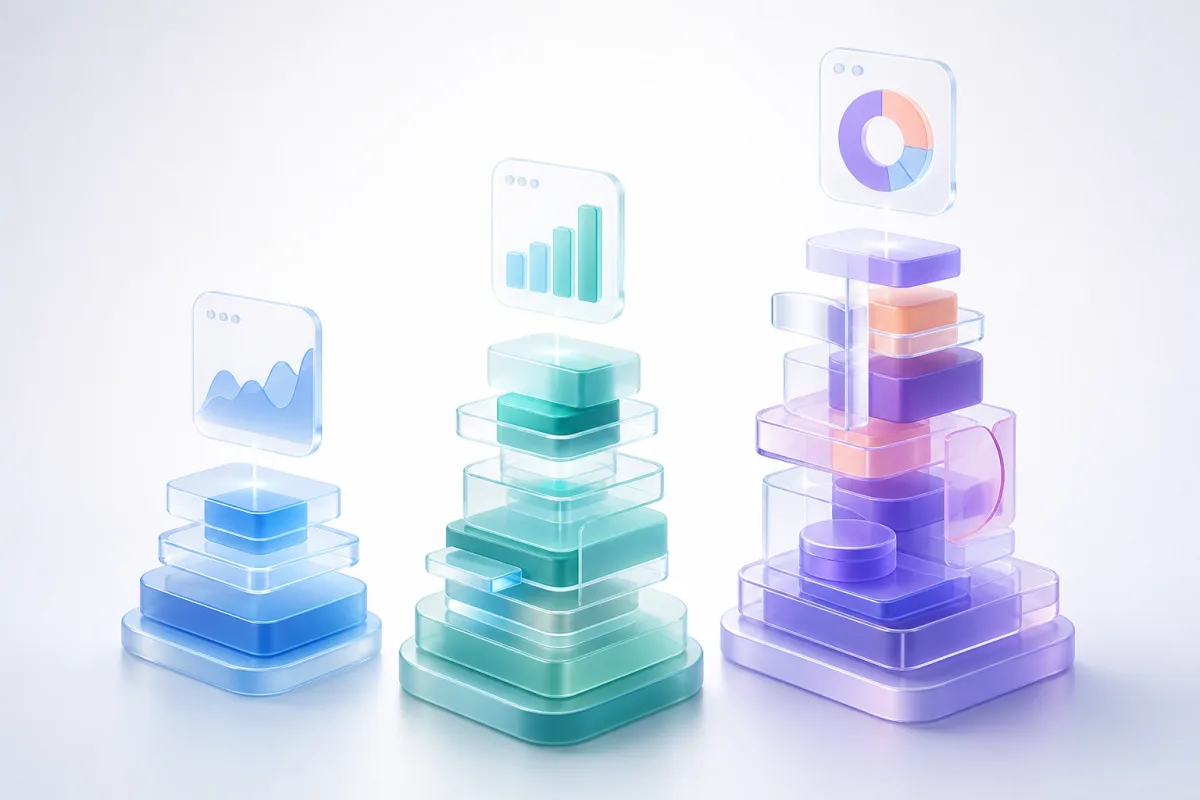
A complete BI/analytics build has four layers, and skipping any of them is usually why a BI project underdelivers.
- Data pipeline / ETL. Extracting, cleaning, and loading data from your actual source systems — the least visible layer and the one that determines whether everything above it can be trusted.
- Warehousing / data modeling. Structuring the data so metrics are defined consistently once, not recalculated differently in every dashboard.
- Dashboards and visualization. The layer most buyers think of as "BI" — but it's only as good as the pipeline and model underneath it.
- Embedded analytics. Surfacing insights directly inside the CRM, ERP, or product your team already uses, instead of a separate tool nobody opens.
- AI-powered insight generation. Increasingly the newest layer — an AI agent that can answer a plain-language question directly, grounded in the same governed metrics as the dashboards.
Custom BI vs. off-the-shelf tools vs. hybrid
The right choice depends on how standard your metrics are and how much your data sources deviate from what commercial platforms expect out of the box.
| Approach | Setup speed | Flexibility | Best for |
|---|---|---|---|
| Off-the-shelf (Power BI, Tableau) | Fast | Limited to platform's data model | Standard metrics, teams already in that ecosystem |
| Hybrid (platform + custom pipeline) | Moderate | Custom data layer, standard visualization | Non-standard sources feeding familiar dashboards |
| Fully custom BI | Slower to start | No platform ceiling | Embedded analytics, AI-native insight generation, complex proprietary data |
What custom BI development costs
Cost scales with data source complexity and how much of the AI-insight layer you want, not with dashboard count alone. A mid-complexity build with a handful of data sources and standard visualizations typically runs from a few thousand dollars into the low tens of thousands; an enterprise build with real-time data pipelines, multiple proprietary integrations, and strong security requirements can run well into six figures. As a reference point, Empat's own engagement bands start with a $15,000 proof of concept and scale from a $30,000+ MVP into full-platform builds — a custom BI project with a genuine AI-insight layer generally sits at the MVP tier or above, not the pure-dashboard end of the range.

The shift to AI-powered analytics in 2026
AI in BI has moved from a bolt-on feature to core infrastructure in 2026: instead of searching for a report, users increasingly ask a plain-language question and get a governed answer directly. The platforms winning this shift combine three things — intuitive natural-language search, AI that stays grounded in a consistent semantic layer so answers don't drift from what the dashboards say, and embedded delivery so people get insights inside the tools they already use. Industry analysis of 2026 BI trends points to the same pattern: governance and trust, not raw AI capability, are what separate BI platforms that get adopted from ones that get ignored.
How Empat approaches AI-powered BI
This is directly in Empat's lane: the same AI-augmented delivery workflow and Claude Certified Architect expertise behind Empat's product work applies to building the AI-insight layer itself, grounded in a governed data model rather than an ungoverned chatbot bolted onto a warehouse. Empat has already built this pattern for a client first-party: BigSister AI, a real-time sales-performance analytics platform with predictive reporting built for an Empat client, is a direct example of the dashboard-plus-AI-insight combination described above, not a hypothetical. See more in Empat's case studies and the AI development practice page.
FAQ
What is a business intelligence development service?
It's the service that builds the data pipeline, data model, and reporting layer connecting your real data sources to dashboards and insights — distinct from simply buying a BI tool license, since the value is in the correctly modeled, trustworthy data underneath.
How much does custom BI development cost?
A mid-complexity build with a handful of data sources typically runs from a few thousand dollars into the low tens of thousands; an enterprise build with real-time pipelines and multiple proprietary integrations can run into six figures. Projects with a genuine AI-insight layer generally sit at MVP-tier pricing ($30,000+) or above.
Should I build custom BI or use an off-the-shelf tool?
Use an off-the-shelf tool like Power BI or Tableau when your metrics are standard and your team is already in that ecosystem. Go custom or hybrid when your data sources are non-standard, you need embedded analytics inside another product, or you want an AI-insight layer grounded in your own governed data model.
How does AI improve business intelligence dashboards?
Instead of someone building and searching through static reports, an AI layer can answer plain-language questions directly, grounded in the same governed metrics as the dashboards — as long as it's built on a consistent semantic layer, which is what keeps AI answers from drifting away from what the dashboards actually show.


