
Gigster vs Toptal Compared: Pricing, Control & Which Model Fits Your Project
Gigster vs Toptal compared — managed teams ($52K+) vs freelancers ($60–200/hr). We break down vetting, control, and which model fits your project in 2026.

Choosing between Gigster vs Toptal is a significant challenge that businesses face. And the problem is way more essential than just comparing the rates. Businesses that need to hire skilled developers think about control, risk, and how your software project will actually be delivered.
The global gig economy is projected to surpass $2 trillion by 2034. Yet companies still list hiring developers as a top challenge in 2026. Even with access to a global talent pool, CTOs struggle to find tech talent with the right communication skills, problem solving skills, and technical capabilities.
Platforms like Toptal and Gigster connect businesses with developers, but they use completely different models. One focuses on individual freelancers. The other provides fully managed development teams. And then there are companies like Empat Tech, which combine dedicated teams with full-cycle delivery.
The stakes are high. Choose the wrong model and you risk to have missed deadlines, budget overruns, poor project management, and limited control over your development team.
This guide breaks down Gigster vs Toptal vs Empat across pricing, vetting process, hiring speed, flexibility, and real-world fit — so you can make a confident decision. If you're a startup founder, product manager, or CTO, this comparison will help you decide how to hire dedicated developers for a startup and scale responsibly.
Toptal vs Gigster vs Empat at a glance
| Feature | Toptal | Gigster | Empat Tech |
|---|---|---|---|
| Founded | 2010 | 2013 (Liquid Labs Inc.) | 2013 |
| Headquarters | Remote-first | San Francisco, CA | Global (European roots) |
| Service Model | Talent marketplace (individual freelancers) | Fully managed service | Custom software development company |
| Talent Pool | Top 3% of applicants, 10,000+ vetted talent | Claimed top 1–7%, AI-matched | Pre-vetted in-house & dedicated developers (95% higher technical education) |
| Vetting Process | Multi stage process incl. test projects | Less transparent AI screening | Rigorous screening process + personal interview |
| Pricing Model | $60–$200+/hr + $79/month | Project based pricing (min ~$52K) | Custom hourly or project based, no platform fee |
| Hiring Speed | 48 hours first match | 10–14 days team assembly | Initial contact in hours; paid test period in days |
| Trial | 2-week trial period | No trial period | Paid test period |
| Engagement Types | Flexible freelance, hourly, full-time | Full project outsourcing only | Dedicated developers, full teams, CTO-as-a-Service |
| Client Control | Direct access to freelance developer | Communicate via PM only | Direct access to developers |
| Track Record | 4.7/5 G2; Fortune 500 clients | Limited reviews; 95% satisfaction (self-reported) | 300+ projects; Fortune 500; YC alumni |
What Is Toptal?
Toptal is a premium freelance marketplace founded in 2010. It connects businesses with highly vetted talent in software development, design, product, and finance niches. The company is best known for its “top 3% of talent” claim and its focus on senior-level professionals.
Toptal operates as a remote-first platform with a global talent pool across more than 100 countries. It is commonly used by startups, scale-ups, and Fortune 500 companies that need experienced remote software engineers, AI developers, front- or backend professionals without committing to permanent hires.
How Toptal works
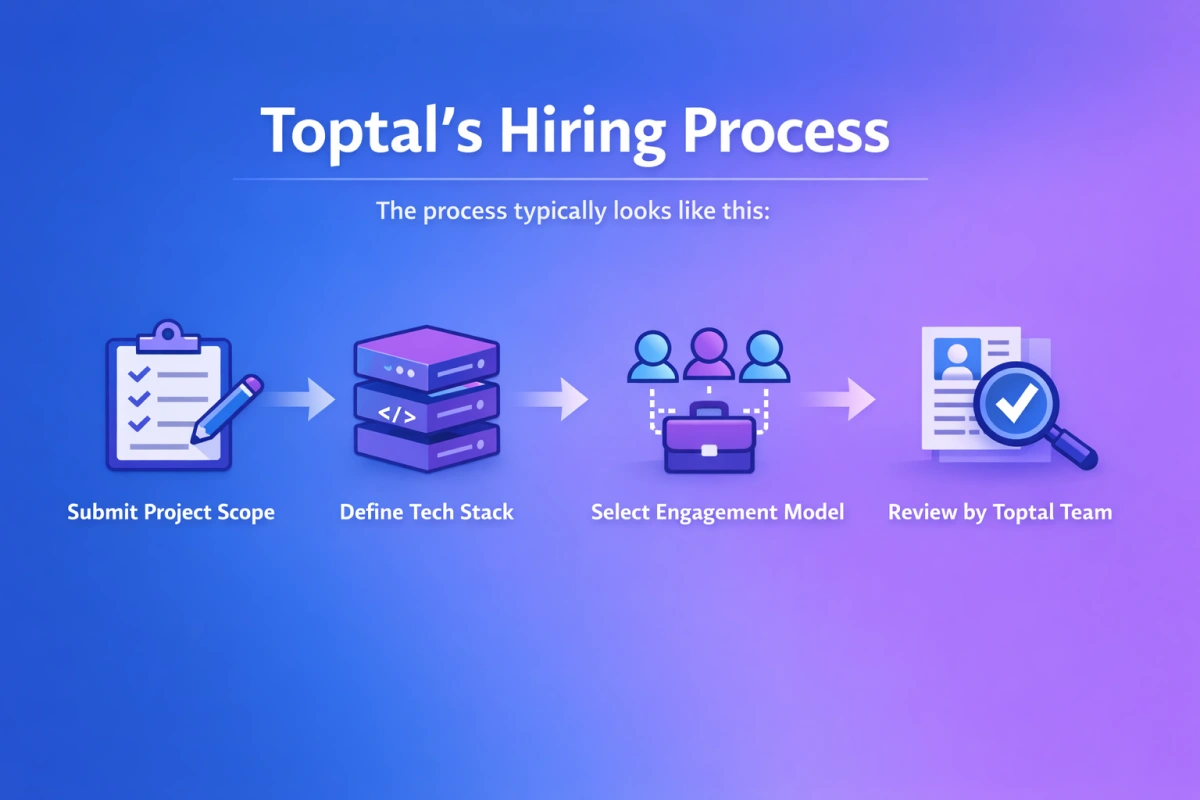
Toptal’s hiring process focuses on speed and curated matching. The company promises to present candidates within 48 hours after reviewing your project requirements.
The process typically looks like this: you submit your project scope, required tech stack, and engagement model. Toptal’s internal team reviews the request and selects candidates from its vetted talent pool. You then interview shortlisted freelance developers and choose the best fit. Work begins with a trial period before moving into a longer engagement.
Toptal supports hourly, part-time, full-time, and project-based contracts. However, clients are responsible for day-to-day project management. If you need structured project management services, you must hire that expertise separately.
For companies that already have internal leadership and clear processes, this flexible hiring model can work well. In the context of Toptal vs Gigster, this is a key difference: Toptal provides talent, not full delivery ownership.
Toptal’s vetting process explained
Toptal’s vetting process follows a multi stage process that evaluates both technical ability and communication skills. It begins with language proficiency and professionalism screening. Candidates then go through personality evaluation and technical interviews focused on real-world problem solving skills. Successful applicants complete live coding challenges and test specific software projects before final approval.
This rigorous vetting process is designed to ensure talent quality and consistency. Toptal emphasizes that its primary focus high quality approach reduces the risks typically associated with hiring developers through open marketplaces.
However, while Toptal’s vetting process is strong at evaluating individual freelancers, it does not assess how developers perform within complete teams on complex software projects.
Toptal pricing breakdown
Toptal operates on a premium hourly pricing model. Developer rates typically range from $60 to $200+ per hour, depending on expertise, region, and demand.
In addition to hourly rates, Toptal charges a $79 monthly talent search fee. There is no upfront hiring fee, but for long term projects or multiple hires, costs can scale quickly. For startups with limited budgets, this may represent a significant investment.
Toptal offers a two-week trial period. This allows clients to evaluate fit before committing long term, although some users report that contract terms around the trial period can vary.
Compared to project based pricing models, Toptal provides more flexibility. But it is rarely positioned as a cost effective custom software solutions for smaller projects or early-stage startups without stable funding. Find in our blog how to hire developers for a startup.
Toptal pros and cons
Toptal’s main advantage is access to highly vetted talent. Its structured vetting process, global reach, and 48-hour matching promise make it attractive for companies seeking top tier talent quickly. It is trusted by enterprise companies and startups alike and provides flexible freelance engagement models.
At the same time, there are trade-offs. The premium hourly rates and monthly subscription add to total cost. Clients must manage full time remote developers directly, which requires internal project management expertise. Toptal is also not designed for fully managed service or complete project delivery, making it less suitable for complex projects that require an entire team working under unified leadership.
What is Gigster?
Gigster was founded in 2013 (as Liquid Labs Inc.) and is based in San Francisco. It focuses on delivering complete software projects through fully managed development teams.
Unlike freelance platforms that connect you with individual freelancers, Gigster takes ownership of the entire software project. Instead of hiring one freelance developer, you get a packaged team that usually includes senior developers, designers, digital marketing experts, and project managers.
In the Gigster vs Toptal comparison, Gigster represents the managed delivery model, while Toptal focuses on individual talent.
How Gigster works
Gigster operates as a fully managed service. That means you don’t hire developers directly. You define your project requirements, agree on scope, timeline, and budget, and Gigster assembles teams to deliver the work.
The process typically looks like this:
You share your project’s scope and goals. Gigster evaluates the requirements and prepares a proposal. After approval, they assemble teams within 10 to 14 days. The assigned project managers handle coordination, timelines, and communication.
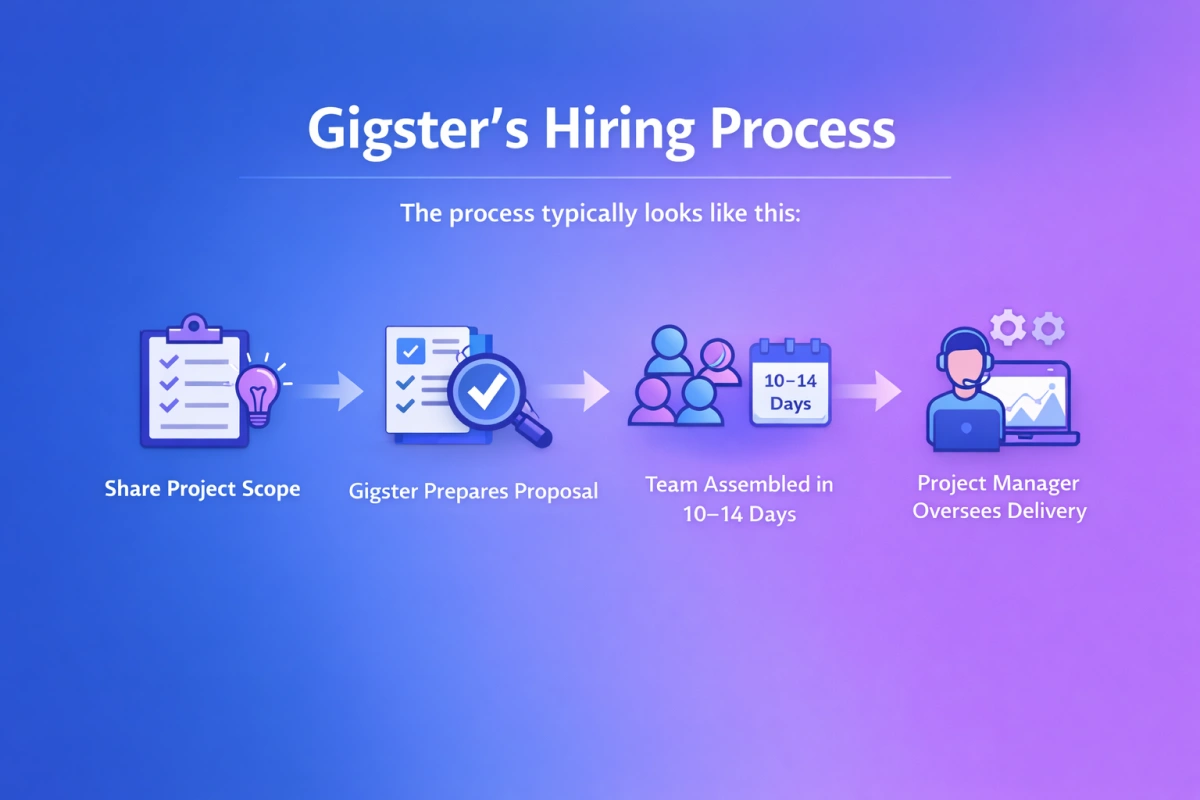
Developers usually work part-time across multiple projects. Clients communicate through the assigned PM rather than directly with remote developers.
This model is designed for companies that want complete project delivery with minimal supervision required from their side.
Gigster’s AI-powered matching and vetting
Gigster promotes its AI-powered matching system. According to the company, it uses internal data and automation to match clients with top tier talent from its gigster talent pool.
However, the details of its vetting process are less transparent than Toptal’s. Gigster states that it works with experienced engineers, some with backgrounds at big tech companies, but it does not publicly describe a structured multi stage process with test projects or technical interviews in the same depth as toptal's vetting process.
For companies that prioritize visibility into how highly vetted talent is screened, this lack of detail can be a concern.
Gigster pricing breakdown
Gigster uses fixed project based pricing rather than hourly rates.
The minimum project cost is typically around $52,000. Final pricing depends on the project phase, complexity, and timeline, but it is generally positioned for high value projects and enterprise companies.
You do not pay Gigster hourly. Instead, you agree on a fixed contract that covers the entire software project from start to finish.
This structure works well for companies with clear project requirements and sufficient budget. However, it may not be suitable for smaller projects or startups with limited budgets. There is no trial period and no public money-back guarantee.
Gigster pros and cons
Pros
Gigster provides turnkey delivery. You get fully managed development teams, including project managers and designers. There is no need to build internal project management services or coordinate multiple remote software developers yourself. The company also transfers IP ownership to the client upon delivery.
Cons
The cost is high. The minimal investment starts around $52,000. There is no trial period to test collaboration before committing. The vetting process is not fully transparent. Clients have limited direct access to developers, as communication typically goes through a PM. Many developers work part-time, which may affect speed and continuity on complex software projects.
Gigster vs Toptal vs Empat: detailed feature comparison
We've researched the market and provide a clear comparison of how Gigster, Toptal, and Empat based on the most important parts of hiring and working with developers.
Talent quality and vetting process
When it comes to talent quality, all three try to offer strong developers and tech experts. However, they use different approaches.
- Toptal focuses on top-tier individual freelancers. The platform claims it accepts only about 3% of applicants after a multi-stage vetting process. They cover language checks, personality evaluation, technical interviews, and test assignments.
- Gigster builds full teams instead of individual hires. It uses internal screening and AI matching to pull from experienced professionals. However, the exact vetting steps aren’t publicly detailed. This makes the process less transparent to clients.
- Empat vets developers through internal technical evaluations and client interviews before engagement. 85% of Emapt engineers have excellent fundamental education in IT or math. Clients also get a paid test period to confirm fit before fully committing.
In short, Toptal’s model is strong for deeply vetted individual talent. Gigster's approach is built around assembling teams quickly. On the contrary, Empat blends vetting with client involvement for clarity and fit.
Pricing and cost transparency
Pricing models create big difference in Gigster vs Toptal vs Empat comparison because they affect how predictable and budget-friendly each option is.
- Toptal charges premium hourly rates (often $60–$200+ per hour) plus a monthly subscription fee to search for talent.
- Gigster does not publish hourly rates. Instead, clients typically start with a $52,000 minimum project fee and pricing depends on the scope of work.
- Empat uses custom pricing that can be hourly or project-based. A considerable benefit is that the development company does not have separate platform subscription or opaque markups.
In comparison, Empat’s model tends to feel more transparent because you work directly with the development team and can see how costs align with specific deliverables.
Hiring speed and onboarding
How fast teams get started matters, especially for urgent projects.
- Toptal often matches you with candidates in about 48 hours. However, take into account that the full onboarding, which includes interviews, contracts, and trials, can stretch across a few weeks.
- Gigster typically assembles full development teams in 10–14 days after scope and proposal approval.
- Empat aims to connect you with candidates within days and begin a paid test period quickly.
Toptal’s quick matching is great for filling individual roles. Gigster’s team assembly time can be longer. Empat prioritizes speed without sacrificing fit, especially for long-term engagements.
Flexibility and engagement models
The type of work you want done usually shapes which platform fits best.
- Toptal helps businesses to hire individual developers, UI/UX designers, or technical specialists. You decide how much they work and guide their tasks.
- Gigster only offers full teams managed by their project leads. You don't have solo developer option.
- Empat covers dedicated developers, full teams, staff augmentation, and full-cycle development from MVP to scale.
Empat’s broader engagement types give you more flexibility, especially if your project evolves or you need both developers and management support.
Project management and communication
How teams communicate and who leads the work makes a big difference in project outcomes.
- With Toptal, you hire individual freelancers. You (or your internal manager) coordinate daily work and priorities.
- On Gigster, a project manager oversees the team and is your main communication point. You don’t talk directly with every developer.
- Empat supports direct communication between you and developers, with optional project management support if needed.
If you want hands-on control over technical decisions, direct communication with devs — like Empat allows — can be more effective than relying solely on a third-party manager.
When to choose Toptal over Gigster
Toptal is the right choice if you’re looking to hire individual senior specialists rather than a full team. It is suitable for companies that already have project management and want flexible hourly engagement.
Use Toptal if your project needs long-term support that includes highly vetted developers, designers, or even finance experts.
For example, an enterprise scaling its internal team or a startup needing to hire a front-end developer would benefit from Toptal’s model. You get access to top-tier tech talent quickly and can integrate them directly into your existing workflow.
It’s also ideal if you need a multi-disciplinary team working on different aspects of a project, such as developers, designers, and finance professionals. At the same time, it allows keeping control in-house.
When to choose Gigster over Toptal
Gigster is a better fit if you want turnkey software delivery without handling day-to-day project management yourself. Their teams come with talented developers, designers, and project managers already assembled. Such a model makes it easy to hand off a project and let them run it.
Choose Gigster if you’re managing a large-budget enterprise project or need full IP ownership of the final product. The platform works on fixed-price contracts, so you know your costs upfront.
It’s also useful for companies that don’t have internal project managers or simply don’t want to coordinate multiple developers. If your priority is a fully managed team delivering an end-to-end cost effective solution with minimal oversight, Gigster is the clear choice.
Why companies choose Empat over Gigster and Toptal
Empat’s personalized approach vs. platform matching
Empat focuses on building teams that fit your project. It's a considerable benefit compared to services when they are just matching your business with available freelancers. Empat takes time to understand your goals, tech needs, and workflow, unlike Toptal, where clients seeking individual freelancers, or Gigster, which assembles teams based on internal algorithms. This means you can collaborate directly with the developers who will actually work on your project.
Paid test period and risk-free hiring
Empat offers a paid test period. You can use it to evaluate both skills and collaboration style before committing long term. This approach reduces risk and gives you confidence that the developers are the right fit for your project. You get hands-on experience with the team. At the same time, you control the real progress, which is something neither Gigster nor Toptal fully provides.
Full-cycle development from MVP to scale
Empat supports projects with flexible, dedicated developers on different stages from MVPs to full-scale products. Whether you’re a startup building your first app or an established company scaling a complex platform, Empat can cover the entire development lifecycle. Empat has successfully delivered over 300 projects across 23 markets and multiple industries. It consistently maintains high standards of quality in every engagement. With 142 reviews on Clutch, the company holds a 5‑star rating, reflecting client satisfaction and well-executed software solutions.
Empat provides a balanced approach for companies that want a blend of personalized talent selection and full project delivery. They also offer transparent pricing, which is discussed before you start the project.
Other Gigster and Toptal alternatives worth considering
There are several other platforms Toptal and Gigster alternatives might fit your needs depending on project size, budget, and the type of developers you’re looking for.
Upwork is a broad freelance marketplace where you can hire Python developers, employ React Native developers, or find any other engineer across all skill levels. It’s flexible on budget and engagement type, making it suitable for smaller projects or short-term support.
Arc.dev focuses on vetted remote developers and offers transparent pricing. Its talent pool is carefully screened, making it easier to find reliable developers for long-term projects.
Turing uses AI-driven matching to connect clients with dedicated development teams. It’s designed for companies that want remote developers integrated into their workflow without handling recruitment themselves.
Lemon.io specializes in Eastern European developers and startup-friendly pricing. It’s a good fit for early-stage companies looking for cost-effective talent without compromising quality.
Flexiple offers tailored vetting and mid-range pricing, balancing quality and affordability. The platform is ideal for projects that need reliable developers but don’t have the budget for top-tier rates.
This overview gives a sense of the range of Gigster and Total competitors available, each with different strengths depending on your project’s size, complexity, and budget.
Conclusion: Gigster vs Toptal vs Empat — Which Should You Choose?
When it comes to hiring developers, each platform serves a different purpose. Toptal provides elite individual talent with flexible engagement options, but its premium rates and onboarding process can be a barrier for smaller projects. Gigster offers turnkey, fully managed teams, making it ideal for large projects, yet the high minimum investment and limited direct access to developers can reduce flexibility. Empat, on the other hand, combines personalized team building with full-cycle development, a paid test period, transparent pricing, and direct developer communication, giving companies more control and confidence.
Choosing the right option depends on your project needs and internal capacity. Select Toptal if you need a single senior specialist to augment an existing team or fill a highly specialized role. Go with Gigster if you have a $50K+ budget and want to outsource a clearly defined project with minimal management involvement. Choose Empat if you want the flexibility of dedicated developers, full project delivery from MVP to scale, and a low-risk way to test your team before committing long-term.
Not sure which model fits your project? Contact Empat Tech for a free consultation and we’ll help you find the right team, whether you need one developer or an entire product squad.
FAQ
Is Toptal or Gigster better for hiring software developers?
Toptal is best if you need an individual senior specialist with flexible hourly or project-based engagement. Gigster is better when you want to fully outsource a complete project to a managed team. Empat combines both approaches, offering personalized team selection with full project delivery and flexible engagement options.
How much does Gigster cost compared to Toptal?
Gigster typically charges a fixed price starting at around $52,000 per project. Toptal uses hourly rates from $60 to $200+ per hour, plus a $79/month talent search fee. Empat provides competitive, transparent pricing without hidden fees, making it a more predictable option for startups and growing companies.
What is Toptal’s developer vetting process?
Toptal follows a rigorous multi-stage process including language and communication screening, personality assessment, technical coding challenges, live problem-solving exercises, and a 3-week paid trial project. Only about 3% of applicants pass, ensuring clients get highly skilled developers.
Does Gigster offer a free trial or money-back guarantee?
No. Gigster does not provide a trial period or a money-back guarantee. Toptal offers a 2-week trial, while Empat allows a paid test period so you can evaluate developers before committing long-term, reducing hiring risk.


