
Toptal vs Turing (2026): Which Platform Actually Hires Better Developers?
Toptal vs Turing compared — $60–200/hr vs $30–60/hr, vetting processes, pros & cons. Find out which fits your hiring needs and when neither is enough.

Finding developers that can really benefit your project may become a challenge. According to the survey by McKinsey, 60% of companies see the lack of tech talent and consider it to be as a major barrier to moving forward with digital transformation.
That’s why many CTOs and startup founders turn to platforms like Toptal and Turing to hire mobile app developers or web engineers. However, theses platforms operate very differently.
If your project needs elite, multi-disciplinary freelancers and flexible engagement models, Toptal is a good choice. If you need a cost-effective solution for building long-term remote engineering teams quickly, Turing may fit better. In case you are looking for a full-cycle development partner, a development company can provide advantages that neither platform offers.
In this article, we’ll cover a data-driven comparison of Toptal vs Turing. We'll compare their hiring process, talent pools, pricing, and engagement models. We’ll also discuss the limitations of freelance platforms and explore why a software outsourcing might be the smarter path for complex projects.
What is Toptal?
Toptal has been on the market since 2010. It positions itself as a platform that connect companies with the top 3% of global freelance talent. Toptal states that businesses that can’t afford hiring mistakes you use their services.
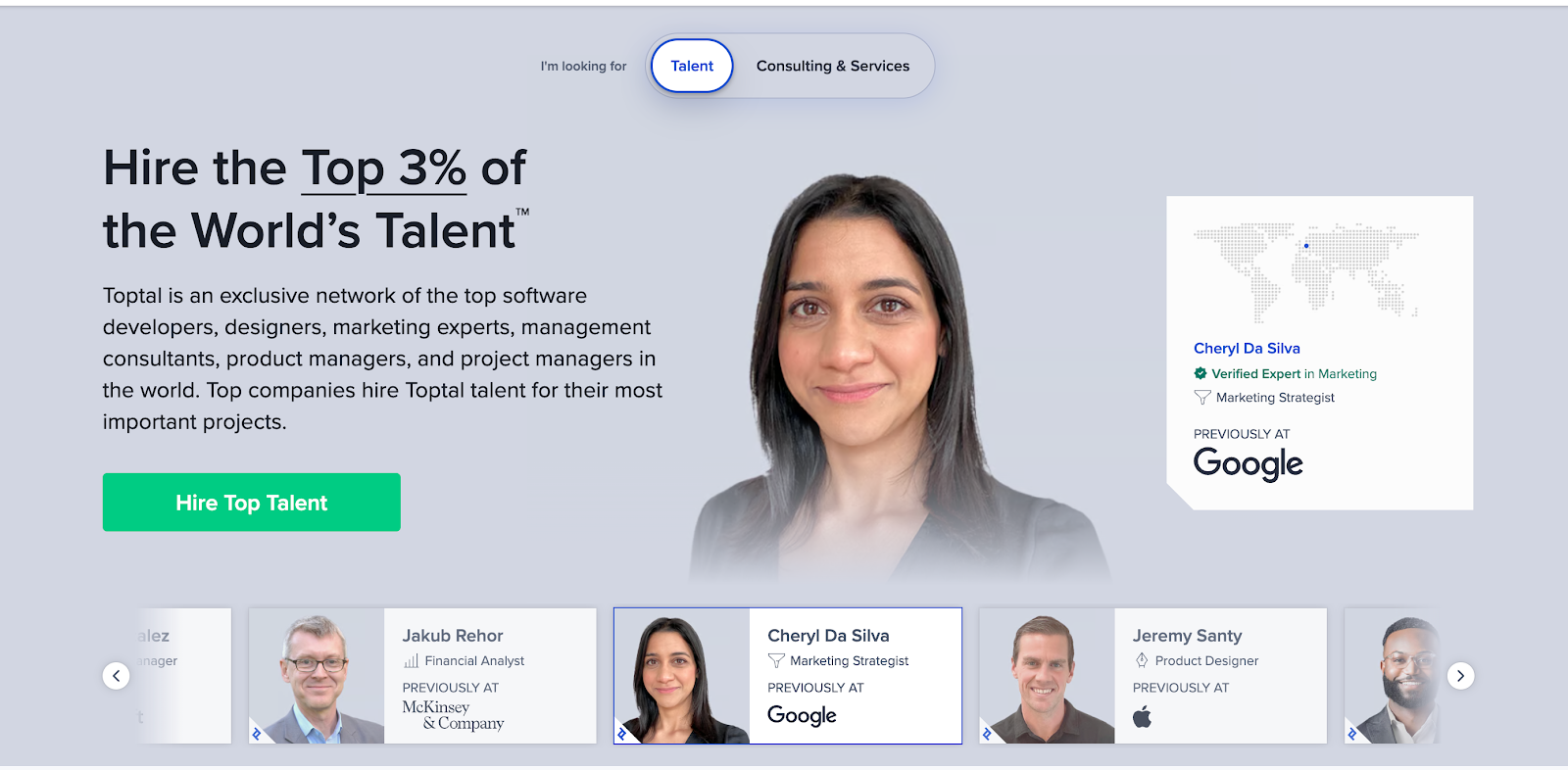
Toptal’s talent pool includes not only software developers. Companies can hire graphic designers, engineers, finance experts, and project managers from one platform. That breadth makes it appealing for teams running complex projects that require more than pure engineering.
Notable clients include Duolingo, Shopify, and Bridgestone. These brands use Toptal when they need top tier talent quickly, without building an internal hiring pipeline.
A key part of Toptal’s value proposition is speed and flexibility. The company claims it can match clients with suitable talent within 24 hours. Businesses can choose hourly, part-time, or full-time engagements. Such a combination works well for both short-term projects and ongoing work.
How Toptal’s vetting process works
Rigorous vetting process is the main characteristic which Toptal is famous for. The company states that they accept only 3% of applicants with proven track record into the network. Considering that Gartner reports 86% of CIOs face intense competition for qualified candidates, the exclusivity is a core benefit of Toptal and a reason why businesses choose this top talent platform.
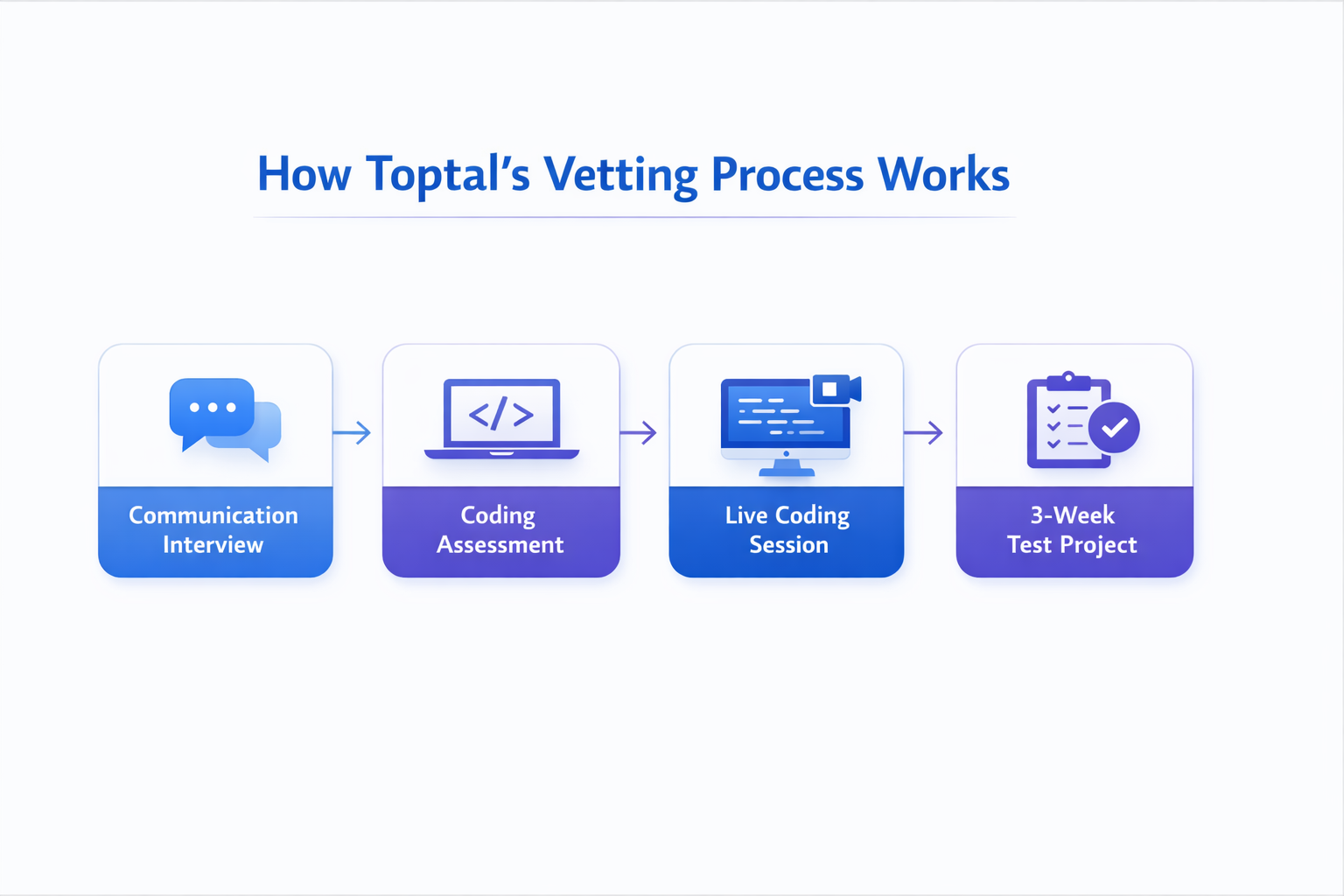
The vetting process typically includes four stages:
- Communication interview to assess language proficiency and soft skills
- Coding assessment focused on real-world problem solving
- Live coding session with senior engineers
- Three-week test project, where candidates work on production-level tasks
This comprehensive vetting process and interview process evaluate technical skills, communication, and reliability. It’s one of the most demanding screening systems in the hiring market. The trade-off is quality over volume. Toptal’s talent pool is smaller, but heavily curated.
Toptal pricing breakdown
Toptal does not publish a public pricing page. It can be frustrating for first-time buyers because such a condition complicates the budget planning. The final cost usually depends on seniority, role, and location.
Typical pricing looks like this:
- Hourly rates: $60–$200+ per hour
- Part-time engagements: $1,000–$1,600+ per week
- Full-time engagements: $2,000–$4,800+ per week
- Upfront deposit: $500 (refundable)
- Platform fee: $79 per month
If you plan a long-term contract, you need to be ready to pay $8,000–$20,000+ per month. This makes Toptal a premium option, especially for startups or budget conscious projects.
Toptal pros and cons
Pros
- Access to elite talent and senior software developers
- One of the most rigorous screening processes in the industry
- Flexible engagement models for short-term and long-term work
- Trusted by well-known global brands
- Two-week trial period to reduce hiring risk
Cons
- High costs compared to most other platforms
- Not transparent pricing
- Smaller talent pool than mass-market platforms
- Not always ideal for early-stage startups or cost-sensitive teams
Toptal is a great choice for companies that prioritize quality and flexibility over price. The next question is how it compares to a platform that focuses on speed and scale. At this point, let's view the Turing option for remote developers search.
What is Turing?
Turing was founded in 2014 with a different goal than most hiring platforms. Turing focuses on scale and speed instead of curating a small, exclusive network. It uses AI to match companies with remote developers faster and at a lower cost.
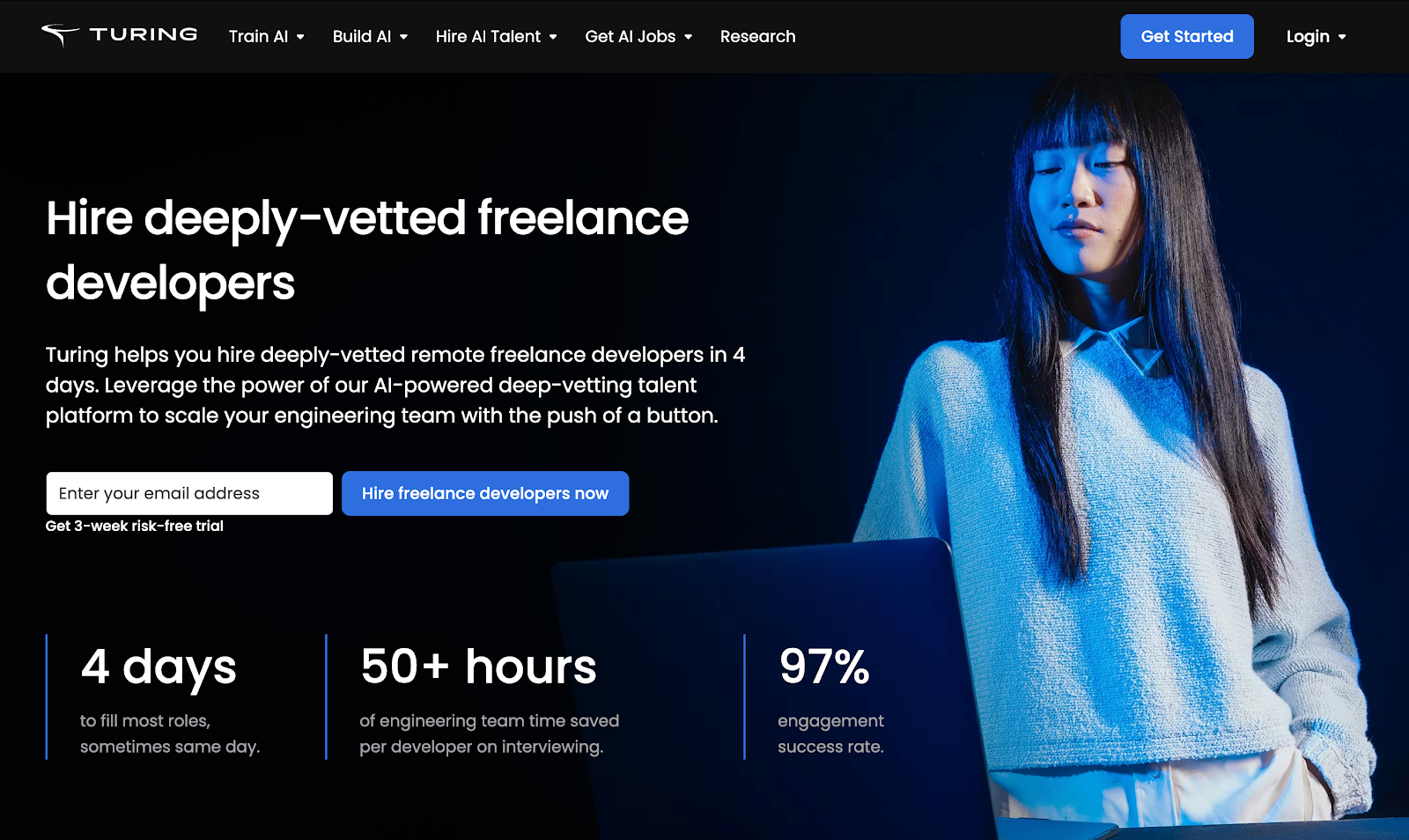
Turing works with a global talent pool which includes more than 1.5 million developers in 150+ countries. The platform focuses on hiring full-time remote developers. This makes it attractive for companies that build long-term engineering teams and don't want to hiring freelancers for short projects.
The platform supports more than 100 skill sets. However, the main focus is on backend software engineering, frontend developers, mobile, cloud, and data engineering. Turing does not cover design or finance profiles, which is another difference with Toptal.
How Turing’s vetting process works
Turing leverages AI for the vetting process, which makes it rather automated. The goal is to screen a very large number of candidates efficiently to find cost effective talents. At the same time, they try to maintain a consistent quality bar.
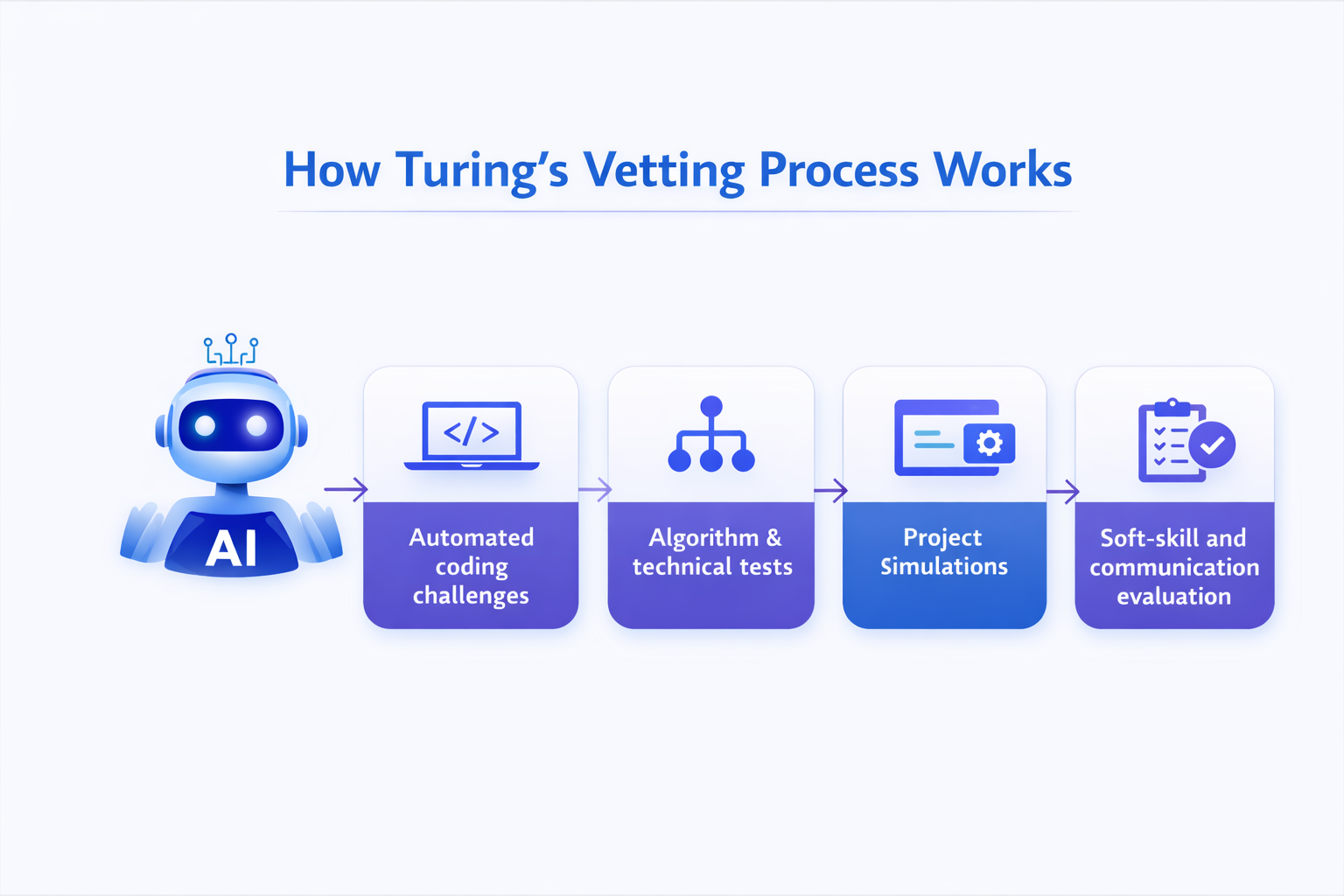
The process usually includes:
- Automated coding challenges
- Tests focused on data structures, algorithms, and system design
- Project simulations based on real-world tasks
- Soft skills and communication assessment
- Live interviews for shortlisted candidates
Turing claims it identifies the top 1% of global developers through this process. Compared to Toptal, the vetting is less manual and less exclusive. On the contrary, it covers a much broader reach. This approach works well when speed and scale matter more than deep personalization.
Turing pricing breakdown
Turing’s pricing model is more transparent than Toptal’s. It's much easier to estimate upfront. The platform uses a salary-based approach for full-time remote developers.
Typical costs include:
- Hourly rates: $30–$60 per hour (can go higher for senior roles)
- Platform fee: usually 15–20% of the developer’s salary
- Upfront deposit: none
- Trial period: two weeks
Developers on Turing can set their own rates based on experience, skills, and location. Overall, this makes Turing a more cost-effective option for companies with fixed budgets or long-term hiring plans.
Turing pros and cons
Pros
- Large global talent pool with fast matching
- Competitive pricing
- Lower costs than premium platforms
- AI-driven process supports quick hiring
- Strong fit for full-time remote teams
- Two-week trial period reduces risk
Cons
- Focused almost entirely on full-time roles
- Limited flexibility for short-term projects
- AI-based talent matching can miss context in complex needs
- Less rigorous process vetting process
- Communication skills quality varies by developer
- Limited scope beyond engineering roles
Turing works best for companies that need to scale engineering teams quickly and keep hiring costs under control. The trade-off is less flexibility and less hands-on support compared to more curated platforms.
Quick comparison table — Toptal vs Turing at a glance
We've conducted a deep research and prepared a side-by-side overview Toptal vs Turing.
This table focuses on the factors that usually matter most when choosing a hiring platform. It includes vetting depth, pricing, engagement models, and scale.
| Feature | Toptal | Turing |
|---|---|---|
| Founded | 2010 | 2014 |
| Talent pool size | Smaller, highly curated pool | 1.5M+ developers |
| Geographic reach | Global | 150+ countries |
| Vetting process | Manual, multi-stage, human-led | AI-driven, automated + interviews |
| Acceptance rate | ~3% of applicants | Claims top 1% of global developers |
| Engagement models | Hourly, part-time, full-time | Primarily full-time remote |
| Typical pricing range | $60–$200+/hour | $30–$60/hour (salary-based) |
| Upfront fees | $500 refundable deposit + $79/month | No upfront deposit |
| Trial period | 2 weeks | 2 weeks |
| Best for | Complex, high-stakes projects needing elite talent | Long-term, cost-effective remote hiring |
| Primary focus | Freelance experts across dev, design, finance, PM | Software engineers and engineering teams |
| Tech stacks | Web, mobile, backend, DevOps, data, design, finance | Web, backend, mobile, cloud, AI/ML |
| G2 rating | ~4.7 / 5 | ~4.2 / 5 |
Toptal vs Turing — head-to-head comparison
When teams compare Toptal vs Turing, they usually try to answer one simple question: which platform fits my way of working, budget, and risk level better?
Below is a direct, practical comparison based on how these platforms actually operate.
Talent pool and developer quality
Toptal runs a small and tightly controlled talent pool. The company says only about 3% of applicants make it through. Because of that, the pool is not huge, but it is very curated. You can hire not only software developers, but also designers, product managers, and finance experts.
Turing uses a different approach. Its vast talent pool includes 1.5 million+ developers from 150+ countries. The focus is almost entirely on engineering roles. Most candidates are mid-level and senior developers who are open to long-term, full-time remote work.
In short: Toptal favors depth over volume. Turing favors reach and speed.
Vetting and screening process
Toptal uses a manual, four-stage vetting process to find elite professionals for remote jobs. It starts with a communication interview. Then, coding assessments, live coding sessions, and a real test project take place. Such a rigorous screening process can last several weeks. The platform tests soft skills as well as technical expertise of remote talents.
Turing relies heavily on AI-driven screening. Candidates go through automated coding tasks, algorithm tests, and project simulations. Live interviews and soft-skill checks come later. This process scales better and moves faster. On the contrary, it is less personal than Toptal’s approach.
Toptal reduces risk through hands-on screening. Turing reduces time-to-hire through automation.
Pricing and cost efficiency
Toptal sits firmly at the premium segment of the market. Hourly rates usually range from $60 to $200+, depending on seniority and role. There is also a $500 refundable deposit and a $79 monthly platform fee. Pricing details are not fully public, which some buyers find frustrating.
Turing is cheaper than Toptal. Typical rates vary between $30 and $60 per hour. The platform uses a salary-based model for full-time roles. Turing usually charges 15–20% of the developer’s salary as its fee. There are no upfront deposits.
If cost control matters, Turing is generally the more predictable option. If quality matters more than price, Toptal justifies its premium for many teams.
Hiring speed and flexibility
Toptal often claims that it matches a developer within 24–48 hours. In practice, onboarding and alignment can still take a few weeks, especially for complex roles. The upside is that it's a flexible platform that offers hourly, part-time, and full-time engagements.
Turing typically matches candidates in 2–3 days, thanks to AI-based methodology. However, it offers full-time remote roles only.
If you need flexibility, Toptal wins. If you need fast, long-term hires, Turing fits better.
Customer reviews and satisfaction
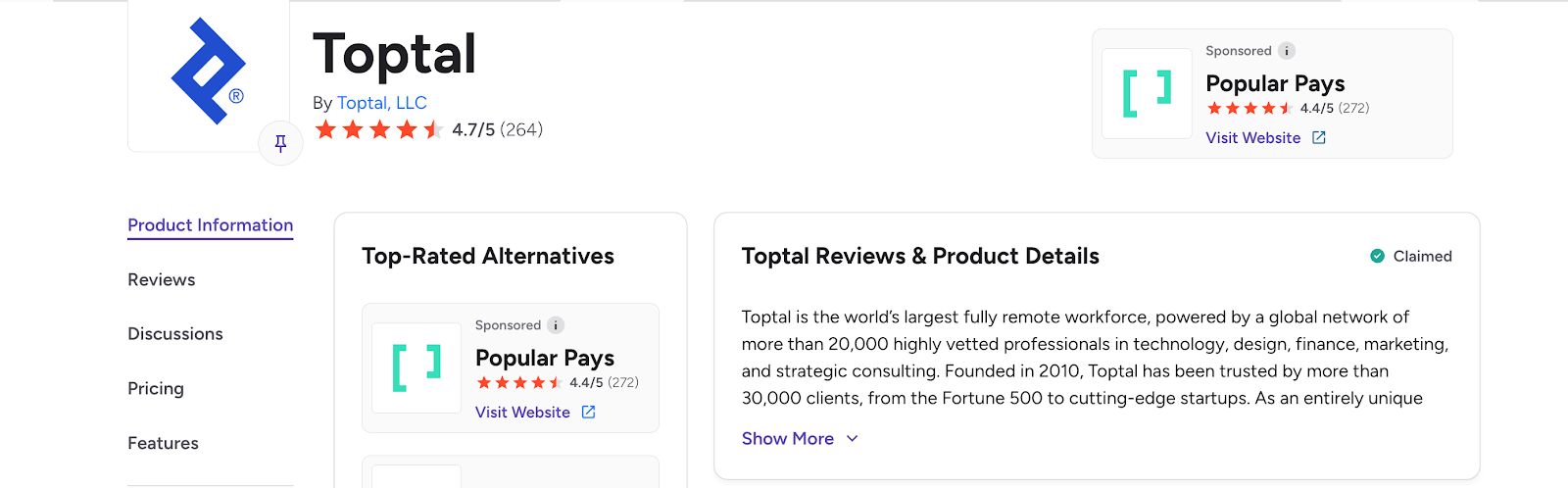
On G2, Toptal scores around 4.7/5, with an NPS close to 20. Users often praise developer quality and reliability. Common complaints focus on pricing opacity and billing during trial periods.
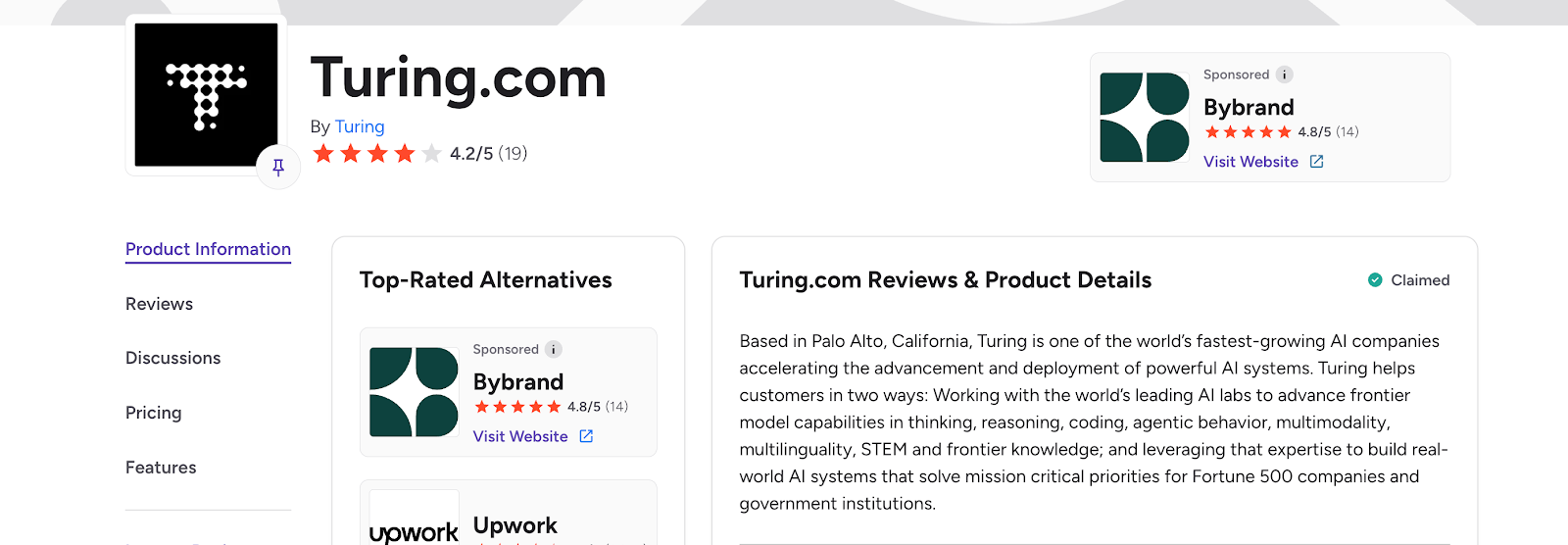
Turing holds a 4.2/5 rating on G2, with an NPS around 21. Customers like the speed and cost efficiency. The main issues mentioned are communication gaps and occasional mismatches caused by automated screening.
When to choose Toptal
Choose Toptal when the cost of a bad hire is higher than the cost of hiring itself. This platform works best for enterprise teams, regulated industries, and complex projects where quality, reliability, and communication matter more than speed.
Toptal is a strong fit if you need short-term or highly specialized work. Companies often use it to bring in senior software developers, hiring AI developers, employing designers or product managers. This is useful when internal teams lack a particular skill and need help without committing to a long-term hire.
The trade-off is price and transparency. Toptal is not suitable for tight budgets or rapid scaling. It's a good match for teams that want confidence in who they are hiring and are ready to pay for it.
When to choose Turing
Turing is a better choice when your goal is to build or scale a remote software engineering team over time. The platform is suitable for searching for long-term, full-time full-stack developers.
Turing works well for companies that want to hire multiple engineers quickly and, at the same time, keep costs under control. Its AI-driven talent matching and large global pool help reduce time-to-hire, especially for common engineering roles. This makes it appealing to hire developers for startups and growing product teams.
That said, Turing is less flexible. If you need part-time help, non-engineering roles, or very short-term specialists, the platform may not satisfy your needs.
Limitations of remote talent platforms
Both Toptal and Turing are marketplaces for connecting businesses with developers. This model works for experienced teams that already have well-developed internal processes.
However, for startups or small companies without a dedicated tech lead, it can be challenging. According to statistics, a bad technical lead can raise project failure rates by ~35%. For example, misaligned expectations or unclear handoffs can slow projects down or negatively impact quality. Both Toptal and Turing have limited accountability for project outcomes. In such a way, the team misses a deadline or the developer leaves, the responsibility is on you, not the platform.
That’s why working with a dedicated development team is the best option. Full-cycle development companies, like Empat Tech, offer end-to-end software development solution that include discovery, web design and development, testing, as well as post-launch support. You get talented developers, project managers, and designers that already work well together. This approach reduces risk and speeds up delivery. In addition, it gives teams a single point of accountability. Such a model can fill the gap between freelance marketplaces and building an internal team from scratch.
This setup is ideal for companies that want high-quality software without micromanaging every step. It combines the reliability of vetted talent with the structure of a true development partner.
Why Empat Tech is a smarter alternative to Toptal and Turing
Full-cycle development, not just talent matching
Many companies struggle with managing remote freelancers. Even though you hire a developer, you are still responsible for coordinating design, QA, and project management. Empat Tech addresses this by providing full teams that handle the workflow from start to finish. When you outsource software development for startups to a reliable partner, you reduce miscommunication, avoid missed deadlines, and keeps the product quality high.
Pre-vetted, dedicated teams with clear costs
Finding skilled developers is hard, and vetting them takes time. In spite of the fact that 95% of Empat developers hold higher technical education degrees, the company also ensures a rigorous screening process for technical and soft skills. In such a way, you don’t have to spend weeks interviewing and you can rest assured that only best developers work on you project. As the teams have worked together before, onboarding will be smoother. Transparent pricing ensures you know the full cost upfront, helping you plan projects without surprises.

Proven experience across projects
Projects often fail when teams lack experience with complex workflows or cross-functional collaboration. Empat Tech has worked on 300+ projects in 23 markets. Its client portfolio includes Fortune 500 companies, Y Combinator startups, and Forbes 30 Under 30 founders. This shows that the teams can handle complex requirements and develop for different industries.
Flexible ways to work
Scaling a team for a specific project can be tricky. Empat Tech offers various engagement models: dedicated teams, staff augmentation, CTO-as-a-service, startup development, or hire-by-role. This flexibility means you can adjust the team size and expertise as your project grows. In such a way, you don't need to commit to full-time hires or juggle multiple freelancers.
Book a free consultation with Empat Tech to discuss your project, get a realistic timeline, and plan your budget before committing resources.
Other Toptal and Turing alternatives worth considering
There are many options, when you need remote developers. Take a look at Turning and Toptal competitors to identify which fits you best developing on your project, budget, and timeline.
- Arc.dev – Focuses on full-time remote developers and promises a faster hiring process, which often under 14 days. It's ideal for startups needing quick, permanent hires.
- Upwork – A large freelance platform full of senior and junior developers. It's good for short-term or budget-conscious projects. Hourly rates range widely from $15 to $100+.
- BairesDev – Offers dedicated software development teams with end-to-end project support. Pricing is higher but includes professional oversight.
- Andela – Connects companies with vetted remote developers and emphasizes cultural and technical fit. Best for long-term team building. Rates depend on developer seniority and region.
- Lemon.io – Matches startups with freelance developers quickly, focusing on speed and simplicity. Hourly rates typically fall between $25–$75.
- Flexiple – Pre-vetted developers for both short-term and long-term projects. More cost-effective than Toptal and ideal for startups needing specialized skills. Hourly rates usually $30–$100.
- CloudDevs – Offers senior freelance developers with global reach. Suitable for companies needing experienced engineers without full-time commitments. Rates generally start at $35/hour.
Final verdict — Toptal vs Turing in 2026
Toptal provides a smaller, highly curated talent pool with high quality talent for short-term, specialized work. Turing offers a larger AI-driven pool for full-time remote developers at a more budget-friendly rate. Both platforms are strong for connecting with skilled developers, but neither handles project management, QA, or end-to-end delivery.
For companies that need a development partner, Empat Tech offers full-cycle teams and clear accountability. Empat has many satisfied clients and holds a 5.0 rating on Clutch. The focus is not just on code, but on getting the product to market and keeping it stable after launch.
If you want a team that takes responsibility for delivery, book a free consultation with Empat Tech and talk through your product, timeline, and budget before you commit.
Frequently asked questions
Is Toptal better than Turing for hiring developers?
It depends on your needs. Toptal is better for elite, multi-disciplinary freelancers and flexible short-term work. Turing is better for cost-effective, long-term remote engineering teams. For end-to-end project ownership, a dedicated partner like Empat Tech is the safer choice.
How much does Toptal cost compared to Turing?
Toptal rates are usually $60–$200+ per hour, plus a $500 deposit and $79/month platform fee. Turing is generally more affordable, $30–$60 per hour, with no upfront deposit and a salary-based model for full-time developers.
What is the vetting process for Toptal vs Turing?
Toptal uses a 4-stage manual vetting process including interviews, coding assessments, and a test project, accepting only 3% of applicants. Turing uses an AI-driven screening system with coding challenges and project simulations, claiming the top 1% of developers globally.
Can I hire part-time developers on Turing?
Turing focuses mainly on full-time engagements. If you need part-time or flexible hiring, Toptal allows more options. Alternatively, Empat Tech provides scalable teams or individual roles that can match the hours and skills you need.


