
AI Integration Services: Adding AI to Systems You Already Run
AI integration means adding intelligence to systems you already run, which is a different problem from building an AI product from scratch. This guide covers the four integration patterns, what each one touches in your existing stack, where these projects actually fail, and what the work costs.

There is a specific kind of project that goes wrong quietly. A team with a working product is told to “add AI.” A demo appears in two weeks and everyone is impressed. Six months later it is still a demo, because nobody scoped the parts that are not the model: grounding, evaluation, cost control, failure handling, and what happens when the answer is confidently wrong in front of a customer.
AI integration is that unscoped work. It is not the same discipline as building an AI product from scratch, and it is not consulting. This guide covers the four patterns worth knowing, what each one touches in a system you already operate, where these projects fail, and what it costs to do properly.
What are AI integration services?
AI integration services add machine intelligence to software you already run — your product, your internal tools, your data. The work is mostly integration engineering rather than model work: connecting a model to your data, grounding its output in facts you control, wiring it into existing auth and permissions, and building the evaluation and cost controls that make it safe to leave running.
This is deliberately narrower than two adjacent things. Building an AI product starts from nothing and owns the whole system. AI strategy consulting produces a recommendation, not working software. AI integration starts from a system that already has users, constraints and uptime expectations, and has to leave all three intact.
The four ways to integrate AI into an existing product
Almost every integration is one of four patterns, and picking the wrong one is the most expensive early mistake. The pattern is determined by where your knowledge lives and how much autonomy the feature needs — not by which model is currently in the news.

A practical rule: start at the top of that table and move down only when a specific requirement forces you to. Most teams that opened with fine-tuning would have been better served by good retrieval, and most teams that opened with agents needed one reliable tool call rather than an autonomous loop.
What AI integration touches in your existing stack
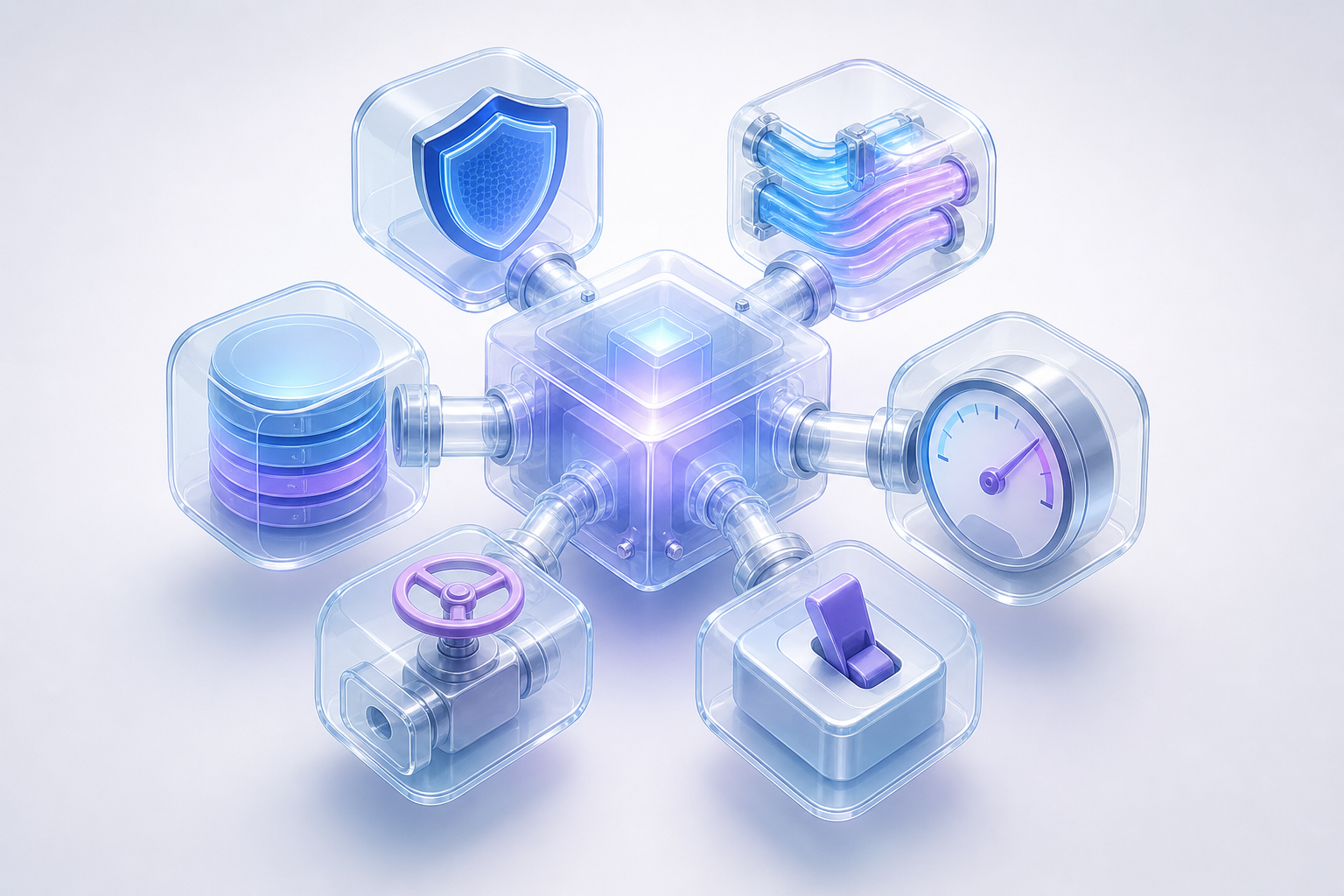
An honest scope covers seven surfaces beyond the model call itself. If a proposal only talks about prompts and a model, it has priced maybe a third of the work.
- Authentication and permissions. The model must never surface data the requesting user could not already see. Retrieval has to be permission-filtered at query time, not after generation.
- Data pipeline. Something has to keep the index current as your records change. Stale retrieval is worse than no retrieval, because it looks authoritative.
- Vector storage. Chunking strategy, embedding model, and re-indexing cadence. These choices dominate answer quality more than the language model does.
- Observability. Log inputs, outputs, retrieved context and latency. Without this you cannot debug a bad answer, only apologize for it.
- Cost controls. Per-user and per-tenant ceilings, plus caching. A single loop without a cap can produce a genuinely alarming invoice.
- Rate limiting and fallbacks. Providers have outages. Decide now whether the feature degrades gracefully or takes a user journey down with it.
- Human-in-the-loop. For any output with legal, financial or clinical consequence, a review step is part of the architecture, not a policy document.
Where AI integrations actually fail
They rarely fail on model capability. They fail on the engineering around the model — and the failure is usually invisible until the feature is in front of real users at real volume.

No evaluation harness
This is the big one. Most teams test an AI feature by trying it and forming an impression. Without a fixed set of representative inputs and expected outputs that you re-run on every prompt or model change, you cannot tell an improvement from a regression — and you will ship regressions. An eval harness is unglamorous, takes days, and is the single highest-return artifact in an AI integration. Ask any prospective partner to show you theirs.
Ungrounded output
A model asked about your business without access to your data will answer anyway. Grounding is not a quality nice-to-have; it is the difference between a feature and a liability.
No cost ceiling
Token spend scales with usage, retries and context length — three things that all grow after launch. Caps and caching belong in the first release.
Latency nobody budgeted for
A retrieval-plus-generation round trip can take several seconds. If that sits in a flow users expect to be instant, the feature fails on experience even when the answers are right.
Autonomy without a blast radius
The more a system can do unsupervised, the more carefully its permissions need bounding. Gartner expects more than 40% of agentic AI projects to be canceled by the end of 2027, usually over cost or unclear business value — a good reason to scope agents narrowly before betting a roadmap on them.
The pattern is well documented at scale. MIT’s 2025 study of 300 public AI deployments found that 95% of enterprise generative AI pilots produced no measurable P&L return, and attributed the gap not to model quality, regulation or talent, but to tooling that could not learn from feedback or adapt to context. That is an integration-engineering problem, and it is fixable.
What does AI integration cost and how long does it take?
Integration work fits a discovery-then-proof-of-concept shape better than a full build. Empat runs AI-driven discovery from $5,000 (1–2 weeks), which ends with a chosen pattern, an architecture, a risk list and an estimate; then a proof of concept from $15,000 (2–4 weeks) that puts the riskiest assumption into working code against your real data. Production hardening — evals, cost controls, observability, permission-filtered retrieval — scales from there.
Direct API integrations are the fastest and cheapest. RAG is the most common and lands in the middle. Agentic workflows and self-hosted models are materially larger commitments, and both carry ongoing operational cost that should be modeled before you start, not discovered in month four.
How to choose an AI integration partner
- Show me your evaluation setup. The sharpest question available. A team without a real answer has been shipping on vibes.
- Which of the four patterns would you use here, and why not the others? You want the trade-off reasoning, not enthusiasm for whichever pattern they last built.
- How will you keep the model from surfacing data a user should not see? Listen for permission-filtered retrieval at query time.
- What is our cost ceiling and how is it enforced? Per-tenant caps and caching should be in the plan already.
- What happens when the provider has an outage? Graceful degradation, not a broken page.
- Where does a human stay in the loop, and who decided that? For consequential output this should be a considered architectural choice.
Why we are a reasonable partner for this
Empat has delivered over 50 AI-powered projects since 2022, out of more than 300 products since 2013. The team holds the Claude Certified credential and includes a Claude Certified Architect. Delivery is AI-augmented in practice, not as a slogan — the team works with Claude, Claude Code, Cursor and Copilot daily — and every line ships human-reviewed.
For regulated data, we are HIPAA compliant and an AWS, Microsoft Azure and Google Cloud partner, which matters when the answer to “where does our data go” has to be written down. BigSister AI (predictive sales analytics) and VitalAI are the closest examples in our case library.
Where to go next: AI development is the hub; custom AI development is the greenfield alternative when there is no existing system to integrate with; the RAG implementation guide goes deep on pattern two; AI agents covers pattern three; and AI workflow automation is the right page if your goal is process automation rather than a product feature. If you would rather start by mapping the options with your own team in the room, there is the AI agent blueprint workshop.
FAQ
What are AI integration services?
AI integration services add machine intelligence to software you already run. The work is mostly integration engineering rather than model building: connecting a model to your data, grounding output in facts you control, respecting your existing authentication and permissions, and adding the evaluation, observability and cost controls that make the feature safe to operate.
How much does it cost to integrate AI into an existing application?
At Empat, AI-driven discovery starts from $5,000 and takes one to two weeks, ending with a chosen pattern, architecture and estimate. A proof of concept against your real data starts from $15,000 and runs two to four weeks. Direct API integrations are cheapest; retrieval-augmented setups sit in the middle; agentic and self-hosted models are larger commitments with ongoing operational cost.
How long does an AI integration take?
It depends on the pattern. A direct API integration can ship in days to a few weeks. A retrieval-augmented feature grounded in your own documents typically takes several weeks. Agentic workflows with tool access, and fine-tuned or self-hosted models, run from weeks to months and carry continuing maintenance work.
Is our data safe when integrating third-party AI models?
It depends on the pattern you choose, which is why the choice matters. With direct API calls and retrieval, prompt contents and retrieved chunks leave your perimeter under the provider's terms. Self-hosted models keep everything inside your infrastructure. In every pattern, retrieval must be filtered by the requesting user's permissions so the model cannot surface records that user could not already access.


